Thursday, 30 July 2015

Summer Scenery on the Yokosuka Line

EMU JR East E217 series stands at Kurihama Terminal on the Yokosuka Line

The Japan Meteorological Agency made a press release announcing that this year's rainy season ended on July 19th in the Tokyo metropolitan area, which means that midsummer has begun. This week's high was 35.8 degrees Celsius in Tokyo. So, the only thing we can do is escape the city at the weekend and go to a beach!

Miura Peninsula is a famous ocean resort in the southern suburb of Tokyo. By taking just an ordinary commuter train, we can reach a beautiful beach for swimming easily from downtown Tokyo. One of my favorite spots is Arasaki in Yokosuka City, Kanagawa Prefecture. Arasaki is a headland on the west coast of the peninsula, about 70 kilometers south west of Tokyo. You can see steeply dipping sandstone, siltstone and tuff beds, which were deposited in the deep sea about 4 to 12 million years ago. The coast provides visitors with good places for enjoying themselves at the rocky shores.

To visit this beautiful spot, please take the JR East Yokosuka Line and get off at Kurihama Terminal. It takes about 80 minutes from Tokyo Station by the E217 series train. The E217 series was launched in 1994 to replace the old EMU 113 series. It is a typical commuter train with eight doors per unit. It is equipped with long seats, but cross seats are also allocated for long distance passengers in several cars. Most trains are directly operated into the Sobu Line via Tokyo Station.

Taking the Yokosuka Line, please enjoy the midsummer scenery.

 
Summer scenery of Arasaki in Yokosuka City near Kurihama Station on the JR East Yokosuka Line 

Tuesday, 28 July 2015

The 90th Anniversary of Dragon Rail

Diesel Railcar JR East KiHa100-0 series arrives at Rikuchu-Kanzaki Station on the Oofunato Line

On July 26th, JR East celebrated the 90th anniversary of its Oofunato Line in Tohoku District, some 450 km north of Tokyo. The Oofunato Line was partially opened between Ichinoseki and Surisawa (30.6km) on July 26th in 1925. The route then fully opened to Sakari (105.7km) in 1935. The track is single and un-electrified. The gauge size is 1,067 mm. Its nickname is Dragon Rail, as the route is devious like a dragon body.

The main fleet of Dragon Rail is 16.5 meter-long diesel railcar, KiHa 100-0 series, which was launched in 1990. A total of 64 units have been built over three years by Niigata Tekko and Fuji Heavy industries. They are operated as a 2-car or a 3-car train every two hours on average. The train runs without conductors on board, which means that the driver operates the train doors.

Dragon Rail has had many hardships over the past 90 years. Specifically, it was paralyzed by the 3.11 tsunami disaster following the giant earthquake in 2011. The section between Kesennuma and Sakari (43.7 km) is still closed. Instead of the train, Bus Rapid Transit (BRT) was operated on the destroyed railway track after the temporary repair. The new railway track is planned to be constructed on the hill to avoid any danger from a future tsunami, but the estimated cost is very high.

I hope that the injured dragon will make a strong comeback soon. Nevertheless, congratulations on the 90th anniversary of Dragon Rail!

 
Diesel Railcar JR East KiHa100-0 series arrives at Geibikei Station on the Oofunato Line
 
Official information about the diesel railcar, KiHa 100 series (in Japanese):

Saturday, 25 July 2015

Shimakaze: Kintetsu's New Flagship Train

EMU Kintetsu 50000 series, "Shimakaze", stands at Iseshi Station
 
Kintetsu is one of the major private railway companies. It has a 437-km-long track, which is the largest private railway network in Japan. The route extends to 5 prefectures in the western part of Japan. The whole route is a single or double track with 1,500 V DC overhead. The gauge size is 1,435 or 1,067 mm.

One of the features of this railway is its extensive intercity express network. For instance, they operate Meihan Express between Osaka and Nagoya cities using luxury trains, because Kintetsu faces fierce competition from JR Central's Tokaido Shinkansen. Moreover, Kintetsu currently gears up a sightseeing train to the Shima area, a reputable marine resort in Mie Prefecture.

The name of the sightseeing train is Shimakaze (Breeze in the Shima area). Shimakaze, EMU 50000 series, was launched in 2013. A total of 3 sets, 18 units, have been built by Kinki Sharyo. The concept of this train is "to be superior to the simple transportation means". In fact, this train provides passengers with superior facilities. Its premium seats are similar to those of first class airline seats. A double-decker car with a scenic cafe is coupled in the middle of the train. It is also equipped with a gorgeous compartment car. The outer design is very fresh, but not my cup of tea, as it looks like Crustacean. Its almond-shaped eyes (frontal lights) are a bit scary for me.

Shimakaze... it is the Kintetsu's new flagship train with a bit of a scary face.

 
Double-decker car, Sa50403 of the Kintetsu 50000 series
 
Officilal information about Shimakaze train (in English):
Official information about Shimakaze train (in Japanese):

Thursday, 23 July 2015

Restoration of the Senseki Line

EMU JR East 205-3100 series arrives at Sendai Station (underground platform) on the Senseki Line

I have received a question from one of my blog readers, asking why JR East operates not electric cars but diesel vehicles on the Senseki-Tohoku Line. That is a good question. Since both the Senseki and the Tohoku sections of the Senseki-Tohoku Line are electrified, it is natural to think that electric cars should be used for this route.

In answer to the question...

Firstly, the electric system is different in each section. The Senseki section has a 1,500 V direct current (DC) system, whereas the Tohoku section has a 20,000 V and 50 Hz alternate current (AC) system. It costs much to make DC-AC dual system trains for the Senseki-Tohoku Line. Secondly, construction of an un-electrified track is cheaper than that of an electrified track as the connecting line between the Senseki and Tohoku sections. As a result, the (hybrid) diesel vehicle is adopted as the Senseki-Tohoku Line train.

Now, the passengers traveling in the Sendai-Ishinomaki area can choose one of two routes, namely, via the Senseki-Tohoku Line or via the Senseki Line. The train via the Senseki-Tohoku Line is suitable for flying passengers, who travel between two major cities (Sendai and Ishinomaki) directly, as it is fast. On the other hand, the train via the Senseki Line is convenient for passengers who get on/off at way stations, as it is operated frequently.

The EMU 205-3100 series is operated on the Senseki Line. It is a 4-car train (2M2T) with snow-resistant brakes and cold-resistant door systems.
 
Train for Ishinomaki has been resumed operation on the Senseki Line

Tuesday, 21 July 2015

Keikyu Wing: Relaxing Train to the Yoko-Yoko Area

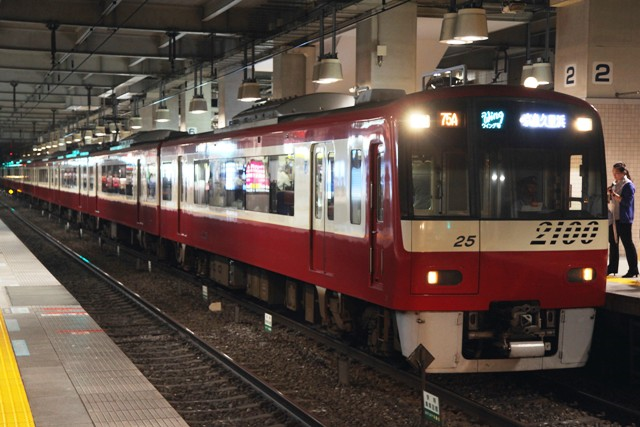
EMU Keikyu 2100 series, "Keikyu Wing", arrives at Kami-Ooka Station

Keikyu Wing is a similar train with Tobu TJ Liner. The concept of this train is "guarantee of seats for long distance commuters". Japanese businessmen and businesswomen in the cities are very busy. They sometimes need something as a treat for themselves, but their journeys home are hard, because urban commuter trains are packed on most of the lines. There is a greater need from long distance commuters for reserved seats. Keikyu Wing with reserved seats provides comfortable traveling by charging a small additional fee.

Keikyu Wing is operated every 20 minutes in the evening as a southbound train. Connecting Shinagawa, a subcenter of Tokyo, and Misakiguchi in Kanagawa Prefecture, its operating length is 65.7 km. Anyone, who pays an additional 200 yen, can enjoy comfortable traveling. It is specifically convenient for commuters who live in the Yoko-Yoko (Yokohama-Yokosuka) area.

The vehicle for Keikyu Wing is an 8-car train, the EMU 2100 series, which debuted in 2008. A total of 10 sets, 80 units, have been manufactured so far by Tokyu Sharyo and Kawasaki Heavy Industries. One of the features of this train is its comfortable cross seats with 2+2 configuration. Riding on Keikyu Wing, passengers are just relaxed and enjoy reading or listening to music, while having a soft drink.Taking the Keikyu Wing on the way home...it's a "petit-zeitaku" (small luxury and gratification) for urban commuters. You did a good job today. Have a good sleep at home tonight.

 
Interior of the EMU Keikyu 2100 series, "Keikyu Wing"
 
More information about Keikyu Wing Train (in Japanese):