Showing posts with label Museum. Show all posts

Thursday, 30 July 2026

A Phantom Train in Ibaraki Prefecture

Series 7000 DMU preserved at Yumenoba in Chikusei City, Ibaraki Prefecture

Have you ever had an experience like this in your country?

Have you ever wanted to ride a train that rarely ran? You kept telling yourself, "Someday I'll ride it," only to find that it had already been retired before you had the chance. Today I'd like to introduce one such train.

Series 7000 was a luxurious DMU operated by the Kashima Rinkai Railway from 1992 to 2010. Interestingly, it was owned not by the railway company itself, but by Ibaraki Prefecture. It was a two-car hydraulic-transmission DMU powered by 169 kW diesel engines, and only a single set was ever built by Nippon Sharyo.

The interior was surprisingly luxurious for a regional railway train. It featured reclining cross seats, not to mention a lounge area, a large TV and even karaoke equipment.

When Series 7000 entered service, it operated as the rapid train Marine Liner Hamanasu ("Hamanasu" means rugosa rose in Japanese). In 2008, it was reassigned to special excursion services before being retired from service in 2010. Since 2024, it has been preserved at Yumenoba (also known as THE HIROSAWA CITY), a vehicle-themed park in Chikusei City, Ibaraki Prefecture.

As I mentioned earlier, I had wanted to ride Series 7000 for many years. Unfortunately, the Kashima Rinkai Railway was quite a long way from where I lived, and I was very busy at the time. Then I was transferred to Indonesia in 2007, and before I knew it, Series 7000 had been retired.

Sixteen years after its retirement, I finally met Series 7000. It was on display in excellent condition alongside other historic rolling stock. Looking at its stylish exterior, I couldn't help thinking that it resembled JR East's HB-E300 hybrid DMU, which I rode recently. Perhaps Series 7000 was ahead of its time—a pioneer of Japan's sightseeing trains.

It was wonderful to finally meet you, Series 7000. I only wish I had had the chance to ride you while you were still in service. Still, I'll come back to visit you from time to time. See you again soon.

Side view of Series 7000

Related link:

Friday, 8 May 2026

Reunion with VSE

DeHa 50001 of the Odakyu Romancecar “VSE” at the Romancecar Museum

Do you remember my post about the Romancecar VSE last year? Today, I’d like to share a touching reunion I had with it afterward.

First, let me briefly review what the Romancecar VSE is.

In the Tokyo metropolitan area, several railway companies compete with luxurious express trains as their flagships. One of the most venerable and popular among them is Odakyu Electric Railway’s Romancecar, which runs from central Tokyo to the western suburbs. Odakyu has continued developing new Romancecar models one after another since the 1950s.

Among them, the Romancecar VSE (Vault Super Express) entered service in 2005. Its official designation is the 50000 series EMU. Each VSE set consisted of 10 articulated cars, and only two sets were ever built, both by Nippon Sharyo.

After 18 years in service, the VSE was retired in 2023. What happened to it afterward remained a mystery for a while, although I did spot it in the Kitami and Sagami-Ono railyards, as I posted last December.

Any updates after that?

Thank you for waiting. Please take a look at the photo above. One of the VSE’s front cars, DeHa 50001, has been on display at the Romancecar Museum near Ebina Station since March 19 of this year. Needless to say, I rushed to the museum and enjoyed a heartfelt reunion.

What I especially enjoyed was getting a close look at the VSE’s articulated bogie attached to the end of DeHa 50001 (see the photo below). This ND-735 bogie was also manufactured by Nippon Sharyo. I was able to observe the pneumatic springs positioned above the cylindrical pillars from very close range. To place the body support point close to the vehicle’s center of gravity, the pneumatic suspension sits about one meter higher than that of ordinary bogies.

Although it’s truly sad to see the VSE retired, I’m grateful for the opportunity to learn so much from the exhibit. Thank you, Romancecar VSE, for all your years of hard work. Please enjoy your well-earned rest.

ND-735 articulated bogie for DeHa 50001


Related Link

Wednesday, 25 February 2026

The 12th Anniversary of Keio Rail-Land

Keio’s first-generation 5000 series EMU at Keio Rail-Land

On October 10, 2025, Keio Corporation quietly marked a happy milestone—the 12th anniversary of the grand opening of Keio Rail-Land. It felt like a good moment to revisit the museum, so I’d like to share a few impressions with you today.

To begin with, let me briefly look back at what Keio Rail-Land is all about. Operated by Keio Corporation (formerly Keio Electric Railway in English), the museum began life in 2000 as a modest model railway playground for children. Thirteen years later, it blossomed into the museum we know today, complete with a spacious exhibition hall showcasing Keio’s preserved rolling stock. You’ll find it right beside Tama-Dobutsukoen (Tama Zoological Park) Terminal on the Keio Dobutsuen Line—a fittingly peaceful spot for a museum devoted to precious trains.

I had thought that all the vehicles preserved at the museum had already been introduced in this blog, but there was one important omission—the first-generation 5000 series EMU. Please take a look at the top photo. Yes, this is KuHa 5723 from the first-generation 5000 series. The series made its debut in 1963 when the Keio Line’s voltage was upgraded to 1,500 V DC. A total of 155 cars were built by Nippon Sharyo, Tokyu Sharyo, and Hitachi. Unlike earlier models such as the 2400 and 2000 series, both the design and the livery of this train were thoroughly modernized. In addition, the eighth-batch cars introduced in 1968 are known as Japan’s first air-conditioned commuter trains equipped with longitudinal seating. The first-generation 5000 series received the 1964 Laurel Prize from the Japan Railfan Club as the most outstanding new train of the previous year.

And one more small discovery: during my visit I also noticed a 12th-anniversary plate displayed on a 7000 series train running on the Dobutsuen Line (please see the photo below). It may look modest at first glance, but the birthday-cake motif is rather charming, isn’t it?

Happy 12th anniversary, Keio Rail-Land.

The 12th-anniversary plate on a 7000 series EMU

Related links:

Friday, 13 February 2026

“Dream Space” in Kiyose City

Unit OShi 25 901 of Series 24 dining car preserved in Kiyose Chuo Park

Great news for rail fans — Yumekukan is finally back after nearly two years and is now open to the public again!

For those who may not know, Yumekukan (“Dream Space”) was a luxury train operated by JR East. It consisted of three beautifully designed cars and first entered service in 1989, mainly for charter and special runs. Since it didn’t have its own power supply car, it was always coupled with standard 24 Series passenger cars and hauled by a locomotive.

After 19 years in service, the train was retired in 2008. Two of the three cars were preserved in front of a shopping mall in Misato City, Saitama, but unfortunately they were closed to visitors in 2024 due to deterioration. Thankfully, Kiyose City in Tokyo stepped in and took over the cars. They were carefully relocated to Kiyose Chuo Park and, after restoration work, reopened to the public on February 1.

When I visited the park, I was immediately struck by how stunning the cars looked. Please check out the photos! The green one is the dining car, OShi 25 901 of the 24 Series. The red one is the lounge car, OHafu 25 901. What impressed me most was how faithfully they have been restored. I even spotted a small freshly painted notice on the underfloor equipment reading “Push, automatic water supply” and “Drain cock for air control” — such a wonderfully detailed touch!

The interior isn’t open yet, but I’ve heard it may be used as a restaurant in the near future. I’m really looking forward to that day.

Under the winter sunlight, Yumekukan was shining beautifully. Kiyose Chuo Park truly feels like a dream space now.

Unit OHafu 25 901 of Series 24 lounge car preserved in Kiyose Chuo Park

Wednesday, 12 November 2025

Yo5000 Series: A Preserved Caboose Car

Unit Yo14740 of the Yo5000 series caboose preserved in Setagaya Park

Today, I’d like to share a quiet, low-key topic. Do caboose cars still run on railways in your country? In Japan, they are extremely rare. They remained in operation until 1984, but today they have almost completely disappeared.

Take a look at the photo above. Here it is—Unit Yo14740 of the Yo5000 series caboose. It was originally built in the 1950s as part of the Japanese National Railways’ Yo3500 series. In the 1960s, it was modified into the Yo5000 series, featuring a two-stage link-type suspension system designed for smoother, faster operation. After roughly 30 years of service, it was retired around 1984, when caboose cars were largely abolished. Today, Yo14740 is preserved in Setagaya Park, Tokyo.

When I was a child, I often saw cabooses on the Tokaido Line, coupled to the end of freight trains. The job of conductors aboard these cars might have seemed easy—they didn’t have to operate passenger doors or make announcements. In reality, they were kept busy ordering the coupling and uncoupling of each freight car at stations and writing reports while on the move. A potbelly coal stove was installed, but it must still have been cold in winter (see the photo below). It looks like it was an uncomfortable ride.

The Japanese freight system has changed significantly. Before 1984, freight trains often stopped at stations to couple and uncouple cars. Today, freight trains mostly run directly between terminals, improving efficiency.

Yo14740—thank you for your decades of service. Now you rest, preserved as a silent witness to Japan’s railway history.

Interior of Yo14740

Friday, 31 October 2025

Two Locomotives in Warabi City

Unit 304 of the Class C11 locomotive preserved in Ooarata Traffic Playground

Do you have a place you’ve always wanted to check out? For example, somewhere you often pass by on the train but have never actually visited. Ooarata Traffic Playground in Warabi City was one such place for me. I had sometimes passed it by on JR East’s Keihin-Tohoku Line, but I had never stopped there until recently. One day, I got off at Warabi Station and walked along the track. About ten minutes later, what caught my eye was a preserved steam locomotive surrounded by a chain-link fence. This is it!

The preserved locomotive was Unit 304 of the Class C11. This model debuted in 1932 to reinforce the transportation capacity of the Japanese Government Railways’ local lines. It’s a small 2-6-4 type tank locomotive (Whyte notation). A total of 381 units were built. Unit 304 was manufactured in 1945 by Nippon Sharyo as part of the fourth production batch of the Class C11. After mainly operating on the Sagami Line, it was retired in 1965 and has since been preserved in Warabi City, Saitama Prefecture.

You can see the box-shaped steam and sand “domes” on the top center of the boiler, can’t you? They look different from those on earlier Class C11s such as Unit 227 and 245. This design change came in the last days of WWII. At that time, these box-shaped domes were adopted to simplify the manufacturing process under urgent wartime conditions. The war had even influenced locomotive design — how sad.

Incidentally, I found another C11 steam locomotive in the playground. Please take a look at the photo below — it’s for kids! How nice it is to live in peace.

Another "Class C11 steam locomotive (playground equipment)”

Tuesday, 16 September 2025

Preserved Tobu Steam Locomotive in Miyashiro Town

Tobu B4 Class Unit 40 preserved in front of Miyashiro Town Office

I recently visited Miyashiro Town in Saitama Prefecture, about 50 kilometers north of Tokyo. Miyashiro isn’t very well-known, even among Japanese people. However, if you mention it as “the town of Tobu Zoological Park,” most people will recognize it—or rail enthusiasts may know it better as the home of the Nippon Institute of Technology, which has an industrial museum preserving valuable rolling stock.

This time, though, my destination in Miyashiro was neither the zoo nor the museum. Instead, I headed to the town office. Why? Because a historic steam locomotive is preserved right in front of the town hall. Take a look at the top photo: this is Unit 40 of the Tobu B4 Class. This locomotive was originally built in 1898 by Sharp, Stewart and Company in England for Japan’s first private railway company, Nippon Railway. It was later taken over by the Government Railways in 1906 and then transferred to Tobu Railway in 1922, where it became Unit 40 of the B4 Class.

The B4 Class is a 4-4-0 type (Whyte notation) steam locomotive with a tender. After years of hauling freight trains, it was retired in 1966 and moved to its current location at the Miyashiro Town Office in 1994. I’m not an expert on steam locomotives, but I was especially impressed by its elegant leading wheels and connecting rods (see the photo below).

If you’re interested, please also check out my previous posts on preserved Tobu steam locomotives: Class B1, Class B3, and Unit 1.

Side view of Unit 40

Monday, 1 September 2025

Train Restaurant in Gyoda City

KuHa 703 of the EMU Tobu 5700 series, Mustard Seed Restaurant

I visited Gyoda City in Saitama Prefecture again. What did I do this time? I stopped by a train restaurant!

Take a look at the top photo... this is “Mustard Seed,” a unique restaurant in Gyoda City built inside a retired Tobu Railway EMU 5700 series train. The 5700 series entered service in 1951 and ran as limited express, express, and special trains for about 40 years. A total of six sets (12 cars) were built by Nippon Sharyo, Kisha Seizo, and Naniwa Koki between 1951 and 1953.

There were two versions of the 5700 series... Early type (2 sets): Two large front windows and Late type (4 sets): Three front windows with a gangway.

The train-turned-restaurant is one of the late-type cars, specifically KuHa 703 and MoHa 5703 (the latter is out of the frame in this photo). I was especially glad to see the rare TT-3 bogie made by Toshiba (see the photo below). Originally, it featured a right-angle Cardan drive mechanism—quite a piece of railway history! If you’re curious about the early type, please check out my previous post as well.

Unfortunately, Mustard Seed was temporarily closed when I visited, which was a pity. Still, I was kindly allowed to photograph this beautiful train and had a wonderful chat with the Chairperson of the KuHa 703 Preservation Society, who was tending the garden. Thanks to him, I learned a lot about the train and the restaurant’s history. Thank you so much, Chairperson! I’ll be back again.

TT-3 bogie

Official Website, Mustard Seed Restaurant (in Japanese):

Saturday, 23 August 2025

Old Diesel Railcar Preserved at an Eye Clinic

Diesel railcar Unit 3 of the Haboro Coal Mine Railway KiHa 22 series (KiHa 223

I recently checked the Preserved Railway Cars Database published by the Japan Railfan Club and found that a total of 3,780 valuable railway vehicles are preserved in Japan. These include locomotives, electric cars, diesel railcars, passenger coaches, freight cars, and more. While most of them are preserved by museums, railway companies, and local governments, in rare cases they are maintained by individuals or private organizations.

Last November, I visited an eye clinic in Saitama City. Was it because I had an eye disease? No—the purpose of my visit was to see a preserved diesel railcar: Unit 3 of the Haboro Coal Mine Railway’s KiHa 22 series (hereafter referred to as KiHa 223). Please take a look at the top photo. You can see its maroon body with a white stripe—beautiful! KiHa 223 is a 20-meter-long hydraulic diesel railcar equipped with a 132 kW diesel engine. It was built in 1966 by Fuji Heavy Industries. After the closure of the Haboro Coal Mine Railway in 1970, KiHa 223 was transferred to Ibaraki Kotsu (today’s Hitachinaka Kaihin Railway) and operated there for 39 years. After retirement, the railcar was taken over by Hoshiai Eye Clinic in 2010, where it was restored to its original Haboro Coal Mine Railway condition from its days in Hokkaido.

What immediately caught my attention was the round “clear view” screen on the front. As you may know, it is a rotating glass disk mounted on the window to disperse snow for the driver (see the photo below). I would like to express my gratitude to Hoshiai Eye Clinic for preserving this precious piece of railway history.

KiHa 223's cabin and clear view screen

Friday, 27 June 2025

Takachiho Railway’s Preserved DMU TR-300 Series

Preserved Ex-Takachiho Railway DMU TR-300 Series in Takachiho Town

This is a continuation of my recent trip to Miyazaki Prefecture. After enjoying the train inn and the spectacular gorge, I headed to a shochu brewery near Takachiho Gorge. Why? Do I like shochu? Of course I do, but that wasn’t the only reason. I went there to see a preserved DMU (Diesel Multiple Unit). You may remember when I posted about the preserved steam locomotive at a shochu brewery last year. At that time, the beautiful photos were provided by Danish railfan Nicolai Okkels. After looking at his photos, I realized that another railway vehicle was preserved at the same site. That meant I had to go.

Please look at the top photo. These are units TR-301 and TR-302 of the former Takachiho Railway TR-300 series DMU. They were built by Niigata Engineering in 1991 and introduced as the reserved-seat sightseeing train Takachiho. Each unit was equipped with a 183 kW diesel engine and a fluid transmission system. At first glance, it looks like a fixed two-car trainset, but in fact it often operated coupled with the TR-100 series. To be precise, each TR-300 car could run independently and was usually connected to a TR-100 series car.

After only 12 years in service, the TR-300 series was retired in 2003. Today, it is preserved at the shochu brewery and used as a rest area (see the photo below). I stopped by there after shopping. I couldn’t drink shochu since I had to drive a rental car, but I was able to relax for a while sitting on the comfortable seats.

Interior of the DMU TR-300 series

Official information about the preserved DMU TR-300 series by the shochu brewery:

Saturday, 21 June 2025

Train Inn and Spectacular Gorge in Miyazaki Prefecture

Unit TR-105 of the diesel railcar TR-100 series reused as a train inn

This is a continuation of my post from June 6th. After observing JR Freight’s mini locomotive at Nobeoka Station, I headed to Takachiho Town in the northwestern part of Miyazaki Prefecture. Takachiho is famous for its stunning natural scenery.

On the way to Takachiho, I noticed some trains along the roadside. What were they? It turned out to be a train inn. This area was once served by the Takachiho Line, which operated until 2005. The line, run by the local Takachiho Railway Company, was unfortunately abolished in 2008 after severe damage caused by Typhoon No. 14. One of the nearby municipalities, Hinokage Town, acquired two diesel railcars and opened a train inn named “TR Train Inn” along the former track. (For reference, “TR” stands for Takachiho Railway.) These railcars are Units TR-104 and 105 of the TR-100 series, built by Niigata Engineering in 1989. The TR-100 series is a 15.8-meter-long railcar equipped with a 183 kW diesel engine and a fluid transmission system. For more details about this unique train inn, please see the link at the bottom of this post.

After visiting the charming train inn, I went to Takachiho Gorge, a deep canyon carved by the Gokase River. The gorge is lined with picturesque columnar joints. At first glance, these formations look like rapidly cooled basalt or andesite lava, but in fact, the host rock is welded tuff erupted from Mt. Aso about 130,000 years ago—a very rare occurrence. I thoroughly enjoyed both the train inn and the spectacular gorge in Miyazaki Prefecture.

Beautiful columnar joints within the welded tuff at Takachiho Gorge

Official website of the TR Train Inn (Japanese only):

Sunday, 25 May 2025

A Serendipitous Reunion with Tobu 8577F

Set 8577 of the Tobu 8000 series EMU on display at the Railway Museum

I’m not a native English speaker, so I often come across unfamiliar words. The latest example was “serendipity.” It’s not a common word, but I wanted to remember it through a real experience. As I mentioned in my last post, I recently visited the vast Shirley poppy field in Saitama Prefecture. When I saw this vermilion-colored field, it reminded me of Tobu Railway’s vermilion-colored train—set 8577 of the 8000 series EMU (hereafter 8577F), which I introduced in 2016. Two hours later, I stopped by the Railway Museum in the same prefecture and unexpectedly came across 8577F. What a coincidence! This is truly serendipity, isn’t it?

Why was the Tobu train on display at the Railway Museum, which is owned by JR East? Here’s the story: in 2023, the Railway Museum formed a partnership with the Tobu Museum in Tokyo. The two museums now collaborate to promote railway culture. As part of this effort, the Railway Museum temporarily exhibited Tobu Railway’s 8577F in its outdoor yard. According to the museum, 8577F was displayed for only one month.

Another question is: how was 8577F transported to the Railway Museum? The answer is as follows. The tracks of Tobu Railway and JR East are connected at Kurihashi Station yard. Moreover, JR East’s line is linked to the tracks at the Railway Museum, so 8577F was hauled from Tobu Railway to the museum by locomotives. Long time no see, 8577F! How have you been?

The JR East line connected with the Railway Museum tracks

Thursday, 22 May 2025

Enjoy Saitama: Shirley Poppies and a Shining Locomotive

Unit 61 of the electric locomotive Class EF58 on display at the Railway Museum

My spring outing is still going on. Next destination after the rose garden in Kanagawa Prefecture was a Shirley poppy (corn poppy) field in Saitama Prefecture. It's located on the Arakawa riverbed in Konosu City, about 50 kilometers north of Tokyo. As soon as I reached the embankment, what jumped into my eyes was a vast vermilion-colored field. It was second to none, even compared to the other famous Shirley poppy fields in the metropolitan area such as Matsudo and Chichibu. Oh, hold on please. Please look at the photo below. This field is different from the others. Light-purple-colored flowers are mixed. What are those? The answer was “Hazerisou (Phacelia?)”. No problem. Mixing of vermilion and light purple flowers was more beautiful.

I can't finish here as this is a railway blog. On my way home, I got off at Omiya station and stopped by the Railway Museum for the first time in 6 years. What was new with this holy place for rail-fans? I found that a new exhibit was added. Please look at the top photo… Unit 61 of the electric locomotive Class EF58 (hereafter EF58 61). EF 58 61 was Japanese National Railways’ special locomotive. It was built by Hitachi in 1953 for VIP trains. For example, the King and Queen of Norway took a train pulled by EF58 61 with the Emperor and Empress of Japan in 2001. Regarding the technical specifications of the Class EF58, please review my past post.

I enjoyed the flowers and the locomotive in Saitama Prefecture on the same day.

Shirley poppy (vermilion) and Hazerisou (light purple) field in Konosu City

Official information, The Railway Museum: https://www.railway-museum.jp/e/

Monday, 28 April 2025

Preserved Electric Locomotive in Hitachi City

Electric locomotive Hitachi Mining Railway No. 13 preserved in Hitachi City

Hitachi is known as the city where Hitachi Ltd. was founded. It’s located in the northern part of Ibaraki Prefecture, about 150 kilometers north of Tokyo. The origin of this city traces back to the Hitachi Copper Mine, which was discovered in the late 16th century. The area developed rapidly in the early 20th century after the introduction of machinery such as rock drills, but this historic mine was unfortunately closed in 1981 after its resources were exhausted.

The Hitachi Mining Railway played an important role in the modernization of the Hitachi Copper Mine. This railway opened in 1908 to transport passengers, materials, and ore. Connecting Sukegawa (present-day Hitachi) and Daiou-in, its total operating length was 5.4 kilometers, and its track gauge was 762 millimeters. In 1957, the line carried 6,500 passengers per day, but it was unfortunately abolished in 1981 as part of streamlining efforts.

Please look at the top photo. This is Electric Locomotive No. 13, which is preserved at the Nippon Mining Museum in the city. It was built by Hitachi in 1926 and was mainly used for freight trains. The locomotive weighs 8,000 kilograms and is equipped with two 33 kW direct current motors. Its wheel arrangement is Ao-Ao. After 34 years of operation, it was retired from service in 1960.

What impressed me most was its pantograph—it looks like a tower! I wondered how the engineers insulated it to prevent current leakage and short circuits. It remains a mystery to me. Anyway, I enjoyed observing this precious electric locomotive from the early days of Japanese industrial history.

Pantograph of Electric Locomotive No. 13

Official website, "Nippon Mining Museum": https://www.jx-nmm.com/english/museum/

Tuesday, 22 April 2025

Preserved Tramcar in the Open-air Architectural Museum

Unit 7514 of the Toei 7500 series tram preserved in Koganei City

The Edo-Tokyo Open-Air Architectural Museum is a lovely place where you can see many historic Japanese buildings. It’s located in Koganei City, about 30 kilometers west of central Tokyo. Since the 17th century, Tokyo has lost a number of precious old buildings because of fires, floods, earthquakes, and even wars. To protect and share what’s left, the Tokyo Metropolitan Government opened this museum in 1993 as an annex of the Edo-Tokyo Museum. The museum’s goal is to relocate, rebuild, and preserve buildings of great cultural value, and to hand down these treasures to future generations. One of my favorite spots is the public bathhouse Kodakara-yu (see the photo below).

The museum doesn’t just display old buildings. Please take a look at the top photo — this is unit 7514 of the Toei 7500 series tram. The 7500 series was introduced in 1962 as a mid-sized (12.52-meter-long) double-bogie tramcar for the Tokyo streetcar lines. Each car had two 60 kW DC motors and could run up to 40 kilometers per hour. After running for 16 years, unit 7514 was retired in 1978.

By the way, unit 7504, which I showed in a previous post, is a “sister car” of this one. You may notice that the color of the body stripe is different. The red stripe on unit 7514 was the original design used when the series debuted in 1962. On the other hand, the blue stripe on unit 7504 appeared around 1975, when one-man (driver-only) operation started.

Kodakara-yu (center) in the Edo-Tokyo Open-Air Architectural Museum
 
Official information about unit 7514 (Edo-Tokyo Open-Air Architectural Museum)
(Please scroll to the bottom of the page)

Friday, 28 February 2025

Preserved Locomotive in Tokorozawa City

Locomotive unit B15 of the Seibu Class B11 is preserved in Tokorozawa City

You may remember when I introduced the Seibu Yamaguchi Line in 2014 and again in 2023. Today, I’d like to add a small supplement to that topic.

Let’s start with a brief review of the Seibu Yamaguchi Line. It is a rubber-tyred Automated Guideway Transit (AGT) system that runs along the border between Tokyo Metropolis and Tokorozawa City in Saitama Prefecture. The line is only 2.8 kilometers long, connecting Tamako (Lake Tama) and Seibu-Kyujo-mae (Seibu Baseball Stadium) stations. The Yamaguchi Line opened in 1985 as Japan’s fifth AGT route. The entire line is an electrified single track with one signal station for train passing. Its power supply is 750V DC, using a third rail.

Now, let’s look back on the history of the Seibu Yamaguchi Line before it became an AGT route. The original line opened in 1950 as an attraction railway called Otogi Densha (“Fairy Train”) inside an amusement park. It was later formalized as a regular railway, renamed the Yamaguchi Line, under the Railway Business Act in 1952.

At that time, the main locomotive type was the Class B11. A total of five units were built by the Seibu Tokorozawa Factory and Nakajima Electric Cars. These were accumulator (battery-powered) locomotives with a 0-4-0 wheel arrangement (Whyte notation), each equipped with two 11 kW DC motors. The batteries were manufactured by Yuasa.

Today, unit B15 of the Class B11 is preserved in front of the “Emi Terrace” shopping mall in Tokorozawa City. Emi Terrace was constructed on the site of the former Seibu Tokorozawa Factory — the very birthplace of unit B15. It’s truly a homecoming for this little locomotive, isn’t it?

Old photos of Seibu Class B11 locomotives are displayed in Emi Terrace

Wednesday, 29 January 2025

Preserved Mini Electric Locomotive in Fuchu City

Unit 1 of the electric locomotive Class JNR EB10 preserved in Fuchu City

Fuchu City is located in the western part of Tokyo Metropolis, about 30 kilometers west of central Tokyo. It has a population of around 260,000, making it the third largest among the 25 cities in the metropolis. The city is known for several famous spots such as Tokyo Racecourse, but my favorite place is Traffic Park, where visitors can see many valuable historical vehicles.

Among them, my favorite exhibit is Unit 1 of the Class EB10 (hereafter EB10 1). The EB10 was developed in 1927 by the Ministry of Railways (later Japanese National Railways) as Japan’s first accumulator (rechargeable battery) locomotive, originally named the Class AB10. It was operated on the Suka Line in Tokyo. Two units were built by Kisha Seizo and Shibaura Denki, and the accumulator was manufactured by Yuasa.

Why was an accumulator locomotive needed in the first place? Good question! There was a gunpowder factory along the Suka Line at that time, and using steam locomotives was considered dangerous due to the risk of fire.

Although it was state-of-the-art when built, the AB10 was later converted in 1931 into a standard direct-current electric locomotive, reclassified as the Class EB10, when the Suka Line was electrified. The EB10 operated on 1,500 volts DC and had an axle arrangement of Ao-Ao. It measured 8.2 meters in length and weighed 22,640 kilograms, with a maximum speed of 40 kilometers per hour.

EB10 1 was retired from regular service in 1971 and brought to Fuchu City for preservation. Since then, this small but charming electric locomotive has been carefully maintained in good condition.

Side view of Unit 1 of the Class JNR EB10

Official information about Fuchu City Traffic Park (machine translation):

Wednesday, 1 January 2025

Preserved Locomotive in Nirasaki City

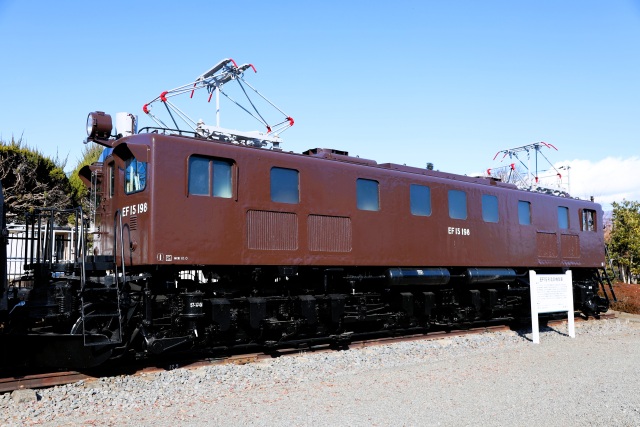
Electric locomotive JNR EF15 198 preserved in Nirasaki Central Park

Happy New Year! The year 2025 has begun. I wish all railfans around the world good health and happiness during this festive season and throughout the coming year. At the start of the New Year, I’m going to show you a beautifully preserved locomotive in Nirasaki Central Park, located in Nirasaki City, Yamanashi Prefecture, about 150 kilometers west of Tokyo.

The Class EF15 is a 1,500-volt direct-current electric locomotive with a 1C+C1 axle arrangement (AAR wheel arrangement). It was developed by the Ministry of Transport in 1947 for hauling freight trains. A total of 202 units were built, but today only four remain preserved in Japan. The EF15 measures 17 meters in length and weighs 102 tons. Its maximum speed was 75 kilometers per hour.

Unit 198 (see the top photo) was built by Toyo Denki and Kisha Seizo in 1958. After operating for 28 years on Japanese National Railways (JNR) lines, it was retired in 1986 as the very last active EF15. Its total running distance reached an impressive 2.12 million kilometers. Please compare it with the Class EF57, which I introduced last November.

I’m not done yet. Please look at the photo below as well. You can see four freight cars coupled behind Unit 198. They consist of three open wagons of the ToRa 70000 series and one caboose of the Yo 5000 series. The ToRa 70000 was JNR’s standard open wagon. A total of 5,100 units were built, but today only 13 still survive. ToRa701 and ToRa702 on the Mojiko Retro Sightseeing Line are precious survivors of the ToRa 70000 series, preserved after renovation.

Caboose JNR Yo 5000 and open wagons JNR ToRa 70000

Monday, 23 December 2024

Preserved Keikyu Train in Zushi City

DeHa 601 of the Keikyu 600 series preserved in Zushi Daiichi Sports Park

Sorry for jumping from one topic to another, but I’d like to continue my story about my recent visit to the Yokosuka Line a little more today.

After enjoying the suburban sceneries along the JR-East Yokosuka line, I headed to Zushi Daiichi Sports Park near Higashi-Zushi Station. My destination was an old train preserved in the park—DeHa 601 of the Keikyu 600 series. When you hear “the Keikyu 600 series,” you may think of the currently active train, but today’s topic is its predecessor, the original 600 series. Please take a look at the photos.

DeHa 601 was built in 1956 by Tokyu Sharyo. Its original classification was DeHa 701 of the 700 series, but it was reclassified as DeHa 601 of the 600 series in 1966. The 600 series mainly operated as Kaitoku (limited express) trains, and all the cars in this series were motorcars. They were Keikyu’s first all-steel trains equipped with a cardan-jointed drive system. The interior was also distinctive, featuring many box seats along with some long bench seats.

After 28 years of service, DeHa 601 was retired from active duty in 1984 and moved to Zushi Daiichi Sports Park. I was particularly fascinated by its front-end design. Its face resembles other classic trains of the era—the JNR 80 series, Tobu 5700 seriesEntetsu 30 seriesOoigawa 21000 series, and so on. It truly embodies the style of the 1950s and 1960s.

Incidentally, DeHa 601 has been lovingly maintained by a local volunteer group called the DeHa 601 Preservation Society. I would like to express my gratitude to everyone involved in keeping this historic train in good condition.

Interior of DeHa601

Sunday, 8 December 2024

Discovering a Dream Diorama in Yokohama

Diorama of the Hara Model Railway Museum in Yokohama

Do you like model trains? My answer is a big yes. I love them and even own a few N-scale models. But… my biggest challenge is finding space for a diorama. As you may know, Tokyo is an extremely high-density city. Typical houses here are often called “rabbit hutches,” and mine is no exception. Building my own diorama is, quite literally, just a dream.

So instead of making one myself, I recently visited the Hara Model Railway Museum in Yokohama and treated my eyes to a wonderful feast. This museum was opened in 2012 by Nobutaro Hara (1919–2014), a world-renowned model-railway maker and collector. His extensive railway models and related collections are now on display for the public. On the large diorama, many first-gauge trains (about 1/32 scale) run dynamically through the scenery.

Please take a look at the top photo. The red-and-gray two-tone locomotive pulling the coaches is the Class V200, a diesel-hydraulic express locomotive of the former Deutsche Bundesbahn. I’ve never seen the real one, but this classic locomotive instantly fascinated me. Cool!

Next, please look at the photo below. You’ll find another two-tone locomotive—beige and red this time—running on the elevated track. That is the Class E03 electric locomotive of Deutsche Bahn. Cool again! What makes the scene even more interesting is that Japanese trains, such as the Tokyu DeHa 20 electric car the Tokyu DeHa 200 electric car, run right in front of the German locomotive. Watching these scenes together is truly enjoyable. I loved the unique, diorama-style world.

German and Japanese trains running on the same diorama