Showing posts with label Keisei. Show all posts

Thursday, 2 April 2026

Keisei Dream Train: The Heartwarming Vehicle

Set 3006 of Keisei's 3000 series EMU, "Keisei Dream Train" 

This may sound a little sudden, but what was your childhood dream? What did you want to become when you were a kid?

On February 28, Keisei Electric Railway Company began operating the “Keisei Dream Train,” using two sets of its trains.

The Keisei Dream Train really lives up to its name. Both the outside and inside of the train are decorated with drawings of children’s dreams for the future. These drawings were made by children and chosen by lottery.

Please take a look at the top photo—that is one of the Keisei Dream Trains, Set 3006 of the 3000 series EMU. You can see a special sticker on the front of the train. It was drawn by a 10-year-old boy whose dream is to become "a train driver of the Keisei 3400 series". What a specific dream! I can completely understand his feelings—please check my previous post about the EMU 3400 series if you have time.

Next, please look at the photo below. This is Car 6, where drawings by boys and girls aged around 10 to 12 are displayed. For example, on the right, there is a drawing of a train and a conductor. It was drawn by another 10-year-old boy, and its title is “A Train Conductor Who Watches Over Safety.” What a responsible child! As proof that he is paying attention, he even drew the yellow warning blocks on the platform—these are tactile paving blocks that guide people with visual impairments. He has very good observation skills.

Finally, there is one more drawing—on the left side of the photo below, you can see a drawing of fashionable women. It was drawn by a 10-year-old girl whose dream is to become both a baker and a YouTuber. How modern! In her drawing, white bread, melon-shaped buns, and coronets are on sale. She imagines that she will introduce her bakery on her YouTube channel. I hope her dreams come true someday.

The Keisei Dream Train is truly a heartwarming vehicle for all passengers.

Interior of Keisei Dream Train

Friday, 27 March 2026

Sayonara to the Shibatetsu 3500 Series

Shibatetsu’s 3540F of the 3500 series EMU arriving at Makuhari-hongo Station

The emotions of rail fans like me are quite complicated. When a new model of rolling stock enters service, I get excited and hurry to the tracks to see it. But when a railway company announces that an old train will be retired soon, I feel sad and think, “It can still work!” I sometimes wonder which one I actually prefer, new trains or old trains.

Probably both. If you are also a rail fan, I hope you understand this mixed feeling.

On February 25, the Shibayama Railway Company (Shibatetsu) announced that its 3500 series EMU will be retired at the end of March. Of course, I felt very sad.

Let me briefly review what Shibatetsu and the 3500 series EMU are like.

Shibatetsu is known as the shortest railway in Japan. The line is only 2.2 kilometers long and opened in 2002 to serve people living on the eastern side of Narita Airport. All trains run through onto the Keisei lines.

The 3500 series EMU is the only model owned by Shibatetsu, and they have only one trainset, Set 3540 (3540F). As I wrote before, Keisei Electric Railway has been leasing 3540F to Shibatetsu since 2013. I really love this four-car train with its red and green stripes.

To say “Goodbye” to 3540F, I chose Makuhari-hongo Station on the Keisei Chiba Line. The Shibayama Railway Line is mostly underground, but Makuhari-hongo is above ground and has good front lighting around noon. One day, I checked the schedule of 3540F, and I decided it was time to go.

Please look at the top photo. This was my last moment with 3540F. It was shining beautifully under the spring sunlight. I also found a special farewell sticker on the front of the train (see the photo below).

Sayonara (Goodbye) and thank you, 3540F! I will never forget you.

By the way, some of my blog readers may be wondering, “Who will be the successor to 3540F?”

Please wait a little longer. I will introduce it soon.

Farewell sticker displayed on the front of 3540F

Related link:

Sunday, 1 February 2026

The Keisei Matsudo Line: A 2026 Update

Keisei-colored 8900 series EMU operating on the Keisei Matsudo Line

I recently visited the Keisei Matsudo Line for the first time in five months, and today I would like to share my firsthand impressions of what I observed there.

First, a brief introduction to the Keisei Matsudo Line. This route was known as the Shin-Keisei Line until March 2025. The name change followed the merger of the Shin-Keisei Electric Railway Company into Keisei Electric Railway Company. Since then, efforts have been ongoing to harmonize systems across the Keisei network and the former Shin-Keisei Line, now operating as the Keisei Matsudo Line. One of the most noticeable outcomes of this process has been the introduction of a new train color scheme.

Following the 8800, N800, and 80000 series EMUs, the 8900 series has also begun to adopt the so-called “Keisei color.” The photograph above shows a Keisei-colored 8900 series EMU that entered service on December 24, 2025. When compared with its previous livery, the transformation is striking. The latest 8900 series’ bold red and blue stripes clearly mark it as a Keisei train.

I also photographed a Keisei-colored 8900 series EMU alongside a Tokyo Metro 16000 series train at Matsudo Station. As shown in the photo below, the 16000 series seemed surprised to see an unfamiliar train beside it. Is my imagination running wild?

In any case, I find both the Shin-Keisei and Keisei color schemes of the 8900 series appealing. I hope that trains in both liveries will continue to operate on the Keisei Matsudo Line for many years to come.

Keisei-colored 8900 series EMU (left) and Tokyo Metro 16000 series EMU (right)

Tuesday, 28 October 2025

Keisei Skyliner AE Series: Over 60 Million Passengers

EMU Keisei AE series Skyliner displaying a gold-colored commemorative sticker

The 3rd-generation Skyliner operated by Keisei Electric Railway is still going strong. The total number of passengers has recently exceeded 60 million, and I’d like to share this happy news today.

Let’s begin with a brief overview. The Keisei Skyliner is an airport access train connecting central Tokyo with Narita International Airport. The current model, the EMU AE series, entered service in July 2010, replacing the previous AE100 series. The AE series is an EMU for 1,435-millimeter-gauge and 1,500 V DC track. A total of eight trainsets (64 cars in total) were introduced. Each set consists of six motorcars and two trailers (6M2T). The train is equipped with an IGBT–VVVF (Insulated Gate Bipolar Transistor-variable frequency drive) inverter control system and 175 kW induction motors. With a maximum speed of 160 km/h, it is the fastest train in Japan outside of the Shinkansen network.

The AE series reached 40 million total passengers in October 2022, then 50 million in July 2024 — meaning it took 21 months to carry another 10 million passengers. This time, it reached 60 million in July 2025, just 12 months later — quite an impressive pace!

To celebrate the milestone, Keisei held a commemorative ceremony at Narita Airport Terminal 1 Station. The 60 millionth passenger was a Japanese family returning home from a trip to Vietnam. Currently, one of the AE series trainsets, AE6, is decorated with special stickers on the front and sides to mark the occasion.

Congratulations to the Skyliner on this remarkable achievement!

Side body of the “60 Million Passengers” commemorative Skyliner

Tuesday, 7 October 2025

Nippori after a Long Time

A train view from Shimogoindenbashi (the EMU JR East E7 series)

Do you have a tradition of visiting ancestral graves in your country? In Japan, yes. Many people do it twice a year in spring and autumn honoring their ancestors. From our perspective, it is not so much a religious activity as a custom. Anyway, I recently visited my maternal ancestors’ grave in Yanaka of Tokyo Metropolis. Yanaka is famous for many cemeteries.

After updating my ancestors on how things are going, I enjoyed strolling around. First, I found myself drawn to Shimogoindenbashi (Shimogoinden Bridge) in front of Nippori Station for the first time in ten years. As I posted before, Shimogoindenbashi is well known as a train viewing spot. JR East’s 12 tracks are seen from the bridge. A total of 2,500 trains run under the bridge per day, so, we can enjoy train viewing continuously there. The bridge was crowded with railfans, families and inbound tourists. Please take a look at the top photo. I shot the JR East’s E7 series shinkansen train running under the bridge. I've been taking pictures of the E7 series repeatedly, but there's something special about a long-distance train approaching its goal, Tokyo Terminal. The E7 series… thank you for your hard work.

Another spot I visited was a scenic cemetery on a hill near Nippori Station. I could see an airport access train, EMU AE series “Skyliner” traveling on the elevated track of the Keisei Line (see the photo below). I have passed through this cemetery many times, but this was the first time for viewing trains. Was it a guidance from my ancestors as a token of their appreciation?

The EMU Keisei AE series Skyliner traveling on the elevated track

Official information, ”Shimogoindenbashi Train Museum" by Arakawa Ward, Tokyo Metropolis (in Japanese):

Saturday, 4 October 2025

Railroad Speeder on the Keisei Line

Keisei's railroad speeder Unit M2591 at Keisei-Makuhari station yard

When I visited the Keisei-Matsudo Line in August, I spotted a rare sight—a railroad speeder, Unit M2591, parked in the Keisei-Makuhari station yard. I got off at the station and was able to observe it from the platform. Please check out the top photo.

Railroad speeder Unit M2591 is a diesel work vehicle built by Matsuyama Jyusharyo Kogyo (MJK). Coupled with rail transport wagons, M2591 carries rails for track maintenance. Its technical specifications are unclear, but it seems capable of hauling over 20 tons of freight. It mainly operates after midnight, once the last train has finished running, so to be honest, I had never seen M2591 in action before. It’s an unsung hero, isn’t it? Its bright yellow body really stood out in the sunlight—beautiful!

Incidentally, did you notice the panda illustration on the side of the speeder? Please take a look at the photo below. This is the mascot character of Keisei Electric Railway, “Keisei Panda.” According to Keisei, he was born as a prince of the House of Panda on Planet Panda. But since he was lazy, his father, King Panda, sent him to Earth for training. Today, he lives in Narita City and works at a zoo as a zookeeper. On the speeder, Keisei Panda is depicted wearing work clothes. You might feel that this version of Keisei Panda looks less cute and even a bit creepy. And that’s right—Keisei intentionally designed their mascot character to have a strong impact rather than just conventional cuteness.

Keisei’s mascot character “Keisei Panda”

Monday, 11 August 2025

The Keisei-Matsudo Line: An Update

Trainset 80026 of the Keisei 80000 series in “Keisei color”

Do you remember when I reported that Keisei Electric Railway merged with Shin-Keisei Electric Railway on April 1st? I recently revisited the former Shin-Keisei Line—now the Keisei-Matsudo Line—and saw the changes for myself.

Let’s start with a quick overview. The Keisei-Matsudo Line is a commuter route in the northwestern part of Chiba Prefecture. It connects Matsudo on JR East’s Jōban Line with Keisei-Tsudanuma on the Keisei-Chiba Line, covering 26.5 kilometers with 24 stations. The line uses standard gauge (1,435 mm), is electrified at 1,500 V DC, and is double-tracked for most of its length. Originally built in 1929 by the Railway Regiment of the former Japanese Army as a training line, it was reopened after WWII in 1947 as the Shin-Keisei Line. Seventy-eight years later, following the merger, it was renamed the Keisei-Matsudo Line.

Now to the main point. After the EMU 8800 series, the 80000 series and N800 series have also begun receiving the so-called “Keisei color” livery. Take a look at the photos—my impression of these trains has changed completely. As you may recall, they used to wear the distinctive white-and-pink Shin-Keisei livery. (You can check my earlier posts featuring the Shin-Keisei-colored 80000 series and the N800 series.) Honestly, it’s a little sad to see the variety of liveries disappear, but there’s no turning back time.

Trainset N818 of the Keisei N800 series in “Keisei color”

Thursday, 24 July 2025

EMU 3200 Series: A New Model on the Keisei Line

Set 3204 + Unit 3205 + Unit 3206 of the EMU Keisei 3200 series

Along with Tobu Railway, Keisei Electric Railway has also introduced a new commuter train: the EMU 3200 series.

Let me start by reviewing Keisei Electric Railway. It is one of the major private railway companies in the Tokyo metropolitan area. This year, Keisei absorbed Shin-Keisei Electric Railway, and now operates a 178.8-kilometer railway network in eastern Tokyo and northern Chiba Prefecture. Its airport access express, the "Skyliner", is well known as Keisei’s flagship train.

Now, let’s move on to the main topic. The first set of the EMU 3200 series debuted on February 22. Keisei plans to introduce a total of 90 units. The main concept of the 3200 series is to improve operational flexibility. A standard trainset consists of eight cars, but it can also be operated as a six- or four-car train. As you know, Keisei experienced a drastic decrease in passengers bound for Narita Airport during the COVID-19 pandemic. In contrast, the number of inbound tourists traveling on the Keisei Line between Narita Airport and downtown Tokyo has increased significantly since 2023. Operational flexibility, depending on demand, is therefore essential for Keisei. For that reason, the 3200 series features couplings between the driver’s cab of the leading car and a middle car (see the photo below). Such irregular train formations have rarely been seen in Tokyo in recent years. Discovering this kind of rarity is one of the greatest pleasures for trainspotters like me.

Coupling between the middle car (left) and the driver’s cab of the leading car (right)

Official information about the EMU 3200 series (in Japanese), provided by Keisei Electric Railway:

Monday, 30 June 2025

“Shin-Keisei” Update: Merger with Keisei

Trainset 8807 of the former Shin-Keisei EMU 8800 series (now in Keisei colors)

On April 1st, Shin-Keisei Electric Railway Company was merged into Keisei Electric Railway Company. How are the former Shin-Keisei and Keisei lines doing now? I recently visited these lines to see for myself.

To start, let me review Shin-Keisei Electric Railway Company (hereafter Shin-Keisei). It was established in 1946 as an affiliate of Keisei Electric Railway Company (hereafter Keisei). In 1955, Shin-Keisei fully opened a 26.5-kilometer railway route between Matsudo and Keisei-Tsudanuma. Shin-Keisei then became a wholly owned subsidiary of Keisei in 2022 through a share exchange. This year, Keisei absorbed Shin-Keisei and became the larger Keisei Electric Railway Co., Ltd. The merger is expected to maximize synergies by enabling quicker decision-making. The former Shin-Keisei line has been renamed the “Keisei-Matsudo Line.”

Now, let’s move on to the main topic. I noticed that the train body colors on the Keisei-Matsudo Line have started to change. Please look at the top photo. This is trainset 8807 of the EMU 8800 series. During the Shin-Keisei era, it featured a pink-and-white two-toned design, but it is now light gray with red and blue stripes—the so-called “Keisei colors”. This color scheme will gradually be applied to all former Shin-Keisei trains.

On the other hand, changes on the Keisei lines themselves were relatively minor. New railway maps that include the “Matsudo Line” have been put up in trains and at stations. I also came across a train with a commemorative plate on the front (see the photo below). It was trainset 3030 of the EMU 3000 series, and the plate read, "Hello Matsudo Line".

Trainset 3030 of the Keisei EMU 3000 series with a commemorative plate

Official railway map by Keisei Electric Railway:

Wednesday, 26 March 2025

The 2nd Generation Kenty Skyliner

Trainset AE4 of the EMU Keisei AE series, the 2nd generation Kenty Skyliner

Do you remember when I introduced you to the "Kenty Skyliner" last year? It was a special poster train on the Keisei Line. Time really flies — a year has already passed, and Keisei Electric Railway has just launched the 2nd generation Kenty Skyliner. I’d like to show you this new poster train today.

Let me start by briefly reviewing who “Kenty” is. Kento Nakajima, also known as Kenty, is a popular Japanese singer and actor. Keisei has been featuring him in their advertising campaigns since 2019. For example, he appeared as the Prince of Keisei in TV commercials, promoting the Skyliner, Keisei’s airport access train to Narita. Following that, Keisei started operating a special poster train called the Kenty Skyliner in 2021. Large posters of Kenty dressed as the Prince of Keisei were displayed on the train’s sides. The idea was that Prince Kenty was escorting passengers—like princesses—on their journey.

Fast-forward to November 2024: the 2nd generation Kenty Skyliner made its debut. Like the first version, this train also features large posters of Kenty on the sides. However, this time, Kenty no longer appears as the prince. He looks more mature and natural, giving a refreshing impression.

Incidentally, the 2nd generation Kenty Skyliner is trainset AE4 of the EMU Keisei AE series. This 8-car train is known for its sleek, crow-like black front design. It can run at up to 160 kilometers per hour, making it the fastest train in Japan except for the Shinkansen. The AE series also received the 2011 Blue Ribbon Prize from the Japan Railfan Club as the best new train that debuted in 2010.

Large posters of Kenty displayed on the sides of the train

Official information (in Japanese):
Promotion movie:

Friday, 14 March 2025

The 55th Anniversary of Tora-san, Part 2

"The 55th anniversary of Tora-san" train, Keisei 3030, runs on the Keikyu line

You may remember when I introduced the 55th anniversary train of Tora-san before. It was trainset 3668 of the Keisei 3600 series displaying the commemorative plate. Today, I’d like to show you two more anniversary trains.

Please look at the top photo. You can see a round-shaped plate on the front of trainset 3030 of the Keisei 3000 series. This train also celebrates “The 55th Anniversary of Tora-san.” The 3000 series was introduced in 2003 to replace older trains on the Keisei Line. It’s a stainless-steel commuter train, with 48 sets (326 cars) built by Nippon Sharyo and others. Because it runs through to the Hokuso Line — part of the high-speed access route to Narita International Airport — its maximum operating speed is 120 km/h.

Meanwhile, Hokuso Railway is also operating a “55th Anniversary of Tora-san” train (see the photo below). This is trainset 7502 of the EMU 7500 series. Hokuso trains directly operate onto the Keisei, Toei Asakusa, and Keikyu lines. The 7500 series, commissioned in 2006 to replace the older 7000 series, is a mainstay of the Hokuso fleet. A total of three sets (24 cars) were built by Nippon Sharyo and Tokyu Sharyo. It’s actually a sister train to the Keisei 3000 series, the main difference being the color of the side stripes.

"The 55th anniversary of Tora-san" train, Hokuso 7502, runs on the Keikyu line

Sunday, 16 February 2025

Keisei Skyliner AE Series: Over 50 Million Passengers

EMU Keisei AE series Skyliner displaying a gold-colored commemorative sticker

It’s a bit of old news, but the passengers of the third-generation Keisei Skyliner exceeded 50 million on June 9th last year. I’d like to bring up this topic today.

Let’s start with a quick look at the Skyliner. It’s an airport access train that connects central Tokyo with New Tokyo International (Narita) Airport. The current Skyliner, officially known as the EMU AE series, was introduced in 2010 to replace the previous model, the AE100 series.

The AE series is an electric multiple unit designed for 1,435-millimeter gauge and 1,500 V DC track. A total of eight trainsets, consisting of 64 cars, were built by Nippon Sharyo and Tokyu Sharyo. Each trainset is composed of six motorcars and two trailers (6M2T). The traction system uses an IGBT–VVVF (Insulated Gate Bipolar Transistor – variable frequency drive) inverter controlling 175 kW induction motors. The AE series can reach a maximum speed of 160 km/h, making it the fastest train in Japan apart from the Shinkansen.

The AE series reached 20 million passengers in September 2016, 25 million in November 2017, and 45 million in October 2023. The period between the 45 millionth and the 50 millionth passenger milestones (June 2024) was only eight months. To celebrate the achievement, Keisei Electric Railway held a commemorative ceremony at Narita Airport Terminal 1 Station. The 50 millionth passenger was a Japanese mother accompanied by her two little daughters.

At present, one of the AE series trainsets, namely AE2, bears a gold-colored commemorative sticker on its front. Congratulations to the Keisei Skyliner for reaching the 50 million-passenger mark!

Side view of the “50 Million Passengers” commemorative Skyliner

Official information about Keisei Skyliner:
Official announcement about the 50 million passengers of the EMU Keisei AE series (in Japanese):

Thursday, 13 February 2025

The 55th Anniversary of Tora-san

“The 55th Anniversary of Tora-san” train arrives at Shibamata Station

Otoko wa Tsurai yo (It’s Tough Being a Man)” is a beloved Japanese film series released from 1969 to 1995, starring Kiyoshi Atsumi. The main character, Tora-san, played by Atsumi, is a kind-hearted vagabond who is always unlucky in love. He works as a street vendor, traveling from place to place, where he meets beautiful “madonnas” and causes innocent ruckuses.

Tora-san is an unlikely hero — lazy, poorly educated, yet deeply human. Despite his flaws, he is loved by local people for his warmth and sincerity. His family home was in Shibamata, located along the Keisei Kanamachi Line. In front of Shibamata Station, you can find a bronze statue of Tora-san (see the photo below).

Last year, Shibamata celebrated the 55th anniversary of Tora-san. To commemorate the occasion, Keisei Electric Railway has been operating a special anniversary train until March 23, 2025. On the front of the train, you can see a commemorative plate marking “The 55th Anniversary of Tora-san.” This plate also celebrates “The 115th Anniversary of Keisei Electric Railway.” The four-car train, set 3668 of the EMU 3600 series, slowly passes through Tora-san’s hometown (see the top photo).

Incidentally, the Keisei 3600 series EMU is a standard commuter train first introduced in 1982. A total of nine sets (54 cars) were built by Tokyu Sharyo and Nippon Sharyo. Today, only two sets (10 cars) remain in service. The trains were originally equipped with a field chopper control system, but set 3668 was later converted to a GTO-VVVF (Gate Turn-Off Thyristor Variable Frequency Drive) system in 1999. It’s quite a rare train to see nowadays.

Bronze statue of Tora-san in front of Shibamata Station

Official information (in Japanese):

Saturday, 1 February 2025

Final Chapter of Shin-Keisei Electric Railway

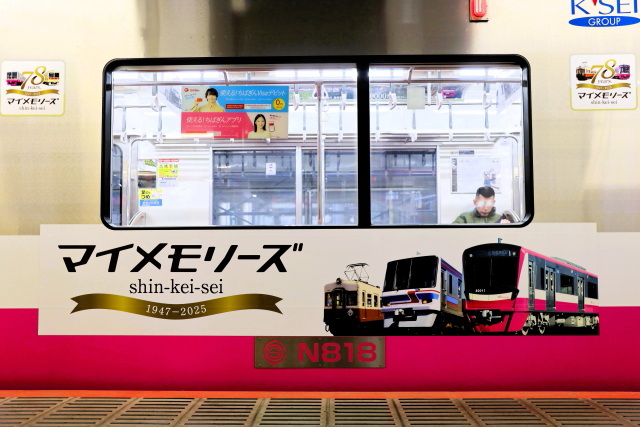
Set N818 of the EMU Shinkeisei N800 series, "My Memories Train"

You may remember when I introduced the news that Keisei Electric Railway Company will absorb Shin-Keisei Electric Railway Company in April 2025. How is the merger project progressing? Just like last November, I recently visited the Shin-Keisei Line and saw the situation with my own eyes once again.

I found that Shin-Keisei was operating a special poster train named My Memories Train, using set N818 of the EMU N800 series. A special sticker showing Shin-Keisei’s 78 years of history is displayed on the front of the train (see the top photo). Large side-body stickers feature Shin-Keisei’s famous trains — the EMU 220, 8900, and 80000 series (see the photo below). In addition, passengers can enjoy special posters inside the train that explain the history of Shin-Keisei.

According to the company, the purpose of My Memories Train is to look back on Shin-Keisei’s 78 years of history together with its passengers. The final chapter of Shin-Keisei Electric Railway is steadily unfolding as the merger within the Keisei Group approaches.

Incidentally, the EMU N800 series is one of the main fleets on the Shin-Keisei Line. It was commissioned in 2005 to replace the old 800 and 8000 series trains. A total of five sets (30 units) were built by Nippon Sharyo. The N800 series is a sister train of the Keisei 3000 series, sharing the same car bodies and technical specifications.

Side body of My Memories Train

Wednesday, 27 November 2024

Deja Vu Colors Return to the Shin-Keisei Line

Set N838 of the Shin-Keisei N800 series, revival-color livery

You may remember my post from last year, where I mentioned that Keisei will absorb the Shin-Keisei Electric Railway in April 2025. How is the merger project progressing now? I recently visited the Shin-Keisei Line for the first time in two years, and saw the changes with my own eyes.

Let me briefly review Keisei Electric Railway and Shin-Keisei Electric Railway. Keisei is one of the major private railway companies in the Tokyo metropolitan area. Its network stretches 152.3 kilometers across eastern Tokyo and northern Chiba Prefecture. Shin-Keisei, on the other hand, is a Keisei affiliate based in Chiba Prefecture, operating a 26.5-kilometer route. Last year, Keisei made Shin-Keisei a wholly owned subsidiary through a share exchange. As the second step, Keisei will fully absorb Shin-Keisei next year to accelerate decision-making and improve business efficiency. After the merger, the Shin-Keisei Line will be renamed the Keisei Matsudo Line.

Now, onto the main topic. I found that two Shin-Keisei trainsets have recently been repainted in their original colors. They are Set N838 of the N800 series EMU and Set 8808 of the 8800 series EMU. In my memory, both sets were repainted into the newer pink-and-white livery only about two years ago. So why return them to their former colors now? It seems to be a way for Shin-Keisei to look back on its history as it approaches the end of its independent era. I fully enjoyed seeing these “déjà vu” trains running again on the Shin-Keisei Line.

Set 8808 of the Shin-Keisei 8800 series, revival-color livery

Related links:

Tuesday, 16 July 2024

The 50th Anniversary of Keisei Skyliner

Set AE3 of the EMU Keisei AE series passes through Shin-Mikawashima station

On December 30th, 2023, Keisei Electric Railway celebrated the 50th anniversary of their Skyliner operation. In commemoration, Keisei is displaying memorial stickers on the train set AE3 of the EMU AE series.

Let me review the history of Keisei Skyliner. It's an airport access train, operated between the city center of Tokyo and Narita Airport. As you know, Narita is the second international airport in the metropolitan area. The first generation Skyliner was commissioned in 1978, when Narita Airport was opened. That was the EMU (old) AE series with gorgeous reclining cross seats. At the beginning, one set was composed of 6 cars, but, changed to 8 cars later. The two-toned cream and maroon-colored bodies were vivid for passengers. The second generation Skyliner, named the EMU AE 100 series, debuted in 1990 replacing the deteriorating (old) AE series. I liked the retractable lights on the front of the AE100 series. It was cool and inspiring. The AE 100 series was retired in 2016 while it was missed by rail-fans. The third generation Skyliner, namely the EMU (new) AE series, was commissioned in 2010. This model is currently operated as a sole model of Skyliner. I'm fond of this train's sharp streamlined body like a crow. It was designed by a famous fashion designer, Yamamoto Kansai. The maximum operating speed of the (new) AE series is 160 kilometers per hour, which is the fastest in Japan except the Shinkansen trains.

Congratulations on the 50th anniversary of Keisei Skyliner!

The first generation Skyliner (left) and the third generation Skyliner (right)

Official website, Keisei Electric Railway:

Wednesday, 17 April 2024

Advent of Spring on the Keisei Line

EMU Keisei 3000 series passes through a vast tulip field near Keisei-Usui station

I'm continuing railway mini-travels to find the advent of spring. My next destination was a vast tulip field located in Sakura City of Chiba Prefecture, about 60 kilometers east of Tokyo.

I got off at Keisei-Usui station on the Keisei main line, and headed to the bank of Kashima River. After strolling for about 30 minutes, a windmill jumped into my eyes and in time, I could see the whole tulip field. Where am I? Is this the Netherlands? Joking aside, I fully enjoyed this colorful tulip field for a while. The even more good news was that I could shoot the tulip field backed by Keisei trains, because the tulip field was located near the Keisei line track. An 8-cars train, the EMU Keisei 3000 series, was passing through the numerous colorful tulips. They are red, yellow, pink, white and so on. The railway track is separated by a road, so, you can see several automobiles are in the foreground of the train, but never mind. What's more important was that I didn't worry about backlighting, as it was a cloudy day. Luck was on my side.

For your information, the EMU Keisei 3000 series is the main fleet of the Keisei commuter trains. A total of 326 cars, were built by Tokyu Sharyo (present J-TREC) and Nippon Sharyo between 2002 and 2019. The EMU Shinkeisei-N800 series, Hokuso 7500 series, and Chiba New Town Railway 9200 series have the same technical specifications as the Keisei 3000 series.

Is this the Netherlands?

Friday, 8 March 2024

Kenty Skyliner: The Prince of Keisei Escorts Passengers

Set AE4 of the EMU Keisei AE series, "Kenty Skyliner"

Railway companies in the Tokyo metropolitan area are in competition to attract passengers. For that purpose, many companies have their own mascot characters, such as Odakyu's "Mokoron" and Sotetsu's "Sounyan", to refine the value of their lines. In addition, several companies use celebrities for their advertising campaigns. For instance, Tokyo Metro, which is a subway operator, has been using a famous actress, Ishihara Satomi, for their TV commercials. On the other hand, Keio Electric Railway recently uses a young emerging actress, Kiyohara Kaya, for their TV ads and digital signages at the stations.

The celebrities contributing to railway companies are not only females. Keisei Electric Railway uses a famous young male idol, Nakajima Kento, for their face of the company. He acts as "the Prince of Keisei", and promotes the airport access train "Skyliner" on the TV commercials. Needless to say, the rival of Skyliner is JR East's "Narita Express". Keisei is operating a special poster train, named "Kenty Skyliner", as well. That's Set AE4 of the EMU Keisei AE series. As you probably have noticed by now, "Kenty" is the nickname of Nakajima "Kento". This train displays a gold-colored "Kenty Skyliner" sticker on the front. Furthermore, large posters of Kenty, who is dressed as the Prince of Keisei, are also displayed on the side bodies. It means that Kenty, the prince of Keisei, escorts passengers in the likeness of princesses. I hope that many passengers, specifically young girls, use Kenty Skyliner to be escorted by the Prince of Keisei.

Side body of "Kenty Skyliner"

Official website, "Kenty Skyliner" (in Japanese):

Tuesday, 19 December 2023

Keisei Skyliner AE Series: Over 45 Million Passengers!

EMU Keisei AE series, Skyliner, displays a gold-colored commemoration sticker

On October 12th, Keisei Electric Railway announced that the passengers of the third generation Skyliner exceeded 45 million on that day. Keisei held a commemoration ceremony at Narita Airport Terminal 1 station. The 45 millionth passenger received a bouquet and a commemorative gift.

Skyliner is the airport access train. It's operated between Ueno, a subcenter of Tokyo, and Narita Airport Terminal 1, which is the second international airport in the metropolitan area. The EMU Keisei AE series is the third-generation vehicle for Skyliner train. It was launched in 2010 to replace the old model, the AE100 series. This limited express train is able to travel with a 160 kilometers per hour maximum speed, which is the fastest in Japan except the Shinkansen vehicles. The AE series is characterized by the crow-shaped black faces. It was designed by a famous fashion designer, Yamamoto Kansai. The interior of Skyliner is luxurious. For example, it has gorgeous reclining seats with wide seat pitches and wide luggage spaces. The AE series won the 2011 Blue Ribbon Prize by Japan Railfan Club as the best train that debuted in 2010.

One set of the AE series, namely set AE7, currently displays a gold-colored commemoration sticker on the front of the train. It proudly says "Thanks, 45 million passengers". There had been less passengers on the Skyliner train in the past few years due to the COVID-19 calamity, but the number of passengers has recently returned to pre-COVID times. Congratulations on the 45 million passengers!

Set AE7 of the EMU Keisei AE series passes through Shin-Mikawashima station

Official information about Keisei Skyliner:
Official information about the 45 million passengers of the EMU Keisei AE series (in Japanese):

Monday, 13 November 2023

Shin-Keisei: Merger with Keisei in 2025

EMU Shin-Keisei 8800 series arrives at Kunugiyama station (July, 2022)

On October 31st, Keisei Electric Railway Company made a press release announcing that Keisei will absorb Shin-Keisei Electric Railway Company in April, 2025.

Let me review Keisei Electric Railway and Shin-Keisei Electric Railway. Keisei is one of the major private railway companies in the Tokyo metropolitan area. It was established in 1909 to transport worshippers to the famous temple, Shinsho-ji. Keisei currently owns a total of 152.3-kilometer-long railway network in the eastern part of Tokyo and northern Chiba Prefecture. The airport access limited express, "Skyliner", is famous for being Keisei's flagship train. On the other hand, Shin-Keisei (New Keisei) is an affiliate firm of Keisei Electric Railway Company in Chiba Prefecture. It owns a 26.5-kilometer-long railway route connecting Matsudo on the JR East Joban line and Tsudanuma on the Keisei Main line. Shin-Keisei was constructed as a training line by the Railway Regiment of the ex-Japanese Army in 1929. After WWII, the railway track was sold to Keisei Electric Railway Company. Then, it was reopened as the Shin-Keisei line of Shin-Keisei Electric Railway Company in 1947.

Keisei has made Shin-Keisei a wholly-owned subsidiary last year through a share exchange. As the second step, Keisei will absorb Shin-Keisei in 2025 to maximize synergies by making faster decisions and improving business efficiency. I hope that the merger will provide Keisei and Shin-Keisei with a more stable business. At the same time, as a rail fan, I wish the unique trains on the Shin-Keisei line will be active on the track for a long time.

Shin-Keisei "Funassyi (local mascot of Funabashi City)" poster train (July, 2022)