Showing posts with label AGT. Show all posts

Monday, 20 April 2026

New LEO LINER on the Yamaguchi Line

Seibu L00 series EMU, LEO LINER (Set L11)

Today, I would like to introduce a new train model in the Tokyo metropolitan area: Seibu Railway’s L00 series EMU, called the LEO LINER, for the Yamaguchi Line. This new model entered service on March 27 and replaces the older 8500 series EMU.

First, let me briefly introduce the Seibu-Yamaguchi Line.

The line is a rubber-tyred automated guideway transit (AGT) system that runs across the border between Tokyo Metropolis and Saitama Prefecture. It connects Tamako (Lake Tama) and Seibu-Kyujō-mae (Seibu Baseball Stadium) stations, and its total length is only 2.8 km. The entire route is single-track and uses a 750 V DC third-rail power supply. Unlike other AGT lines such as the Seaside Line, and the Nippori-Toneri Liner, trains on this line are operated by a driver. It is not a driverless system.

The top photo shows the L00 series. Each trainset consists of four aluminum-alloy cars, each 8.5 meters long (two motor cars and two trailer cars). The traction system uses variable frequency drives with 110 kW induction motors. One of the differences from the older 8500 series is that the L00 series has double-leaf external sliding doors. Seibu Railway plans to introduce three trainsets of the L00 series by the end of March 2028.

My first impression was that it looks similar to the Yurikamome 7500 series EMU. It also reminds me of JR East’s HB-E220 series. The polygonal shape of the front of the train seems to be a trend in the design of recent rolling stock.

Regarding the interior, please look at the photo below. There is a transverse seat located just behind the driver’s cab. It is called the “Kids Seat,” and it is designed for a parent and a child. They can enjoy watching the driver operate the train and looking out the front. Recently, more Japanese railway companies seem to be installing special seats for parents and children, and I think this is a very good idea.

I enjoyed observing Seibu’s new LEO LINER very much.

“Kids Seat” in the L00 series train

Related link:

Tuesday, 24 March 2026

Yamitetsu Part 4: Telecom Center

7500 series EMU approaching Telecom Center Station on the Yurikamome LineYurikamome's 7500 series EMU approaching Telecom Center Station on the Yurikamome Line

Do you remember the Japanese slang word “yamitetsu”? This term is used mainly among railfans in Japan. Today, I’d like to share a small update on my recent yamitetsu activities.

To review briefly, yamitetsu refers to railfans who enjoy taking photos of trains in the dark. The word combines “yami” (darkness) and “tetsu” (iron). In Japanese, tetsudō means “railway” — literally “iron road.” I’m still a beginner yamitetsu, but I’m slowly learning.

Recently, I visited Telecom Center to enjoy the night scenery. The building has offices, restaurants, and telecommunication facilities, and there’s an observation deck on the 21st floor with a great view of Tokyo’s waterfront area.

I originally went there just to enjoy the night view. However, about a minute after arriving, a train suddenly caught my eye — the 7500 series EMU on the Yurikamome Line! (See the photo above.)

As you may know, the Yurikamome Line is an automated guideway transit (AGT) system in the Tokyo Bay area. It opened in 1995 and connects Shimbashi and Toyosu, covering 14.7 km. The trains run on rubber tires instead of steel wheels. All trains are fully driverless and conductorless (Level GoA4), so the doors and operation are completely automated.

The 7500 series EMU entered service in 2018 to replace the older 7200 series. Eight sets (48 cars) were introduced. It looks beautiful at night, but if you’d like to see its daytime appearance, please check my post from 2019.

In the end, I couldn’t resist taking pictures of the train — even though my original purpose was to enjoy the night view. Finally, I’m sharing a photo of Rainbow Bridge and Tokyo Tower at night. That was what I meant to focus on!

Have a good night.

Night view of Rainbow Bridge and Tokyo Tower

Wednesday, 11 December 2024

Happy Rainbow Train on the Ina Line

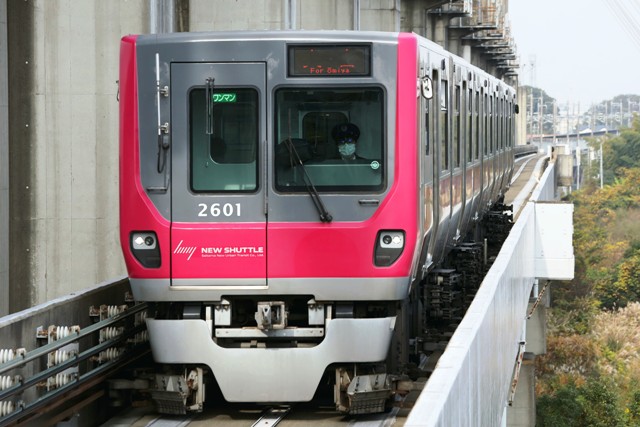
Happy Rainbow Train coming down from Maruyama Depot

On November 30th, a new train debuted on the Ina Line of the New Shuttle. It is the sixth set (Set 26) of the 2020 series EMU, and has been given the cheerful nickname “Happy Rainbow Train.”

Let me start with a brief review of the New Shuttle. It’s a rubber-tyred automated guideway transit (AGT) system in Saitama Prefecture, about 30 kilometers north of Tokyo. Its formal name is the Ina Line of the Saitama New Urban Transit Company. Connecting Omiya and Uchijuku, the line is 12.7 kilometers long. The entire route opened in 1983 alongside JR East’s Shinkansen tracks. The route is mostly double-tracked, but has some single-track sections. The trains are powered by 600-volt three-phase alternating current. Instead of overhead wires, three rigid conductors are installed along the track. You can see these rigid power-supply wires and the guide rail in the top photo.

Now, let’s head to the main topic. As its name suggests, the Happy Rainbow Train (Set 26) features a colorful rainbow livery. It stands out from the existing 2020 series sets—such as Set 2223, and 25. Inside the train, wheelchair spaces and priority seats have been enlarged. The heating and ventilation systems were also upgraded.

When I visited the Ina Line, the Happy Rainbow Train was “sleeping” in Maruyama Depot. That was a pity… but just five minutes later, the situation changed dramatically. The front lights turned on and the train slowly rolled out of the depot. It “squirmed” its body (see the top photo) and made its way toward the main track (see the photo below). What a stroke of luck!

Happy Rainbow Train heading toward the main track on the Ina Line

Related links:

Monday, 22 July 2024

The Yukarigaoka Line: Update

EMU Yamaman 1000 series travels on the Yukarigaoka line

As I recently posted, I took the Yamaman-Yukarigaoka line for the first time in eleven years. What has changed and what has remained the same on this small AGT (Automated Guideway Transit) line?

The trains haven't changed. The EMU 1000 series is still operated on the line as a sole model. These lovely trains were built by Nippon Sharyo in 1982. The 1000 series is comfortable to ride except in summer. What does that mean? What I’m saying is air conditioners are not equipped on the trains. That must be tough for passengers in this season, but instead, each passenger gets a wet towel and a paper fan for free on the train. What's more, I got a bottle of water and salt tablets as well from the promotion. The salt tablets, which were offered by a snack maker, Kabaya, had a sweet-sour taste… definitely my favorite! Such a wonderful service.

One more news on the Yukarigaoka line is how to ride the trains for passengers with commuter passes. The existing commuter pass is no longer necessary. You need only your face. The railway company, Yamaman, started a facial recognition boarding system on June 15th this year. I couldn’t try this boarding system, as I’m not a frequent passenger of the Yukarigaoka line, but the facial recognition system seems to be very convenient. Incidentally, a single ticket has also been changed from a magnetic ticket to the QR code ticket.

The Yamaman-Yukarigaoka line… the trains are little worn-out, but the services to passengers are really on the leading-edge.

Two automatic ticket gates on the right are the facial recognition boarding system

Officilal information about the facial recognition and the QR code boarding system by Yamaman (in Japanese):

Saturday, 13 July 2024

Lavender Field on the Yukarigaoka Line

EMU Yamaman 1000 series travels on the Yukarigaoka line

Here we are still in the middle of the gloomy rainy season in Tokyo. We have been having hot and humid days. I'm thinking of refraining from strolling in this season, but once the sun's rays peep through the clouds, I can't help going out.

My destination this time was Sakura Lavender Land in Chiba Prefecture, about 40 kilometers east of Tokyo. It's a vast lavender field, where the purple color spreads over. Lavender has long green stalks topped with a bunch of small purple flowers. They are extremely fragrant, and help me to be relaxed. To my joy, admission to Sakura Lavender Land is free... thank you.

To get to this purple world, the nearest railway station is Joshidai (Women's University) on the Yukarigaoka line. This route is a rubber-tyred automated guideway transit system operated by a real estate company, Yamaman. It looks like an attraction in an amusement park, but it's an authentic railway under the Railway Business ACT. The route is composed of the main and the annular sections. The starting station is Yukarigaoka, which is a transfer station to the Keisei line. All the trains leave Yukarigaoka station, run counterclockwise on the annular section, and come back to Yukarigaoka terminal. The total line length is only 4.1 kilometers. The track is single and the electric system is 750 V DC. 3-car trains, named the EMU 1000 series, are operated every 20 minutes on average.

I enjoyed both the beautiful field and the lovely train.

Sakura Lavender Land near Joshidai station on the Yukarigaoka line

Saturday, 11 May 2024

Advent of Spring: Nippori-Toneri Liner

Set 38 of the EMU Toei 330 series, Nippori-Toneri Liner

Japan has four distinct seasons. Each season is beautiful in its own way. Cherry blossoms might be famous in spring, but they can't be the only beautiful flowers. In recent years, nemophila has become popular among people. It's an annual herb native to North America. The plant grows only up to 20 centimeters tall, and produces tiny blue flowers. The small flowers mean nemophila usually play a supporting role in gardens, but several parks are famous for nemophila flowers as their stars. Toneri Park in the northern part of Tokyo is one of such places. We can see a vast nemophila field in spring. It looks like a beautiful blue carpet on a gentle hill.

To get to Toneri Park, the nearest station is Toneri-koen on the Nippori-Toneri Liner operated by Bureau of Transportation, Tokyo Metropolitan Government. The route is known as the rubber-tired AGT (Automated Guide way Transit) system. Connecting Nippori in the downtown area and Minumadai-shinsuikoen, its operating length is 9.7 kilometers. Track is double and the electric system is 600V three-phase AC, 50 Hz. ATO (Automatic Train Operation) system is adopted, so there is no driver and conductor on the train. As a result, the front seat on the train is vacant, so passengers can freely sit on it. The EMU Toei 330 series was my vehicle to Toneri Park the other day. Needless to say, I sat on the front seat of the 330 series, and fully enjoyed the view ahead to Toneri-koen station. I felt awesome!

Nemophila field in Toneri Park near Toneri-koen station, Nippori-Toneri Liner

Thursday, 14 March 2024

The 40th Anniversary of the New Shuttle

The New Shuttle track has 3 rigid wires for power supply and a guide rail (lower left)

I recently visited the New Shuttle for the first time in two years. What's new with this AGT (Automated Guideway Transit) line?

Let me review the New Shuttle. It's a rubber-tyred automated guideway transit (AGT) system in Saitama Prefecture, about 30 kilometers north of Tokyo. The formal name is the Ina line of Saitama New Urban Transit Company. Connecting Omiya and Uchijuku, its operating length is 12.7 kilometers. The route was opened in 1983 beside the JR East's Tohoku and Joetsu Shinkansen track. The track is mostly double, but partly single. The power supply is 600V three-phase alternate current. Instead of an overhead catenary, three rigid wires are installed along the track. Unlike the other AGT lines such as the Yurikamome, Nippori-Toneri Liner and Seaside Line, a driver operates each train. It's not a driver-less operation. For your information, the definition of the Automated Guideway Transit is a transportation system that runs on rubber tires by applying guide wheels to the guide rails in the center or side walls of the track. It doesn't necessarily mean driver-less operation. You can see three rigid wires for power supply and a guide rail in the top photo.

In commemoration of the 40th anniversary, all trains of the New Shuttle have been displaying 40th anniversary stickers since last August. We can see illustrations of both the retired model, EMU 1000 series (later modified to the 1010 series), and the latest model, EMU 2020 series, on the sticker. Time really flies. Congratulations on the 40th anniversary of the New Shuttle!

The 40the anniversary sticker of the New Shuttle train

Official website, the New Shuttle (in Japanese): https://www.new-shuttle.jp/

Monday, 22 January 2024

Special-colored Train on the Seaside Line

Set 48 of the EMU Kanazawa Seaside Line 2000 series

Why do I like trains? Because, I like to travel and like the travelling sound of trains. They may be true, but I think that there is one more reason. The answer is the beautiful coloring of the train bodies.

Let's look concretely. Please look at the top photo. Set 48 of the EMU 2000 series is the special-colored train on the Kanazawa Seaside line in Yokohama City. It was introduced onto the line in 2019, when the Seaside line was extended to Kanazawa Hakkei terminal. Different from the other trains on the line, set 48 has blue-colored bodies, on which the seaside wave is designed. The train bodies are solid; meanwhile, the wave design on the bodies has a round shape... well-balanced. In addition, the designs on the front and the side bodies are connected. They totally express sea waves. It's well thought out. Set 48 gracefully runs on the elevated track backed by the marina of Kanazawa-hakkei. It fits the sea of Yokohama City.

Incidentally, Kanazawa Seaside line is a rubber-tired AGT (Automated Guideway Transit) transportation system in the southern part of Yokohama City, Kanagawa Prefecture, about 40 kilometers south of Tokyo. It was opened in 1989 by Yokohama Seaside Line Company. Connecting Shin-Sugita on the JR East Negishi line and Kanazawa-hakkei on the Keikyu main line, its route length is 10.8 kilometers. Its electric system is 750V DC. The ATO (Automatic Train Operation) system is adopted, so, there is no driver and conductor on the train.

Set 48 runs on the elevated track backed by the marina of Kanazawa-hakkei

Monday, 10 July 2023

Seaside Walking on the Seaside Line

EMU 2000 series travels on the Kanazawa Seaside line in Yokohama City 

Here we are still in the gloomy rainy season in Tokyo. We have been having hot and humid days, but, once the sun's rays peep through the clouds, I never fail to go out to enjoy a stroll on weekends. My destination this time was Umino-Koen (Marine Park) in Yokohama City, about 50 kilometers south of Tokyo. There are a designated swimming beach and marine sports facilities such as beach volleyball courts and a windsurfing boathouse. You can also enjoy clam digging on the beach in spring. An outdoor BBQ facility, which was temporarily closed for the COVID-19 calamity, has been just reopened.

To visit this urban resort, the nearest railway station is Uminokoen-Shibaguchi on the Kanazawa Seaside line. Taking this opportunity, please let me review this public transportation system again. The Kanazawa Seaside line is so-called AGT (a rubber-tired automated guideway transit). There is no driver and conductor on the train. As a result, the driver's seat on the train is vacant except in an emergency case. A passenger can freely sit on it and can enjoy scenic views through the frontal window of the train. The route was opened in 1989 by Yokohama Seaside Line Company. Connecting Shin-Sugita on the JR East Negishi line and Kanazawa-hakkei on the Keikyu main line, its operating length is 10.8 kilometers. The track is double, and the electric system is a 750 V DC with the third rail.

I fully enjoyed the seaside walking on the Kanazawa Seaside line.

A beach in front of Uminokoen-Shibaguchi station on the Kanazawa Seaside line

Sunday, 12 February 2023

The Seibu-Yamaguchi Line: Update

Set V3 of the EMU Seibu 8500 series travels on the Yamaguchi line 

I visited the Seibu-Yamaguchi line for the first time in nine years. What's new with this lovely transit?

Let me review the Seibu Yamaguchi line. It's a rubber-tyred automated guideway transit (AGT) system in the northern part of the Tokyo metropolitan area. The route was originally opened in 1950 as an attraction railway in an amusement park. It was then changed to the AGT line in 1985 under the Railway Business ACT. The route runs through Seibu Group's amusement facilities such as Seibu Dome (Seibu indoor baseball field) and Seibu-en Amusement Park. The total route length is 2.8 kilometers. The EMU 8500 series is the only model of trains operated on the line. It was commissioned in 1985, when the AGT line was opened. 3 sets (set V1, V2 and V3) in total were built by Niigata Tekko. The maximum operating speed is 50 kilometers per hour.

Let's head to the main topic. I found that the names of the stations had been changed. For example, Seibu-yuenchi (Seibu Amusement Park) station was renamed as Tama-ko (Lake Tama) to prevent confusion with the actual entrance location of the amusement park. I also found that the body colors of two trains had been changed. Set V2 had been changed from white to dark green; while set V3 had been modified to three tones of gray, beige and dark brown.

I couldn't find big news, but it's OK. The Yamaguchi line is working well, so I don't want it to change.

Set V2 of the EMU Seibu 8500 series arrives at Seibu-en-Yuenchi station

Monday, 26 September 2022

The Yurikamome Line: Who Closes Passenger Doors?

Set 47 of the EMU 7300 series arrives at Ariake-tennis-no-mori station 

I recently received a good question from my friend, who is a non-railfan. He said "I know the Yurikamome trains are operated without drivers and conductors. Question is who closes passenger doors on the trains at each station?"

To start, let me quickly review the Yurikamome (Black-headed Gull) line. It's a rubber-tyred AGT line connecting Shimbashi and Toyosu stations. AGT is an abbreviation for Automated Guide way Transit. It's a small sized train with rubber-tires instead of steel bogies. There are 16 stations over the total operating length of 14.7 kilometers. The power supply is 600V and 50Hz three-phase alternate current. It uses the ATO (Automatic Train Operation) system, so there's no driver or conductor on the train. It means passengers, specifically railfans, can freely sit on the front seats to enjoy scenic views through the window.

Thanks for waiting. Let's head to the main topic. The answer to the question is "The door operation of the Yurikamome trains is also automated". There are human sensors (motion sensors) on the automatic platform gates at each station. The passenger doors on the trains are synchronized with the automatic platform gates, so, they are automatically closed after passengers' getting on and off finish. In other words, automatic platform gates are essential for the automatic door operation on the Yurikamome trains. Needless to say, station platforms are under remote monitoring by railway employees from the control room through surveillance cameras. That's a fail-safe system.

He said "Thanks, I feel relieved now." It was an eureka moment.

An automatic platform gate at Shiodome station, the Yurikamome line

Sunday, 17 July 2022

The Yurikamome Line: Update

Set 58 of the EMU 7500 series arrives at Ariake-tennis-no-mori station

I recently visited the Yurikamome line for the first time in three years. What's new with this Automated Guideway Transit (AGT) in the Tokyo Bay area?

Let me quickly review the Yurikamome line to start. Yurikamome (Black-headed Gull) is a rubber-tyred AGT line connecting Shimbashi and Toyosu. There're 16 stations over the total operating length of 14.7 kilometers. The train on the line is 51.1 meters long, and consists of six cars. The power supply is 600V and 50Hz three-phase alternate current. There's no driver on the train, so, passengers can freely sit on the front seats to enjoy scenic views through the window.

Let's head to the main topic. I found that all the old trains, namely the EMU 7000 and 7200 series, had already been retired from the track. Instead, the number of the latest model, namely the 7500 series, has greatly increased. Currently, eight sets of the 7500 series are operated on the line together with the previously-existing 7300 series. Technical specifications of the 7500 series are almost the same as the 7300 series, but a different point from the 7300 series is the frontal design. You can see blue-colored "driver-less operation lights". They are lighted when the train is operated in driver-less operation mode.

When I stopped by Ariake-tennis-no-mori station, the 7500 series train arrived at the station. I found a little rail-fan standing on the front seat of the train. He was all smiles, and taking in a scenic overlook of the front view. Enjoy your time!

Set 55 of the EMU Yurikamome 7500 series

Official information, the trains on the Yurikamome line (in Japanese):

Tuesday, 4 January 2022

The New Shuttle 2000 Series: Update

Set 24 of the EMU New Shuttle 2000 series travels on the Ina line

Let me continue where I left off my last year’s post.

The EMU 2000 series is the largest fleet on the Ina line of Saitama New Urban Transit Company (hereafter "the New Shuttle"). It was commissioned in 2007 to replace the decrepit 1010 series. 7 sets in total were built by Kawasaki Heavy Industries. Each set has a different body color. They are dark-pink (set 01), orange (set 02), green (set 03), yellow (set 04), blue (set 05), red (set 06) and pale-pink (set 07). Among these, the body color of set 01 was slightly changed from metallic-pink to dark-pink in 2018. It's a typical geek topic that trainspotters like to talk about.

Incidentally, the New Shuttle is a rubber-tired automated guideway transit (AGT). The 2000 series has a stainless-steel body. It was widened a lateral width compared to the previous models in order to alleviate congestion during the rush hour. The one set is composed of six motorcars. The power supply is 600V three-phase alternate current. Instead of an overhead catenary, three rigid wires are installed along the track. The electric control system on the 2000 series is IGBT-VVVF (Insulated Gate Bipolar Transistor - variable frequency drive) inverter. It means that the three-phase alternate current is once converted to direct current by converters, and converted again to three-phase alternate current by inverters on the train to control traction motors. Each set has six 125 kW traction motors. The maximum operating speed is 60 kilometers per hour.

Set 21 (new color) of the EMU New Shuttle 2000 series

Tuesday, 21 December 2021

The New Shuttle: Maruyama Rail Yard

Maruyama Rail Yard

Let me continue where I left off my last post. After taking a photo of the EMU 2020 series, I stopped by Maruyama Rail Yard near Maruyama station. It's New Shuttle's only rail yard.

I could observe many trains from an outer road of the yard and a bridge crossing the storage tracks. They were the EMU 2000 and 2020 series. The 2000 series is the largest fleet on the line. It was commissioned in 2007 to replace the old EMU 1010 series. 7 sets, 42 cars in total, belong to Maruyama Rail Yard. Each set has a different color. Among these, set 01 (dark pink), 02 (orange), 03 (green) and 06 (red) were being stored on the storage tracks. On the other hand, the 2020 series is the cutting edge model on the line. I could see set 23 (dark pink) and 24 (yellow) on the storage tracks.

I found one more... set 53 of the EMU 1050 series. It's the second generation train launched in 1990 for the entire opening of the route. 4 sets (24 cars) of the 1050 series were built, but currently, set 53 may be only active on the line. The 1050 series has got older, and is near the end of its own life. The body color of the 1050 series was changed to white in 2019, matching the brand new 2020 series.

Maruyama Rail Yard is open to the public once a year. I would like to join the next rail yard tour.

EMU New Shuttle 2000 (left), 1050 (center) and 2020 (right) series

Sunday, 19 December 2021

The New Shuttle: Update

Set 25 of the EMU New Shuttle 2020 series travels on the Ina line

I visited the Ina line of Saitama New Urban Transit Company (hereafter "the New Shuttle") for the first time in four years. What's new with this AGT line?

To begin with, let's quickly review the New Shuttle. The New Shuttle is a rubber-tyred automated guideway transit (AGT) system in Saitama Prefecture, about 30 kilometers north of Tokyo. Its route length is 12.7 kilometers between Omiya and Uchijuku stations. The track is mostly double, but partly single. The route was opened in 1983 beside the JR East's Joetsu Shinkansen track. Unlike the other AGT lines such as the Yurikamome, Nippori-Toneri Liner and Seaside Line, a driver operates each train. It's not a driver-less operation.

I found that many trains had been retired from the track for the past four years. For example, set 1151 of the EMU 1050 series disappeared in March, 2020. I liked this red-colored vehicle, but would no longer be able to see it. The remaining two sets of the 1050 series are still on active duty, but chances for traveling on the track are getting less and less because of degradation over time. Another news is the increasing number of the latest model, the EMU 2020 series. Five sets of the 2020 series are being operated on the line. They have green (set 21), orange (set 22), pink (set 23), yellow (set 24) and purple-colored (set 25) stripes... very colorful. I show you the newest set, named set 25, debuted in February, 2020. Please look at the picture above.

To be continued...

Set 1151 of the EMU New Shuttle 1050 series (January, 2016)

Official information about the New Shuttle (in Japanese):

Friday, 13 November 2020

The Kanazawa Seaside Line Update: Part 2

Set 33 of the EMU 2000 series travels on the Seaside line backed by the blue ocean

The Kanazawa Seaside line is a rubber-tired automated guideway transit (AGT). There is no driver and conductor on the train. As a result, the driver's seat on the train is vacant except in an emergency case. A passenger can freely sit on it and can enjoy scenic views through the frontal window of the train.

As its line name suggests, one of the beautiful sceneries on the Seaside line is the blue ocean. If you ride on the northbound train at Kanazawa-hakkei terminal, a seascape will suddenly appear in front of you just after leaving the terminal. You can start savoring the resort atmosphere. You will then enjoy the sceneries of beautiful Marine Park, Hakkei-jima Island, Hakkeijima Sea Paradise (an aquarium with an amusement park) and so on. Same as the Yurikamome line in the Tokyo Bay area, the Seaside line is indeed a scenic AGT line in the Tokyo metropolitan area.

Incidentally, Kanazawa-hakkei temporary terminal on the Seaside line had been isolated from Keikyu Kanazawa-hakkei station due to a delay in land acquisition around Keikyu Kanazawa-hakkei station. The distance between the temporary terminal on the Seaside line and the Keikyu station was 150 meters. To make matters worse, the passengers changing trains had to cross a wide road, National Route 16. It was inconvenient for passengers to change trains.

On March 31st, 2019, the new Kanazawa-hakkei terminal was finally completed just above the Keikyu Kanazawa-hakkei station. What had been dissatisfying the passengers was eventually removed.

A marina near Kanazawa-hakkei terminal on the Seaside line

Monday, 9 November 2020

The Kanazawa Seaside Line: Update

Set 46 (special color) of the EMU 2000 series travels on the Seaside line

I recently visited the Kanazawa seaside line for the first time in a year. It was the sunny autumn weekend. I enjoyed every minute of this futuristic vehicle ride.

The Kanazawa Seaside line is a rubber-tired AGT (Automated Guideway Transit) system in the southern part of Yokohama City, Kanagawa Prefecture, about 40 kilometers south of Tokyo. It was opened in 1989 by Yokohama Seaside Line Company. Connecting Shin-Sugita on the JR East Negishi line and Kanazawa-hakkei on the Keikyu main line, its operating length is 10.8 kilometers. The track is double, and the train adopts a 750 V DC. ATO (Automatic Train Operation) electric system, so there is no driver or conductor on the train.

I came across a special colored train, namely set 46 of the EMU 2000 series. Different from the standard colored trains, set 46 has black and orange colored stripes on the body. The black color symbolizes the night sky, while the orange color represents the morning sun in the Yokohama bay area. Set 46 became the first train with LED frontal lights on the line.

Incidentally, the EMU 2000 series is currently the sole model on the line. It was launched in 2011 to replace the old EMU 1000 series. Eighteen sets (from set 31 to set 48) of 5-car train (90 cars) were built by J-TREC (former Tokyu-sharyo) between 2011 and 2019. The era of the EMU 2000 series will continue for the time being on the Kanazawa Seaside line.

Set 39 (standard color) of the EMU 2000 series travels on the Seaside line

Official information about the EMU 2000 series (in Japanese):

Friday, 29 November 2019

Kanazawa Seaside Line: Update

Set 43 of the EMU 2000 series travels on the Kanazawa seaside line

I recently visited the Kanazawa seaside line for the first time since 2012. What has changed on this automated guideway transit (AGT) line in the last 7 years?

The biggest change was its rolling stock. All the sets of the old EMU 1000 series were retired from the track in 2014. Instead, the new EMU 2000 series has become the sole model on the line. The 2000 series was first introduced in 2011 on the line. A total of 16 sets (from set 31 to set 46) were built by J-TREC (former Tokyu Sharyo). One set is composed of 5 motor cars. The body of the 2000 series is stainless steel, which is different from the previous 1000 series.

Incidentally, the Kanazawa seaside line is a rubber-tired AGT transportation system in the southern part of Yokohama City, Kanagawa Prefecture, about 40 kilometers south of Tokyo. It was opened in 1989 by Yokohama seaside Line Company. Connecting Shin-Sugita on the JR East Negishi line and Kanazawa-hakkei on the Keikyu main line, its operating length is 10.8 kilometers. The electric system is 750 V DC. ATO (Automatic Train Operation) system is adopted, so there is no driver and conductor on the train.

Sitting on the front seat, the passenger can enjoy the view ahead. I specifically like a marine view between Hakkei-jima and Nojima-koen stations. Same as the Yurikamome line on the coast of Tokyo Bay, the Kanazawa seaside line is the urban marine resort route in Yokohama City.

Set 37 of the EMU 2000 series travels on the Kanazawa seaside line

Official information about the Kanazawa seaside line:
Official information about the EMU Yokohama Ne Transit 2000 series (in Japanese):

Monday, 11 November 2019

EMU 7500 Series: New Model on the Yurikamome Line

Set 51 of the EMU 7500 series travels on the Yurikamome line

I recently visited the Tokyo Bay area for the first time in a year. What was new with this futuristic region in Tokyo?

I found that Yurikamome Company (the former name was Tokyo Rinkai Shin-kotsu Company) introduced a new train model named the EMU 7500 series on November 11th, 2018. Yurikamome is a rubber-tyred AGT (automated guide way transit) line opened in 1995. Connecting Shimbashi and Toyosu, its current operating length is 14.7 kilometers.

The 7500 series is ordinarily operated without a driver the same as its senior models namely EMU 7000, 7200 and 7300 series. There is no independent cockpit on the train, so the passengers, especially rail-fans like me, can enjoy the beautiful bay view ahead. Technical specifications of the 7500 series are the same as those of the previously-existing 7300 series, but a different point from the 7300 series is the frontal design. You can see blue-colored "driver-less operation lights". They are lighted when the train is operated in driver-less operation mode. Regarding the interior, dual information displays and a free Wi-Fi system are equipped on the 7500 series. The company plans to introduce a total of 8 sets, 48 units, by June 2020.

Incidentally, before inauguration of the Yurikamome line, people were concerned that the railway company would struggle with debts, because the construction cost was quite large. So far, their fears were utterly groundless, because the number of passengers has been much higher than anticipated. I saw many foreign passengers use this line for sightseeing in the Tokyo Bay area.

Set 53 of the EMU 7500 series travels on the Yurikamome line

Official information about the EMU Yurikamome 7500 series (in Japanese):

Saturday, 21 July 2018

EMU 320 series: New Model for the Nippori-Toneri Liner

EMU Toei 320 series arrives at Adachi-dai station

The Nippori-Toneri Liner is a rubber-tired automated guideway transit (AGT) in the northern part of the metropolis of Tokyo. Connecting Nippori in the downtown area and Minumadai-shinsuikouen, its operating length is 9.7 km. The number of passengers has been rapidly increasing on the route. It was 49,000 passengers per day when the route was opened in 2008; however, it reached 80,000 passengers per day in 2017. Because of this unexpected growth, the trains are heavily congested during the rush hours. 

The train operator, namely the Transportation Bureau of the Tokyo Metropolitan Government (hereafter Toei), can't sit on their hands. Toei has been launching new rolling stock one after another to enhance the transportation capacity. For instance, a large capacity model, EMU 330 series, was introduced on the route in 2015. Toei then launched the latest model, namely EMU 320 series, in 2017.

What is the difference between the 330 series and the 320 series? The major difference between the two models is their bodies. The 330 series has white colored aluminum alloy bodies; while the 320 series has green colored bodies made of stainless steel. The 330 series was built by Mitsubishi Heavy Industries; while the 320 series was assembled by Niigata Transys.

Toei recently made a press release announcing that the two more sets of new trains will be launched by March 2020 for further enhancement of transportation capacity, but there was no information about the detail so far. Let's wait until the next announcement.

EMU Toei 320 series leaves Nippori station

Official information about the Nippori-Toneri Liner:
Official information about the EMU Toei 320 series (in Japanese):