Showing posts with label Odakyu. Show all posts

Friday, 8 May 2026

Reunion with VSE

DeHa 50001 of the Odakyu Romancecar “VSE” at the Romancecar Museum

Do you remember my post about the Romancecar VSE last year? Today, I’d like to share a touching reunion I had with it afterward.

First, let me briefly review what the Romancecar VSE is.

In the Tokyo metropolitan area, several railway companies compete with luxurious express trains as their flagships. One of the most venerable and popular among them is Odakyu Electric Railway’s Romancecar, which runs from central Tokyo to the western suburbs. Odakyu has continued developing new Romancecar models one after another since the 1950s.

Among them, the Romancecar VSE (Vault Super Express) entered service in 2005. Its official designation is the 50000 series EMU. Each VSE set consisted of 10 articulated cars, and only two sets were ever built, both by Nippon Sharyo.

After 18 years in service, the VSE was retired in 2023. What happened to it afterward remained a mystery for a while, although I did spot it in the Kitami and Sagami-Ono railyards, as I posted last December.

Any updates after that?

Thank you for waiting. Please take a look at the photo above. One of the VSE’s front cars, DeHa 50001, has been on display at the Romancecar Museum near Ebina Station since March 19 of this year. Needless to say, I rushed to the museum and enjoyed a heartfelt reunion.

What I especially enjoyed was getting a close look at the VSE’s articulated bogie attached to the end of DeHa 50001 (see the photo below). This ND-735 bogie was also manufactured by Nippon Sharyo. I was able to observe the pneumatic springs positioned above the cylindrical pillars from very close range. To place the body support point close to the vehicle’s center of gravity, the pneumatic suspension sits about one meter higher than that of ordinary bogies.

Although it’s truly sad to see the VSE retired, I’m grateful for the opportunity to learn so much from the exhibit. Thank you, Romancecar VSE, for all your years of hard work. Please enjoy your well-earned rest.

ND-735 articulated bogie for DeHa 50001


Related Link

Sunday, 22 February 2026

Serving a Double Purpose on the Odakyu Line, Part 3

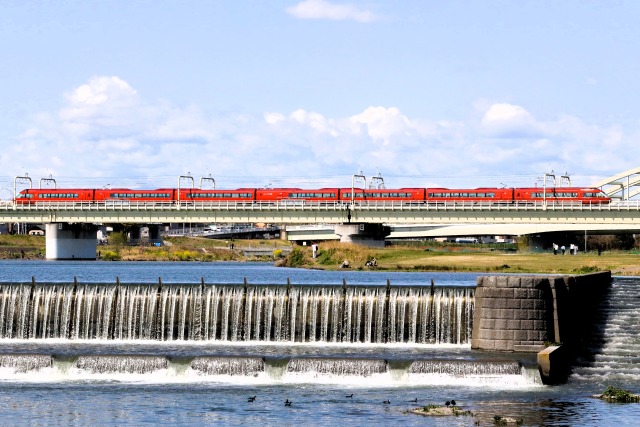
A local train, Set 3657 of Odakyu's 3000 series EMU crossing Tama River

The other day, I headed to the Tama River to take care of a personal errand. When I arrived at my nearest station on the Odakyu Line, I immediately noticed something unusual. Many passengers were standing around the concourse, looking puzzled. Was something wrong? When I checked Odakyu’s website, I finally understood the reason: the trains were heavily delayed.

Did I have no idea what to do?

Please don’t worry—railfans are always optimistic. I quickly changed my mindset, realizing that this was a chance to see some rare railway scenes. The proof is in the pudding. Please take a look at the top photo. It may look like an ordinary photo at first glance, but it is actually quite rare because of the shooting angle.

I took this photo of an all-stop train crossing the Tama River through the window of the last car of an express train standing at Noborito Station. In short, the local train on the local track caught up with the express train on the express track. This rare situation, caused by timetable disruption, made it possible to capture this unusual angle. You may think, “Is that all?”—but I hope you can understand my excitement as a railfan.

By the way, what was my errand at the Tama River? The answer lies in the photo below. I visited the riverside near Noborito Station and enjoyed fossil hunting. My find of the day was a fossil crab (Carcinoplax sp.?), from the Iimuro Formation, which was deposited about 1.3 to 1.1 million years ago. Its long claw is cool, isn’t it?

Once again, I served a double purpose on the Odakyu Line.

A crab fossil (Carcinoplax sp.?) found near Noborito Station

Tuesday, 10 February 2026

2026 Snow Scene on the Odakyu Tama Line

Odakyu 8000 series EMU approaching Haruhino Station against a snowy backdrop

Do you get snow in your country? Here in Japan, it depends on the region.

During winter, mountains block the cold, wet winds blowing from the northwest, which causes heavy snowfall on the Japan Sea side. As a result, only dry air reaches the Pacific side, including the Tokyo metropolitan area, so Tokyo usually enjoys sunny days throughout the season.

However, there are exceptions. When a low-pressure system approaches from the Pacific side, the Tokyo metropolitan area can also experience snowfall. That happened last weekend in Tokyo. It was a difficult time for ordinary people, but for rail fans like me, nothing was more exciting than snowfall. It was a perfect opportunity to take train photos against snowy scenery.

I visited Haruhino Station on the Odakyu Tama Line and waited for trains rushing toward me with snow-covered backgrounds.

Five minutes later, a cream-faced train with a blue stripe emerged from the tunnel. Please take a look at the photo above. That is an 8000 series EMU—how cool! The 8000 series is becoming increasingly rare, as many sets have been scrapped and/or transferred to Seibu Railway. Thank you, 8000 series EMU, for your hard work in this cold weather.

Ten minutes later, the next train came out of the tunnel. Please see the photo below—yes, that is the 4000 series EMU. Nearly nineteen years have already passed since it entered service. Recently, the 4000 series has been operating through onto the JR East Jōban Line via the Odakyu and Tokyo Metro Chiyoda Lines. Thank you for your long service. I think the 4000 series has a great smile in this photo. Or am I just daydreaming?

I fully enjoyed the 2026 snow scene on the Odakyu Tama Line. Being a rail fan is awesome, isn't it?

Odakyu 4000 series EMU approaching Haruhino Station against a snowy backdrop

Friday, 2 January 2026

Return of the Red 1000 Series EMU

Odakyu’s red 1000 series EMU arriving at Iriuda Station on the Hakone Tozan Line

Happy New Year! The year 2026 is finally here. I hope all railfans around the world will enjoy a healthy and peaceful year. As my first update of the year, I’d like to share a little piece of happy news.

The red 1000 series EMU has returned to the Hakone Tozan Line. Please take a look at the photo above. Yes — that’s Odakyu’s red 1000 series EMU on the Hakone Tozan Line. It really stands out with its bright red color.

For those who may not be familiar with it, the 1000 series debuted in 1988 as a commuter train with a stainless-steel body and a neat blue stripe. Later, in 2009, the sets that operated on the Hakone Tozan Line were repainted in red (vermillion)—the traditional color of the line. These red trains sadly disappeared in 2022 when they were retired, but many passengers and railfans continued hoping for their return.

And finally, in November 2025, a brand-new red 1000 series EMU joined the fleet. Odakyu Group plans to introduce four sets—16 cars in total—by March 2026. It’s wonderful to see this symbolic color running through the mountains once again.

In the photo below, you can see set 1066 carefully descending the steep track with the Hakone mountains behind it. It really gives you a sense of how dependable the 1000 series is. I have a feeling this spot will become one of my regular photo destinations this year.

Set 1066 of the red 1000 series descending the steep Hakone Tozan Line

Related link:

Saturday, 27 December 2025

VSE: After That

Odakyu’s 50000 series EMU, Romancecar VSE, preserved on a shunting track

I recently happened to see Odakyu’s Romancecar VSE twice by coincidence. Today, let me share these memorable encounters with you.

Before that, here is just a small introduction to the Romancecar VSE. Odakyu’s 50000 series EMU, also known as the VSE (Vault Super Express), was the flagship model of the Romancecar fleet. It debuted in 2005 as a 10-car train with articulated bogies and quickly became very popular among tourists.

After 17 years of service, the VSE was retired from regular operation in 2022. So, what has it been doing since then?

In November this year, I saw it at Kitami Fureai Hiroba. This public park is built on an artificial deck constructed above Odakyu’s Kitami Railyard. While strolling through the park, I spotted the VSE from one of the viewing points. Please take a closer look at the photo above. You can see a white trainset with a red stripe — the VSE! It was being preserved on a shunting track.

More recently, I saw the VSE again at Odakyu’s Sagami-Ono Railyard when I went shopping. The trainset was on a dismantling siding. Please take a look at the photo below. It had already been separated into sections, and one of its articulated bogies was exposed. I was sad to see the VSE in that condition, but at the same time, I learned a lot from observing the bogie. For example, you can see a pneumatic spring just above the gray pillar. The pneumatic spring of the VSE was installed one meter higher than that of standard trains to enhance ride comfort.

Finally, here is some good news. One of the VSE’s leading cars will be exhibited at the Romancecar Museum in the near future. I’m very much looking forward to seeing it.

VSE on a dismantling siding at Sagami-Ono Railyard

Friday, 12 December 2025

Dual-Gauge Tracks on the Hakone-Tozan Railway

Odakyu 60000 series EMU on the dual-gauge track

Do you have any dual-gauge tracks in your country? Here in Japan, we actually have a few, and every time I come across one, I feel a little spark of curiosity. Today, let me share one such spot with you — a charming dual-gauge section on the Hakone-Tozan Railway in Kanagawa Prefecture.

First, just a small introduction. The Hakone-Tozan Railway is a dependable mountain climber that makes its way up the slopes of Hakone Volcano. It connects Odawara on the Odakyu Line to the terminal at Gōra, covering about 15 kilometers. The entire line is a single electrified track, but what makes it interesting is that the lower half uses narrow gauge (1,067 mm), while the upper half switches to standard gauge (1,435 mm).

And that’s where the dual-gauge section comes in — connecting the lower and upper parts of the line.

If you look at the photo above, you’ll find a three-rail dual-gauge track — quite a sight if you enjoy the technical side of railways. Running on it is a narrow-gauge Odakyu Romancecar, the 60000-series EMU. This train travels directly from the Odakyu Line onto the Hakone-Tozan Line, following the left rail and the inner right rail as it climbs toward Hakone-Yumoto.

Then, in the next photo below, the view becomes even more fascinating. At Iryuda Station’s yard, you can see three types of tracks lined up together: a narrow-gauge track (right), a dual-gauge track (center), and a standard-gauge track (left). There’s also a red, standard-gauge Hakone-Tozan 2000-series EMU resting quietly in the shed.

So the purpose of this dual-gauge stretch is quite simple:

1. to let the narrow-gauge commercial trains pass through, and

2. to give standard-gauge trains a path in and out of the yard when they’re not in service.

For a rail fan like me, small scenes like these always feel like hidden treasures. I can’t help but stop and watch for a moment. Perhaps you feel a little of that excitement too?

Left: standard-gauge, Center: dual-gauge, Right: narrow-gauge

Thursday, 6 November 2025

The 60th Anniversary of Hakone Soba

60th anniversary special menu item of Hakone Soba Restaurant: “Mocoron Soba”

Do railway companies in your country diversify their businesses? In Japan, they certainly do. For instance, many railway companies operate their own department stores along their lines. Another example is the real estate business. The residents living in their housing developments are expected to take the company’s trains to go shopping, commute, and attend school.

This diversification also extends to smaller ventures. Take a look at the photo above — it shows a bowl of Japanese noodles from Hakone Soba, a modest restaurant located inside Shimokitazawa Station on the Odakyu Line. Operated by Odakyu Restaurant System Co., Ltd., a subsidiary of the Odakyu Group, Hakone Soba has grown to more than 40 locations along the line. I love this style of noodles — they’re served quickly, reasonably priced, and, of course, delicious. It’s the perfect stop when I’m in a hurry.

In August this year, Odakyu celebrated the 60th anniversary of Hakone Soba. To mark the occasion, a special menu item was introduced. Look again at the top photo — you’ll notice a semicircular fish cake sitting on the noodles. What’s that? It’s Mocoron!

Mocoron, as you may know, is Odakyu’s cheerful blue rabbit mascot. I was pleasantly surprised to find Mocoron appearing as a topping in this commemorative dish. It was as tasty as it was charming.

And there’s more. The Odakyu Romancecar is also joining the celebration. I spotted a commemorative sticker on the side of Set 30255 of the EMU 30000 series. The entire Odakyu Group seems to be celebrating the 60th anniversary of Hakone Soba together — truly, an “all hands on deck” moment for this beloved brand.

Commemorative sticker on the side of Odakyu Romancecar, EMU 30000 series

Saturday, 25 October 2025

Serving a Double Purpose on the Odakyu Line, Part 2

EMU 1000 (left) and 2000 series (right) running side by side on the Odakyu Line

It’s mid-autumn in Tokyo, and the daytime temperature now hovers around 20 degrees Celsius. The most comfortable season of the year has arrived! I recently visited the Tama River again along the Odakyu Line.

After getting off at Izumi-Tamagawa Station, I headed to the riverbank and focused on searching for fossils—my lifelong passion. Please take a look at the photo below. This was my find of the day: a fossilized Cultellus sp., a large, rectangular marine bivalve. Welcome back to the world above ground after more than a million years of sleep!

Of course, I can’t end without mentioning the railway side of things—this is a railway blog, after all! On my way home, I switched gears to another hobby: trainspotting at Izumi-Tamagawa Station. My theme that day was the “double-double track” (a quadruple track). In 1964, the company planned to expand the double track into a double-double track in the urban area to relieve congestion. Because of the densely built-up surroundings, the project took nearly half a century to complete, finally finishing in 2018.

Today, the inner two tracks are used for limited express and express trains, while the outer two are for semi-express and local trains. Please take a look at the top photo—seeing two trains running side by side like they’re racing is always exciting for rail fans.

That day, I enjoyed both the million-year history of the Earth and the modern engineering of the double-double track in the city. I truly served a “double purpose” that day on the Odakyu Line.

Fossil Cultellus sp. found near Izumi-Tamagawa Station

Friday, 10 October 2025

A Hanging Strap with a Unique Design: Part 2

Mocoron-themed hanging strap in the Odakyu Mocoron Train

I was very surprised when I checked the “Popular Posts of the Last Month” section on this blog. To my surprise, “A Hanging Strap with a Unique Design” was ranked number one. As I mentioned in that post, it was just a “trivial topic” for me, so I was amazed by the result. I always post about what I find interesting, without thinking much about popularity. Even so, it still feels a little strange to me.

Now, this is the second post about the “hanging strap with a unique design". Please take a look at the top photo. I found this strap inside Set 5055 of the EMU 5000 series on the Odakyu Line. It has two small, ear-like protrusions on the top of the ring. Doesn’t it look like someone? … It’s Mocoron!

What is Mocoron?

Mocoron is the mascot character of Odakyu Electric Railway. He (or she) is a blue rabbit who helps promote child-friendly services on the Odakyu Line. Mocoron likes riding trains and is always looking for something fun. Please take a look at the photo below. You can see a stuffed Mocoron sitting in the driver’s cab of Set 5055, which is called the “Mocoron Train”So cute, isn’t it?

By the way, Odakyu has not officially announced where the Mocoron-themed hanging straps are installed. As far as I know, there is at least one strap in each car of the Mocoron Train. I also found some in a few sets of the EMU 8000 seriesIn addition to taking photos of trains or observing their bodies, it might be enjoyable to look for Mocoron straps when you ride Odakyu trains. Trainspotting has many small pleasures, doesn’t it?

Stuffed Mocoron sitting in the driver’s cab of the Odakyu Mocoron Train

Friday, 29 August 2025

Night-time Walk on the Enoshima Line

 EMU Odakyu 30000 series, Romancecar EXE, travels on the Enoshima line

My summer night-time walk continued, with my next destination being Enoshima Island in Kanagawa Prefecture.

As I mentioned before, Enoshima Island is a well-known sightseeing spot in the Tokyo metropolitan area. It is located about 60 kilometers southwest of central Tokyo. One of the island’s most popular seasonal events is the Enoshima Lantern Festival, where visitors can enjoy countless lanterns illuminating streets, parks, and shrines. This year, I visited the festival for the first time in eight years. After strolling around the island, I climbed the Enoshima Sea Candle (Enoshima Observation Lighthouse) and enjoyed a bird’s-eye view of the glowing lanterns (see photo below).

Of course, I can’t finish without mentioning the railway side of things… since this is a railway blog! To reach Enoshima Island, the nearest station is Katase-Enoshima, the terminal of the Odakyu Enoshima Line. Before heading to the island, I did some train photography near the station. My target was the EMU Odakyu 30000 series, Romancecar EXE (Excellent Express). As I wrote before, the EXE is the first multipurpose Romancecar, introduced in 1996. Each trainset can be divided into six- and four-car sections to improve operational flexibility.

This time, I captured a four-car EXE trainset led by its streamlined front car. Finding a good shooting spot can be tricky, especially if I want to shoot in front-light conditions. Fortunately, I remembered the location where I photographed the EMU 60000 series back in March, so I could successfully take this shot as well (see top photo). As a trainspotter, I’m particular about photographing trains I haven’t captured yet. You feel the same way too, don’t you?

Night view from Enoshima Sea Candle (Enoshima Observation Lighthouse)

Official information about "Enoshima Lanterns 2025" by Shonan Fujisawa Revitalization Consortium (in Japanese):

Wednesday, 30 July 2025

EMU "Seibu" 8000 Series: Start of Commercial Operation

Set 8103 of the EMU Seibu 8000 series travels on the Haijima Line

Do you remember when I introduced Seibu Railway’s new train, which had been purchased second-hand from Odakyu Electric Railway? Three months have passed since then, and Seibu has now put this commuter train into commercial operation under the name “Seibu” 8000 series (see the top photo).

Let me first review the history of this train during the Odakyu era. The Seibu 8000 series originally debuted as the EMU “Odakyu” 8000 series in 1983. A total of 32 sets, 160 units, were built by Nippon Sharyo, Tokyu Sharyo, and Kawasaki Heavy Industries. It is the oldest train still operating on the Odakyu line, and is also known as the last steel-bodied commuter train on the line. Incidentally, after renovation, the 8000 series was equipped with a variable frequency drive electric control system.

Forty-one years later, it was decided that seven sets, 42 units in total, of the Odakyu 8000 series would be transferred to Seibu Railway. This helps Seibu reduce the cost of acquiring new trains. In addition, maintenance costs will also be lower, since the 8000 series is already equipped with a variable frequency drive system, which, as you know, reduces electricity consumption.

Lastly, please don’t forget that the EMU Odakyu 8000 series is still in operation on the Odakyu line (see the photo below). This makes railfans like me happy, as we can ride and compare both the Odakyu 8000 and the Seibu 8000 series. I hope both versions of the 8000 series will continue running for as long as possible.

Set 8262 of the EMU Odakyu 8000 series travels on the Odawara Line

Official information about the EMU Seibu 8000 series (in Japanese):

Sunday, 27 July 2025

Seijo Corty: My Neaby Train Observation Deck

View from the train observation deck at Seijo Corty Shopping Mall

I am not a native English speaker, so posting blogs in English is a good opportunity for me to learn a foreign language. I recently learned a proverb: "It’s hard to see what is right under your nose." I’d like to remember this proverb by using a real example.

Last week, I went shopping in Seijo-gakuenmae, my neighborhood. After that, I stopped by the roof garden of the Seijo Corty Shopping Mall. It’s close to my house, but it was actually my first visit. As soon as I arrived at the garden, I found a wonderful train observation deck. I hadn’t realized there was such a nice spot so close to home. “It’s hard to see what is right under your nose.” That’s exactly how it felt.

Enough with the preamble—please look at the top photo. You can see a straight quadruple track on the Odakyu Line. Two trains are running side by side: the EMU Tokyo Metro 16000 series (left) and the Odakyu 8000 series (right). The former is on the express track, while the latter is on the local track. Both shine beautifully in the afternoon sun. Doesn’t it make you excited? Even better, there are comfortable benches surrounded by trees on this deck. Sitting on one of them, I was able to enjoy a relaxing time.

Incidentally, if you have time, please also check out my previous posts about other train observation decks in the Tokyo metropolitan area: ShimogoindenbashiKitatopiaShibuya Hikarie, HorinouchiFuefuki, and so on.

 The roof garden of Seijo Corty Shopping Mall, surrounded by trees

Sunday, 4 May 2025

Two Topics on the Seibu Railway

Test run of the EMU Seibu 8000 series (ex-Odakyu 8000 series)

I’d like to continue with the topic of Seibu Railway today.

I recently visited Tokorozawa Aviation Memorial Park in Tokorozawa City, Saitama Prefecture. I’m not particularly an airplane enthusiast, but I enjoyed visiting the birthplace of Japanese aviation, as it is the site of Japan’s first airfield. On my way home, I switched back to being a trainspotter when I came across an unfamiliar train at Kokukoen (Aviation Park) Station on the Seibu-Shinjuku Line. What was that train?

It immediately rang a bell—I realized I had seen it before: the ex-Odakyu 8000 series! As I mentioned in a previous post, Seibu Railway purchased 100 secondhand train cars from Odakyu Electric Railway and Tokyu Corporation in 2024. These included the EMU Odakyu 8000 and Tokyu 9000 series. Eight months later, the ex-Odakyu 8000 series was modified into the “EMU Seibu 8000 series” and began its test runs. According to Seibu Railway, the reborn 8000 series is scheduled to debut at the end of this month. I can’t wait!

Just after the ex-Odakyu train departed, a yellow-colored train with a special plate on its front arrived at the station. What was that? It turned out to be the special “130th Anniversary of Kawagoe Railway” train. The Seibu-Shinjuku and Kokubunji Lines were originally inaugurated by the Kawagoe Railway in 1895. I found that the anniversary plate was displayed on the front of train set 2065 of the EMU Seibu 2000N series. The round plate was provided by Sayama City for the celebration. Congratulations on the 130th anniversary!

Seibu Railway is full of fascinating topics.

"The 130th anniversary of Kawagoe Railway" train departs from Kokukoen station

Official information about the 130th anniversary of Kawagoe Railway (in Japanese):

Friday, 25 April 2025

2025 Sakura Season on the Gotemba Line

Limited express "Fuji-san (Mt. Fuji)" running on the Odakyu line

The sakura (cherry blossom) season has already passed in Tokyo, but the front line of blossoms is still moving northward across Japan. A person traveling with this “sakura front” could enjoy the flowers for more than two months. The front also climbs into the mountains. I recently visited the foothills of Mt. Fuji in Shizuoka Prefecture.

I got off at Suruga-Oyama Station on JR Central’s Gotemba Line. My destination was Fuji Reien (Fuji Cemetery), where my grandmother’s grave is located. As I approached the cemetery, I was greeted by fully bloomed sakura trees on the mountain slopes. Their light pink blossoms created a vivid contrast with the blue sky and snow-capped Mt. Fuji.

Taking this opportunity, I’d like to give an update on the limited express train Fuji-san (Mt. Fuji) that runs on the Gotemba Line. The Fuji-san departs from Shinjuku Terminal on the Odakyu Line and continues directly onto JR Central’s Gotemba Line. The train used for this service is the EMU Odakyu 60000 series, MSE (Multi Super Express). The MSE normally consists of ten cars, but the formation can be divided into six- and four-car sets for greater operational flexibility. For the Fuji-san service, a six-car trainset is used.

I found a special “Mocoron” sticker on the front of the MSE. Mocoron is Odakyu’s mascot character. The sticker is part of Odakyu’s initiative to support child-rearing. For this purpose, the MSE includes a special lavatory equipped with a baby bed.

Fully bloomed sakura trees and snow-capped Mt. Fuji

Wednesday, 16 April 2025

Serving a Double Purpose on the Odakyu Line

Romancecar "GSE" crossing Odakyu Tama River Bridge

It’s mid-spring in Tokyo, and daytime temperatures are now over 20 degrees Celsius every day. The best season of the year has arrived! I recently visited the bank of the Tama River bank on the Odakyu line.

As soon as I reached the embankment, what caught my eye was a double-double track railway bridge—the Odakyu Tama River Bridge. About five minutes later, my photo target appeared: the EMU Odakyu 70000 series, “Romancecar GSE (Graceful Super Express)”.

GSE is the newest model in the Romancecar fleet. It features upper-deck cockpits, allowing passengers to enjoy the forward view from the very front car. It also has large side windows that provide a clear, wide view of the scenery. The body color of the GSE is called “rose vermilion.”

Please take a look at the top photo—the GSE is crossing the Tama River in the morning sun, under a bright blue sky. Beautiful!

After finishing my train photography, I switched gears to another hobby of mine—fossil collecting. As I’ve mentioned before, it’s been my lifelong passion. This time, my hunting field was the riverbed near the Odakyu Tama River Bridge. In this area, we can observe many fossiliferous beds from the Iimuro Formation, which consists of shallow marine sediments deposited about 1.3 to 1.1 million years ago.

Please look at the photo below—this was my find of the day, a fossilized Fusumagai (Clementia vatheleti). It’s a large, thick, rounded bivalve. Welcome back to the world above ground, after more than a million years!

I truly served a double purpose that day on the Odakyu Line.

Fossil "Fusumagai (Clementia vatheleti)" found near the Odakyu Tama River Bridge

Sunday, 23 March 2025

Advent of Spring on the Odakyu-Enoshima Line

EMU Odakyu 60000 series (4-car trainset) approaching Katase-Enoshima Terminal

The sun is getting stronger in the metropolitan area, and the daytime temperature is now close to 20 degrees Celsius. Winter has gone, and spring is here. I couldn’t stay at home any longer, so I hopped on a train to look for signs of spring. My destination was Katase-Enoshima on the Odakyu-Enoshima Line.

Let me start by briefly reviewing the Odakyu-Enoshima Line. It’s a branch of the Odakyu-Odawara Line, connecting Sagami-Ono—where you can transfer from the main line—and Katase-Enoshima, the gateway station to Enoshima Island. The line was opened in 1929 as a commuter route in the western part of Kanagawa Prefecture, and its total length is 27.6 kilometers.

After arriving at Katase-Enoshima Terminal, I visited Katase Beach, which faces the Pacific Ocean (see the photo below). The beach was filled with young people and families, each enjoying the warm day in their own way. Out on the sea, many surfers were riding the waves. How were the waves, you ask? They looked pretty good!

Before heading home, I enjoyed taking some train photos near Katase-Enoshima Terminal. Please look at the top photo. It shows the EMU 60000 series, Romancecar MSE (Multi Super Express). One MSE trainset usually consists of 10 cars, but it can be divided into 6-cars and 4-cars sets for flexible operation. I’ve already posted many MSE photos on this blog, but this one is a carefully selected shot showing a 4-car MSE trainset led by a streamlined front car. As a trainspotter, I wanted to share a scene you haven’t seen here before.

Katase Beach near Katase-Enoshima Terminal

About the EMU Odakyu 60000 series Romancecar MSE (in Japanese):
About Romancecars in general (in English):

Sunday, 26 January 2025

Timetable Disruption on the Odakyu Line

Platform display at Chitose-Funabashi station on the Odakyu line

The other day, I headed to Shinjuku to take care of some personal business. When I arrived at my nearest station on the Odakyu Line, I immediately noticed something unusual. Many passengers were standing around the concourse, looking puzzled. Was something wrong?

When I looked up at the platform display, I finally understood the reason. Please take a look at the top photo. The trains were heavily delayed. It was already past 11 o’clock, yet the train scheduled to leave at 9:43 had not even arrived at the station. To make matters worse, the next train’s destination wasn’t Shinjuku but Kyodo — just one station away. Due to a signal system malfunction, train service between Kyodo Station and Shinjuku Terminal had been suspended.

But please don’t worry — railfans are always optimistic! I’m one of them, too. I quickly changed my mindset and decided to make the best of the situation. First, I took a photo of the platform display showing the rare destination “Kyodo.” Then I moved on to Kyodo Station, looking for more unusual scenes. Please take a look at the photo below. It might look ordinary at first glance — an Odakyu 3000 series EMU running on the track — but for me, it was a little treasure. The train was switching from the express track (on the left) to the local track (on the right), a sight I rarely see at this station.

I couldn’t finish my personal business as planned that day, but I was satisfied — after all, I got to witness some rare and fascinating railway scenes.

Odakyu 3000 series EMU changing tracks at Kyodo station

Tuesday, 17 December 2024

Marginal Section on the Yokosuka Line

EMU JR East E235-1000 series, 4-car train, running on the Yokosuka Line

The JR East Yokosuka Line is one of the longest commuter routes in the Tokyo metropolitan area, stretching about 70 kilometers. Many trains continue directly onto the Sōbu Rapid Line via Tokyo Station and head toward destinations such as Chiba, Kimitsu, and Narita Airport.

The other day, I boarded a southbound Yokosuka Line train at Tokyo Station. It first traveled along the underground section beneath the densely built-up central area. My train consisted of 15 cars, including two Green Cars (first-class cars). After emerging from the tunnel, it ran through the urban business and residential districts in Tokyo Metropolis and Kanagawa Prefecture—still with its 15-car formation.

However, after leaving Zushi, the train entered the countryside along the line’s marginal section. My train was now made up of only 4 cars. Farmland and forest spread out along the tracks. I got off at Higashi-Zushi Station and enjoyed the beautiful autumn leaves along the line (see the top photo). The marginal section of the Yokosuka Line offered a very relaxing atmosphere.

Incidentally, I witnessed a rare scene at Zushi Station on my way home. Odakyu’s new train, Set 5064 of the EMU 5000 series, was standing in the station yard. Set 5064 had just been completed and was on its delivery run from the J-TREC Yokohama Factory to a railyard on the Odakyu Line via JR East tracks. I was very lucky, so I photographed it together with JR East’s EMU E235-1000 series (see the photo below).

Set 5064 of the Odakyu EMU 5000 series (right) at JR East Zushi Station

Monday, 2 September 2024

Sunflower Festival on the Odakyu Line

EMU Odakyu 8000 series stands at Sobudaimae station

It's September already. Time really flies. Before introducing the topics of autumn, I'm going to keep on subjects of this summer a bit more.

Sunflower festivals are popular midsummer events in Japan. Many flower lovers flock to the festival venues. I’m also one of them. This year, I went to check out the sunflower festival of Zama City in Kanagawa Prefecture with my family. In the festival ground, nearly 550,000 flowers were blooming along Sagami River. It was very vivid and gorgeous. Whenever I visited sunflower festivals, I feel strange mood while I walk in the field. To be exact, I feel many eyes watching me. It’s because all the flowers face me. A round shaped sunflower looks like someone's face. Probably, I’m spaced out.

To visit this beautiful sunflower field, we took the Odakyu line, and got off at Sobudaimae station. It took about 50 minutes from Shinjuku, a subcenter of Tokyo. Taking this opportunity, I’m going to show you the EMU 8000 series, the active oldest commuter train on the Odakyu line. The 8000 series is a fully painted steel body train. It was commissioned in 1982 to replace old commuter trains such as the 2600 series. Its clean and beautiful body hasn't faded despite 42 years having passed by. As I recently posted, 40 units of the 8000 series are being transferred to Seibu Railway, another major private railway in Tokyo starting this year. The history of this experienced Odakyu train will keep going on.

Zama Sunflower Festival