Tuesday, 31 January 2017

Yellow Paradise Train on the Sunzu Line

Set 1301 of the EMU Izu-Hakone Railway 1300 series travels on the Sunzu Line

I visited the Sunzu Line of Izu-Hakone Railway for the first time in four years. The Sunzu Line is a local route operated by Izu-Hakone Railway in Izu Peninsula, which is located about 120 km southwest of Tokyo. What was the news with this local railway?

It was a beautiful and sunny day. The train on the Sunzu Line was also beautiful. I found a unique yellow colored EMU (electrical multiple units) running on the track. It was set 1301 of the 1300 series from Seibu Railway. The 1300 series was originally built by Tokyu Sharyo in 1979, under the name of the EMU Seibu 101 series. Two sets, six units of the 101 series were, then, transferred to the Sunzu Line of Izu-Hakone Railway in 2008 having changed their name to the EMU 1300 series. Among the two sets of the 1300 series, set 1301 recently returned its body color to yellow, which was the original color in the Seibu era. Izu-Hakone Railway calls it the Yellow Paradise Train.

In this season, it stays fine for many days in the Tokyo metropolitan area, as the northern mountains block the wet and cold northwest wind. I could take pictures of the running Yellow Paradise Train backed by snow-capped beautiful Mt. Fuji near Daiba Station. It was the gently curved track and best position for rail photographers. It was a great success and it was worth coming all the way to the Sunzu Line.

Set 1301 of the EMU Izu-Hakone Railway 1300 series travels on the Sunzu Line

Saturday, 28 January 2017

Tokyo Night Walking: 2017 Shinjuku "Minamillumi"

Set G6+G7 of the EMU JR East 485 series, Hana (flower), stands at Shinjuku Station

Following the Shibuya Blue Cave, I am going to show you the other winter illuminations in Tokyo today.

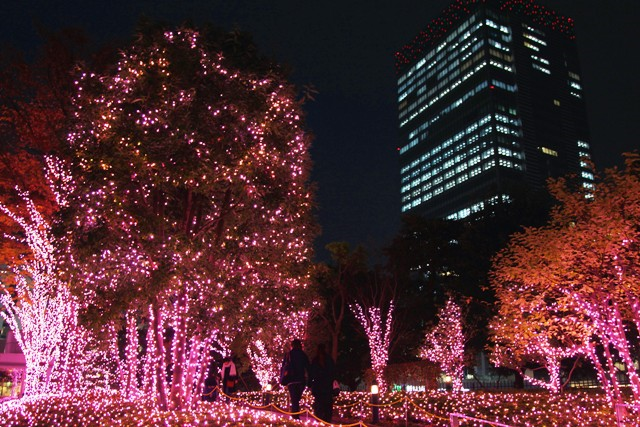
Shinjuku is the world's largest railway station. Trains of five companies and one public corporation arrive at and leave this giant terminal. The ridership of Shinjuku is 3.5 million passengers per day. In this season, the passengers can see beautiful street illuminations, which are called Minamillumi, in the southern side of the station. This year, the trees on the street were decorated with pink colored LED lights. The street was all pink. I saw many couples, groups and families enjoying walking under the millions of lights. 

On the way back home, I found a Hana train standing at Shinjuku Station. Hana (flower) is one of the "ozashiki trains" operated by JR East. Its formal name is set G6+G7 of the EMU 485 series, which belongs to JR East Oyama Rail Yard. It is a 6-car AC-DC dual electric system train. The interior of Hana is arranged as a Japanese-type room. The floor is straw-matted with Japanese style low tables so that the passengers are relaxed taking off their shoes as if they are at home. Hana is usually operated as a chartered train to go to and from resort areas. For instance, I once came across Hana train at Ootsuki Station, which was closed to Mt. Fuji, a famous resort area in the western suburb of Tokyo.

Looking at the fantastic street illuminations and the rare ozashiki train, I enjoyed winter night walking in Shinjuku.

Street illuminations, "Minamillumi", near Shinjuku Station

Wednesday, 25 January 2017

Tokyo Monorail Update: New Color of the 1000 Series

1091F of the EMU Tokyo Monorail 1000 series (new color) arrives at Shin-seibijo Station

I visited Tokyo Monorail for the first time in two years. Time really flies! When I visited there last time, the company was celebrating the 50th anniversary of the Haneda Airport Line. They had just launched the new model, the EMU 10000 series.

What was the news with Tokyo Monorail this time? The company has started the renovation of the old models, namely the EMU 1000 and the 2000 series. As a result, we can see many new colored trains on the line. Please look at the photos. They are the 1000 series after renovation. You can see the white colored bodies with light green, light blue and the dark blue colored doors. The roofs are painted the same colors as the doors. It would be beautiful, if you saw them from high-rise buildings. The interior of the 1000 series was also renovated. The seat colors have been changed to the same colors as the doors. The floor has also been changed to a greyish soft color.

In the meantime, Tokyo Monorail changed their timetable on December 17th. The main point was that the standard travel time between Hamamatsucho and Haneda Airport Terminal 1 was cut by one minute (from 17 to 16 minutes) by Haneda Express train. Only one minute... but, it is important for the company, because Tokyo Monorail faces fierce competition from Keikyu Line on the airport access route from the downtown Tokyo area. As a passenger, I welcome this kind of competition, as long as safety is assured.

1043F of the EMU Tokyo Monorail 1000 series (new color) travels on the Haneda Line

Official guide of Tokyo Monorail:
Official Gallery of Tokyo Monorail (in Japanese):

Sunday, 22 January 2017

Heritage Electric Car on the Jomo Line

Electric car DeHa101 of the Jomo Electric Railway DeHa100 series

Jomo Electric Railway is a small local company in Gumma Prefecture. The company has the Jomo Line, which connects Chuo-Maebashi, the main city of the prefecture and Nishi-Kiryu, the city well known for its textile industry. The route length of the Jomo Line is 25 km. The track is single and electrified. The gauge size is 1,067 mm. The electric system is 1,500 V DC overhead.

Jomo has two kinds of passenger cars. One is the EMU 700 series, come from the Keio-Inokashira-Line. The other one is an electric car, DeHa101 of the DeHa100 series, which has been operated on the line since 1928. What a longevity car it is! Because of advanced age, DeHa101 usually sleeps in Oogo Rail Yard. We seldom see it, when it is running.

Celebrating the New Year, a special operation of DeHa101 was conducted on January 3rd. I rushed over to Oogo Rail Yard, and observed this classic car for the first time. The chocolate colored body with a rounded roof, three front windows and a large single front light was very cool. The trucks were classical, but looked very sturdy. They were so-called KO-type bogies with advanced coil springs built by Kawasaki-sharyo. DeHa101 left Oogo Station at 12.34, and headed to Chuo-Maebashi. I was proactive to move to the main track, and shot the running DeHa101 in the falling light. That was a great success.

DeHa101 is designated Modernization Heritage by Gumma Prefecture, and is a great prefectural asset.

Electric car DeHa101 (left) and DeHa104 (right, preserved car, not for commercial operation)

Official information about Jomo Electric Railway:
Official information about DeHa 101 (in Japanese):

Thursday, 19 January 2017

Gateway Station to the Dream World: Part 2

Concourse of Keio-Tama-Center Station

I visited Keio-Tama-Center Station for the first time in half a year. What was the news with this unique station?

Before showing the changes of the station, let's review Keio-Tama-Center Station. Keio-Tama-Center is known as the nearest station to Sanrio Puroland, which is an indoor theme park operated by Sanrio Entertainment Company. Many kids, mainly girls, visit this dream world to meet with popular mascots such as "Hello-Kitty". It is precious income for the railway company to transport passengers to and from Sanrio Puroland.

Currently, Keio-Tama-Center functions as a "welcome station" to Sanrio Puroland. For instance, station name plates and station clocks were replaced by lovely ones with Sanrio mascots. The ceiling of the station concourse was also replaced very recently by a colorful one with Sanrio mascots. I also found many Sanrio mascots on the platforms such as elevators, handrails and displays of boarding positions to trains.

For your information, Keio-Tama-Center Station was opened in 1974, when the Keio-Sagamihara Line was extended from Keio-Yomiuri-Land to Keio-Tama-Center. The station was constructed in the center of Tama New Town, which was jointly developed by the central government and the Tokyo metropolitan government to solve the increase of the population. It is located about 30 km west of Shinjuku, a giant sub-center of Tokyo Metropolis. It is about half an hour's ride from Shinjuku by limited express train.

Keio-Tama-Center keeps on evolving as a gateway station to the dream world.

Elevator of Keio-Tama-Center Station