Tuesday, 30 June 2020

EMU Hokuso 7300 Series: Keisei's Sister Train

7308F of the Hokuso 7300 series arrives at Higashi-Matsudo station    

Hokuso is a local railway company in Chiba Prefecture. It belongs to the Keisei Group. Keisei Electric Railway Company holds the majority of Hokuso's stock.

The EMU Hokuso 7300 series is one of the main fleets on the Hokuso line. It was launched in 1991, when the section between Keisei-Takasago and Shin-Kamagaya was inaugurated. Two sets, eight units, were built by Tokyu Sharyo and Nippon Sharyo. The 7300 series is a sister train of the Hokuso 7800 series, the Chiba Newtown Railway 9800 series and the Keisei 3700 series. In other words, these four models have basically the same technical specifications. They have stainless steel bodies with the same designs. They have a GTO-VVVF (GTO-variable frequency drive) inverter electric control system with 130kW induction motors.

The Hokuso 7300 series, 7800 series and the Chiba Newtown 9800 series are 8-car trains with four motorcars (6M2T); meanwhile, the Keisei 3700 series is a 6-car train with two motorcars (4M2T). The Hokuso 7300 series is their own rolling stock; meanwhile, the 7800 series is a rental train from Keisei Electric Railway.

Incidentally, Hokuso was established in 1972 for the carriage of the Chiba Newtown residents. The route extends to the western part of Chiba Prefecture including Chiba Newtown. Connecting Keisei-Takasago and Imba-Nihonidai stations, its route length is 32.3 kilometers including Chiba Newtown Railway line. The track is double and electrified. The gauge size is 1,435 millimeters. The electric system is 1,500 V overhead. Hokuso trains are directly operated onto the Keisei, Toei-Asakusa and Keikyu lines.

7308F of the Hokuso 7300 series leaves Higashi-Matsudo station   

Friday, 26 June 2020

Hydrangea Footpath on the Joban Line

Set K426 of the EMU JR East E531 series travels on the Joban line

Hinuma is a brakish lake located about 120 kilometers northeast of Tokyo. Large-sized Shijimi clams are a noted product in the lake, but it's not everything. On the coast of the lake, we can see hydrangea flowers in this season. The hydrangea footpath is open in Hinuma Natural Park. Visitors can enjoy over 30 species, 10,000 of the flowers along the footpath. I like Oak-leaved hydrangea (Hydrangea quereifolia or "snow flake") best. As its name suggests, it has oak-shaped leaves and pure white petals.

To visit Lake Hinuma Natural Park, the nearest station is Mito on the JR East Joban line. The EMU E531 series is the main fleet on the line. It was launched in 2005 to replace decrepit old trains such as the EMU 403 and 415 series. 460 cars in total were built by Tokyu Sharyo, J-TREC, Kawasaki Heavy Industries and JR East Niitsu Factory. The E531 series is an AC-DC dual system train consisting of ten cars (four motorcars and six trailers) in the main sets with five cars (two motorcars and three trailers) in the subsets. The gleaming stainless steel body with a dark blue colored stripe is an outward characteristic of the E531 series. In terms of the technical specifications, a maximum speed is 130 kilometers per hour. The IGBT-VVVF (Insulated Gate Bipolar Transistor - variable frequency drive) inverter electric control system with induction motors is on board.

I enjoyed the beautiful hydrangea footpath and the AC-DC dual system train on the Joban line.

Hydrangea Footpath in Lake Hinuma Natural Park

Tuesday, 23 June 2020

EMU 80000 Series: New Model on the Shin-Keisei Line

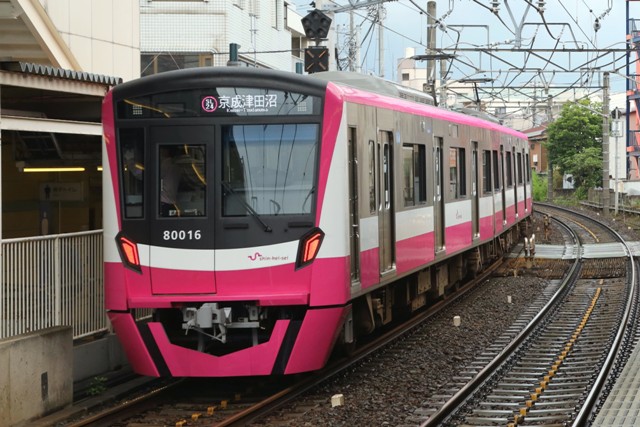
80016F of the EMU Shin-Keisei 80000 series arrives at Minoridai station

Shin-Keisei (New Keisei) Electric Railway launched their new commuter train, the EMU 80000 series, for the first time in 14 years. The first set named 80016F was built by Nippon Sharyo, and launched on December 27th, 2019.

The 80000 series is a sister train of the EMU Keisei 3100 series, which was also launched in 2019. Shin-Keisei is an affiliate firm of Keisei Electric Railway Company. The two companies introduced similar models around the same time to save the development and manufacturing costs. The 80000 series and the 3100 series have the same stainless steel bodies with the same designs. Both the 80000 series and the 3100 series have brand new SiC-VVVF (silicon carbide-variable frequency drive) inverter electric control systems. The new system on the 80000 series comes with a nineteen-percent improvement in its electric power consumption performance over the previous IGBT-VVVF inverter electric control system on the Shin-Keisei N800 series.

On the contrary, the specifications of the above two models are slightly different. The Shin-Keisei 80000 series is a 6-car train consisting of four motorcars and two trailers; meanwhile the Keisei 3100 series is an 8-car train consisting of six motorcars and two trailers. The former has flip-up type luggage storage on each car and a free Wi-Fi system on the train; meanwhile the latter doesn't have those. The former has Mitsubishi's 155kW induction motors; meanwhile, the latter has Toyo's 140kW induction motors.

Shin-Keisei plans to introduce the second set of the 80000 series in the fiscal year 2021.

80016F of the EMU Shin-Keisei 80000 series leaves Minoridai station

Official information about the trains on the Shin-Keisei line (in Japanese):

Saturday, 20 June 2020

Revisit to the Gorgeous Iris Garden on the Keisei Line

3006F of the EMU 3000 series travels on the Keisei line

The Japan Meteorological Agency made an announcement that this year's rainy season started on June 11th in Tokyo. It's a gloomy hot and humid period for Tokyoites before midsummer, but it's a pleasure to see some of the beautiful flowers, which only bloom in this season.

The iris is a typical flower that blooms during the rainy season in Tokyo. Large colorful flowers attract millions of gardeners and flower lovers. My favorite is the bluish purple (Edo-murasaki) colored blossom. It's gorgeous and elegant. I recently visited the famous Horikiri Iris Garden for the first time in eight years. Admission to the Horikiri Iris Garden is free, as it's operated by the very generous Katsushika Ward Office... thank you. I saw many people wearing masks to prevent the spread of the coronavirus, which was new in 2020.

To get to this gorgeous garden, the nearest station is Horikiri Shobuen (Horikiri Iris Garden) on the Keisei line. I enjoyed taking photographs of the Keisei trains such as the EMU 3000 series on the way back home. The 3000 series is Keisei's standard commuter train, which was launched in 2002. Forty-eight sets (326 cars) were built by Nippon Sharyo, Tokyu Sharyo, and J-TREC between 2002 and 2019. The 3000 series has an IGBT-VVVF (Insulated Gate Bipolar Transistor - variable frequency drive) inverter electric control system with 125 kW induction motors. The EMU Shinkensei-N800 series, Hokuso 7500 series, and Chiba New Town Railway 9200 series have the same technical specifications as the Keisei 3000 series.

Horikiri Iris Garden near Horikiri Iris Garden station on the Keisei line

Official information about the Keisei trains (in Japanese):
Outline of Keisei Electric Railway:

Wednesday, 17 June 2020

Kanahei Poster Train on the Seibu-Shinjuku Line

40152F of the EMU Seibu 40000 series, Kanahei poster train, travels on the Shinjuku line

As I posted before, Tobu Railway launched a special poster train on their Tojo line to promote tourism to the sightseeing spots in Kawagoe City. Tobu's rival, Seibu Railway, can't keep their arms crossed in this condition. On March 14th this year, Seibu Railway also launched a special poster train (Kanahei poster train) on their Shinjuku line to promote tourism to Kawagoe City.

Seibu offered one set of their 10-car train, 40152F of the EMU 40000 series, for the Kanahei poster train. A famous cartoonist, Kanahei, designed the bodies of the train. We can see many of Kanahei's animal characters and Kawagoe's historic spots in the design. The 40000 series is Seibu's high-end commuter train launched in 2017. A total of 6 sets, 60 units, were built by Kawasaki Heavy Industries from 2017 to 2020. The first batch 4 sets have multi-purpose seat, which the conductor can change from long seats to cross seats using a remote control; meanwhile, the second batch 2 sets, including 40152F (Kanahei poster train), have long seats only. All 40000 series trains have a special space, "partner zone", for wheelchairs and pram users in car number 10.

Incidentally, Kawagoe is a historic city about 40 kilometers northwest of Tokyo. There are many old houses, shops, and ex-local government offices along the streets in the downtown area. To get to Kawagoe from Tokyo, we can choose from three routes, namely the JR East-Kawagoe, Tobu-Tojo or Seibu-Shinjuku lines. As a passenger, I welcome three companies' competition.

"Partner zone" and the interior of the EMU Seibu 40000 series

Seibu's official information about the Kanhei poster train (in Japanese):
https://www.seiburailway.jp/news/news-release/2019/20200312kanahei_kawagoecampaign.pdf
Kanahei's official information about the Kanahei poster train (in Japanese):
https://kanaheis-small-animals.jp/news/2020/03/119/
Official information about the EMU Seibu 40000 series (in Japanese):
https://www.seiburailway.jp/fan/zukan/40000/index.html