Friday, 5 November 2021

Hakone Ropeway: Update

Hakone Ropeway

After getting off the Hakone Tozan Cable Car, I stopped by Sounzan station on the Hakone Ropeway after a long absence. Hakone Ropeway is a gondola lift opened in 1959. Connecting Sounzan and Togendai, its total operating length is 4.05 kilometers. The height difference between the lowest and the highest points is 303 meters. The route is currently divided into two sections, so, the passengers have to change the cabin at the intermediate Owakudani station. The operating system of Hakone Ropeway is "Funitel", which has two arms attached to two parallel overhead cables, providing more stability in high winds. Hakone Ropeway is officially recognized in the Guinness Book of World Records as the busiest aerial lift, since two million passengers per year are on board.

What's new with Hakone Ropeway? The company plans to replace the gondolas. The new gondolas will be TARIS built by CWA in Switzerland. TARIS is larger than that of the present gondola. It also has a wider door; thus, passengers can ride on or off safely and easily. Although it's delayed further than the first plan probably because of the COVID-19 calamity, I hope that the new gondolas will be commissioned soon.

Now is the time when we are getting deeper into autumn in the Hakone Mountains. I then visited Shissei-kaen (Botanical Garden of Wetlands) located in the northern part of Hakone. The forest and mountain around the Shissei-kaen glowed red, yellow and brown. It made a nice contrast with the blue sky.

Autumn colors in Shissei-kaen

Official website, Hakone Ropeway:

Monday, 1 November 2021

New Model on the Hakone Tozan Cable Car Line

Funicular set 01 (Ke11 and 21) travels on the Hakone Cable Car line

The state of emergency caused by the new corona virus has been lifted. I tasted a sense of freedom, and visited Hakone Cable Car line for the first time in nine years. What's new with this famous funicular railway?

I found the 5th generation new cable cars named set 01 and 02 on the track. They were launched in March last year to replace the 4th generation ones namely set HT1 and HT2. Just like the 4th generation model, the new model is also a 2-car train to transport flocking sightseers. Thanks to the mass transit vehicles, one train can accommodate 250 passengers. These new cars were built by Keio Juki and Von Roll Holding AG in Switzerland. The motor output for the operation is 230 kW. What's the major difference between the 4th generation retired model and the 5th generation new one? The answer is the layout of passenger seats. The retired model has cross seats; meanwhile, the new model has long seats. It's probably to reduce in-vehicle overcrowding.

For your information, the Hakone Cable Car line was opened in 1921, so, this is the 100th anniversary. Connecting Gora and Sounzan, the route length is 1,273 meters. The track gauge size is 983 mm. The height difference is 209 meters and the maximum inclination is 18.3 degrees. It takes 10 minutes from Gora to Sounzan station. One of the features of this funicular is 4 intermediate stations, which are not only for sightseers but also for local residents.

Funicular set 02 (Ke12 and 22) travels on the Hakone Cable Car line

Official website, Features of Hakone Tozan Cable Car:
Official information, the rolling stock of Hakone Tozan Cable Car (in Japanese):

Thursday, 28 October 2021

EMU Sotetsu 8000 Series: Update

Set 8711 of the EMU Sotetsu 8000 series arrives at Izumino-chuo station

After all the EMU 7000 series trains' retirement in November, 2020, the EMU 8000 series became the elder group of trains on the Sagami Railway (Sotetsu). Today, let me update on how the 8000 series is going.

In the first place, retirement of the 8000 series has started one by one. 4 sets, 40 cars in total, have already disappeared from the track. These 8000 series trains have been replaced by the new models, namely the 12000 and 20000 series. Sotetsu plans to decommission a total of seven sets (set 8701 to 8707) of the 8000 series within a few years. The next generation is already gaining power.

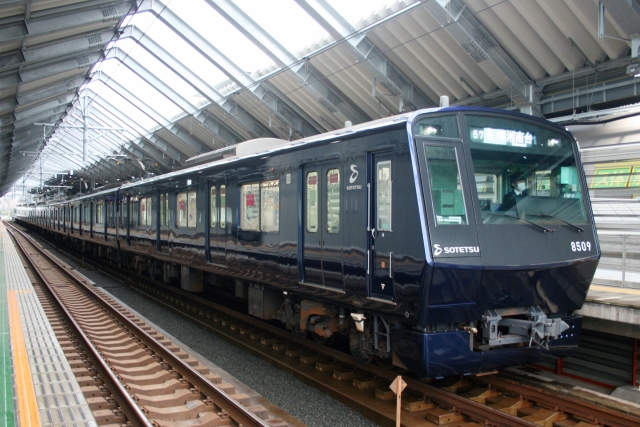
Secondly, the renovation of the 8000 series has started in parallel. Set 8709 became the first renovated 8000 series train. Its body color was changed to "Yokohama navy blue". The position of the front light was moved from the lower to the upper part. The passenger seats were also changed. The trains that the renovation applies to are 6 sets (set 8708 to 8713), which were built after 1994.

For your information, the 8000 series was commissioned in 1990. 13 sets, 130 cars in total, were built by Hitachi from 1990 to 1999. As a rail fan, I like the 8000 series because there are cross seats in the train. Although it's a commuter train, we can enjoy the atmosphere of the holiday tour sitting in the comfortable cross seats. It's a brief refreshing time for busy urban commuters.

Set 8709 (after renovation) of the EMU Sotetsu 8000 series

Official Sotetsu train picture book (machine translation):

Sunday, 24 October 2021

EMU Sotetsu 10000 Series: New Color

Set 10701 of the EMU Sotetsu 10000 series arrives at Hoshikawa station

I recently visited Yokohama City, as something came up. After finishing my meeting, I took a detour on my way back home, and enjoyed Sagami Railway (Sotetsu) for a while. It's been one and a half years since I last took the Sotetsu line. What's new with Sotetsu?

I came across a renovated train, set 10701 of the EMU 10000 series. It used to be a silver-colored train with blue and orange-colored stripes, but it has become ultramarine-colored (so-called Yokohama Navy blue-colored). Look closely, I also found that the position of the front lights had been moved from the lower to the upper part of the face following recent trends. In addition, I was surprised that the renovation had been conducted by JR East Nagano factory... not by Sotetsu's factory. It's probably because the 10000 series has the same specifications as those of the JR East E231 series.

This renovation was one of Sotetsu's projects to enhance the "company brand strength". Many railway companies in the Tokyo metropolitan area are in competition to attract passengers. It might be hard to imagine for foreigners, but I expect you understand that the railway network in the metropolitan area is dense, so, it allows the passengers to choose the best route to get to their destination.

For your information, the Sotetsu 10000 series was launched in 2002 to replace old models such as the 6000 series. 8 sets, 70 cars in total, were built by Tokyu Sharyo and JR East Niitsu factory.

Set 10701 of the EMU Sotetsu 10000 series stands at Hoshikawa station

Sotetsu official website (machine translation):
https://www.sotetsu.co.jp/?wovn=en
Official information about the EMU 10000 series, New Color (in Japanese):

Wednesday, 20 October 2021

An Old Sluice on the Keikyu Line

Set 1508 of the EMU Keikyu 1500 series travels on the Daishi line 

It's late-October already. Time really flies. The maximum daytime temperature is around 20 degrees Celsius... very pleasant season. I went for a walk along to the Keikyu line with the warm autumn sun on my back.

I found an old water gate named Kawasaki-kakoh Sluice located at the Tama River. It was built by the ex-Home Ministry in 1928 based on the canal and harbor project plan drawn up at that time. This gargantuan development project was unfortunately stopped due to WWII, but the sluice was preserved. It's valued architecture, and designated as National Registered Cultural Properties in 1998. We can see eye-catching stone carvings of local fruits such as pears, grapes and peaches on the top. The design of the sluice shows a lot of playfulness and humor.

To get to Kawasaki-kakoh Sluice, the nearest station is Minatocho on the Keikyu-Daishi line. The Daishi line is a short branch line. Connecting Keikyu-Kawasaki and Kojima-shinden stations, the route length is only 4.5 kilometers. The main fleet on the line is a 4-car train, the EMU 1500 series. 166 cars in total were built by Tokyu Sharyo and Kawasaki Heavy Industries from 1985 to 1993. The specifications of the early 5 sets (20 cars) are rather old, as they have steel bodies and DC motors with a field chopper control system. They are the oldest active group of the Keikyu trains, and mainly operated on the Daishi line.

I enjoyed the old sluice and the oldest train on the Keikyu-Daishi line.

Kawasaki-kakoh Sluice

Official information about the Keikyu trains (in Japanese):