| EMU Kintetsu 3220 series stands at Karasuma-Oike station |
| EMU Kintetsu 3200 series leaves Gojo station on the subway Karasuma line |
| EMU Kintetsu 3220 series stands at Karasuma-Oike station |
| EMU Kintetsu 3200 series leaves Gojo station on the subway Karasuma line |
| EMU 10 series stands at Kyoto station on the subway Karasuma line |
Osawa pond in Daitoku-ji temple Official information about the EMU 10 series on the subway Karasuma line, part 1 ( in Japanese): Official information about the EMU 10 series on the subway Karasuma line, part 2 ( in Japanese): |
EMU JR Central N700S series stands at Tokyo station |
| Logo of the EMU JR Central N700S (Supreme) series |
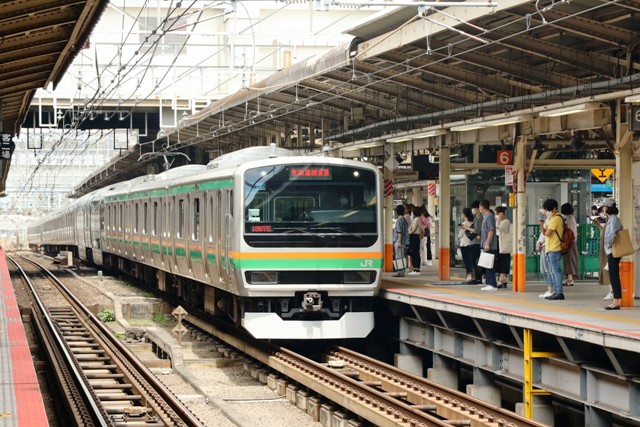
EMU JR East E231 series arrives at Yokohama station |
The EMU E231 series is one of the major group trains on the JR East lines, and widely operated in the Tokyo metropolitan area. It was launched in 2000 to replace the old models such as the 103, 115, 201 and 205 series. A total of 2,736 cars were built by Tokyu Sharyo (present J-TREC), Kawasaki Heavy Industries and JR East Niitsu Factory from 2000 to 2011. There are two types of E231 series. One is a commuter train type, and the other is a suburban train type. Here, I'm going to explain the latter in this post
The suburban train type of the E231 series was launched in 2000 on the Tohoku main line. Different from the commuter train type, it has 6 doors per unit. The suburban type train consists of a 10-car main set and a 5-car additional set. In other words, it's operated as a 15-car set (a 10-car main set coupled with a 5-car additional set) or 10-car set (a 10-car main set alone). All trains belong to Oyama Railyard on the Tohoku main line or Kohzu Railyard on the Tokaido main line.
The bodies are stainless-steel, with orange and green-colored stripes. The main set has two double-decker Green Cars (first class cars). With regard to the technical specifications, the suburban type of the E231 series has IGBT-VVVF (Insulated Gate Bipolar Transistor-variable frequency drive) electric control and regenerative braking systems. The traction motor is type MT73 induction motors that generate 95 kilowatts of electricity.
| EMU JR East E231 series travels on the Yokosuka line |
There are many railway companies in the Tokyo metropolitan area. These companies are in competition to attract passengers. It might be hard to imagine for foreigners, but I expect you understand that the railway network in this area is quite dense, so, it allows passengers to choose the best line to get to their destination.
Keikyu is one of the major companies in the Tokyo metropolitan area. They have an 87 kilometers line network in the southern part of the region. This company faces fierce competition from Tokyo Monorail Company on the route between downtown Tokyo and Tokyo International (Haneda) Airport. Furthermore, Keikyu is also exposed to competition with JR East on the section between downtown Tokyo and Yokohama station. The important factors are fares, speed and passenger services.
In 1994, Keikyu launched a new train, the EMU 600 series, to improve their passenger services. The 600 series is a commuter train, but it has comfortable cross seats in the cabin to provide passengers with good services. 14 sets (88 cars) were built by Tokyu Sharyo and Kawasaki Heavy Industries from 1994 to 1996. The body is aluminum alloy and painted with red and cream colors. With regard to the technical specifications, the 600 series has a GTO-VVVF inverter (variable frequency drive) electric control system with 120 or 180 kW induction motors. The 600 series is directly operated onto the Toei-Asakusa, Keisei, Hokuso and other lines.
The EMU 600 series opened a new era on the Keikyu line.
| Set 654 of the EMU Keikyu 600 series leaves Shinagawa station (July, 2014) |