Thursday, 30 December 2021

The Nagareyama Line: Update, Part 2

Mix colored Ryutetsu train, KuMoHa 5003 (red) + KuMoHa 5105 (yellow)

Let me continue where I left off my last post.

I'm going to introduce the rolling stock on the Ryutetsu Nagareyama line in more detail. The EMU 5000 series is the sole model operated on the line. It's the ex-Seibu New 101 series, and moved to Ryutetsu in 2010. Five sets in total belong to Nagareyama Rail Yard. Each set has a different base color. They are pink (set 5001, "Sakura"), orange (set 5002, "Ryusei"), red (set 5003, "Akagi"), light-green (set 5004, "Wakaba") and yellow (set 5005, "Nanohana"). One set is composed of two 20 meters-long motorcars. They are Class KuMoHa 5000 and KuMoHa 5100. Class KuMoHa 5000 has two pantographs and rheostatic controllers; meanwhile, Class KuMoHa 5100 has a motor generator and a compressor. Each car has four 150 kW DC motors. All sets have been modified to meet a driver-only operation, as conductors are not on board on Nagareyama line trains.

In the meantime, I found a mixed-colored train by chance. It's a combination of a red car (KuMoHa 5003) and a yellow car (KuMoHa 5105). According to several rail fans' sites, KuMoHa 5005 of the set 5005, "Nanohana", broke down during operation on November 22nd this year. The combination of the red and the yellow car may be a temporary solution to cope with the car trouble. Although it's a cursed nuisance for Ryutetsu railway engineers, I was happy to see this kind of rare train as a trainspotter. Trainspotters are troublesome creatures.

Mix colored train of the EMU Ryutetsu 5000 series stands at Mabashi station

Tuesday, 28 December 2021

The Nagareyama Line: Update

Set 5002, "Ryusei" of the EMU Ryutetsu 5000 series

The end of the year is coming soon. Time really flies. The spread of COVID-19 is lessening in Japan, so, I recently visited the Ryutetsu Nagareyama line for the first time in seven years. What was new with this local route?

Before getting down to the main topic, let me quickly review the Nagareyama line. It's a short private railway operated by Ryutetsu company in Chiba Prefecture, about 20 kilometers northeast of Tokyo. Its route length is 5.7 kilometers between Mabashi and Nagareyama stations. Nagareyama has been developed as a center of an inland water transportation system since the 18th century, and changed to a commuter city in the 1970s. The route was opened in 1916 by Nagareyama Light Railway Company (present Ryutetsu Company). Passengers are commuters and students who go to offices and schools in Tokyo and its surrounding large cities. The track is single and electrified. The gauge size is 1,067 millimeters. The electric system is 1,500 V DC overhead. 2-car trains are operated every 13 to 20 minutes.

I found that the color design of the trains had been changed compared to seven years ago. For example, set 5002 of the EMU 5000 series named "Ryusei" was changed from orange with a white stripe to orange and light-blue two-toned. It was designed by an illustrator Sugimoto Seina. She designed not only the train bodies but also the frontal plates and the hold on straps. This unique train was launched in January, 2021.

To be continued...

Set 5002, "Ryusei" arrives at Nagareyama station

Official information about the rolling stock of Ryutetsu (in Japanese):
Official website, Ryutetsu (in Japanese):

Saturday, 25 December 2021

Type C Train: New Model on the Disney Resort Line

Set 101 of the EMU 100 series (Type C train) arrives at Tokyo Disney Land station

Merry Christmas! The spread of COVID-19 is lessening in Japan. Most of the amusement parks are open as usual. Tokyo Disney Resort is no exception, but you need to make a reservation in advance. I recently visited the Disney Resort line in Tokyo Disney Resort for the first time in almost eight years.

Let's quickly review the Disney Resort line. It's a monorail route operated by Maihama Resort Line Company. It's a public transport opened in 2001 under the Railway Business Act, NOT an attraction inside the resort. The route is a looped single track running through amusement facilities, official hotels and JR East Maihama station. It's 5 kilometer-long with four stations. The trains run counterclockwise throughout the day. Using ATO (automatic train operation) system, driverless operation is conducted; meanwhile, a conductor is on board for door operation and guide announcements to passengers.

What's new with this resort monorail? I found a new train named the EMU 100 series (hereafter "Type C") on the line. It was commissioned in July, 2020 to replace the old model, 10 series (hereafter "Type X"). Two sets of Type C are currently operated on the line. What are the differences between the two models? The outer designs are similar to each other, but only Type C has color shades on the body stripe. The passenger windows of Type C are slightly larger than those of the Type X. Regarding the interior, Type C has simple long seats; meanwhile Type X has corner sofa-type seats.

Interior of the EMU 100 series (Type C train)

Official website, Disney Resort line:
Official website, the 20th anniversary of Disney Resort line
including promotion movie (in Japanese):

Thursday, 23 December 2021

Yotsuya: "Four Valleys" in the Urban Area

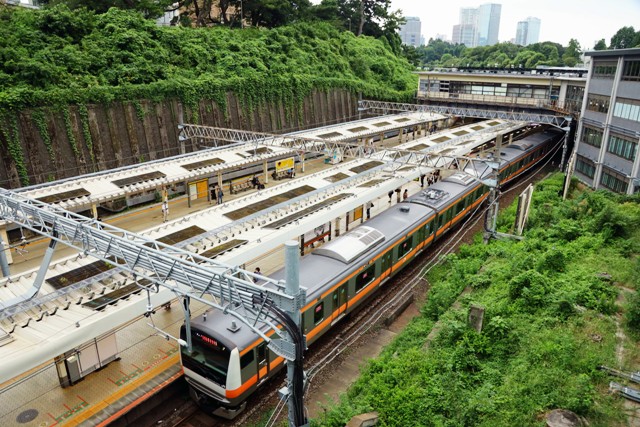
JR East Yotsuya station is situated in a valley

Tokyo is a city of hills. It's especially true in the western part of the downtown area. Yotsuya is no exception. Yotsuya means "four valleys" in Japanese. In fact, JR East Yotsuya station is situated in a valley. There is a railway tunnel in the immediate vicinity of the station that cannot be imagined within a city center. I pass through Yotsuya by train every day on my way to the office.

One day, I stopped over at Yotsuya station as I had a business meeting there. I had some time before my meeting, so I enjoyed a stroll for a while. What was new with this valley station? I found that the railway signal for the eastbound trains on the Chuo Rapid line track was moved about 200 meters toward the east. It's probably because of the effect of platform extension work. JR East currently plans to connect additional cars for the existing Chuo Rapid line commuter trains. 10-car trains will be changed to 12-car ones by the fiscal year 2023. During the above work period, the station platforms are also extended at each station. Under the influence of platform extension, the railway signal at Yotsuya station had to be moved.

Now I understand what had hitherto puzzled me... why do train traffic jams recently form during morning rush hour at Yotsuya station? The answer must be... "because the railway signal was moved". Is it trifling news? You're not wrong, but it was an eye-opening experience for me.

The railway signal was recently moved about 200 meters toward the east.
(The previous position was here)

Tuesday, 21 December 2021

The New Shuttle: Maruyama Rail Yard

Maruyama Rail Yard

Let me continue where I left off my last post. After taking a photo of the EMU 2020 series, I stopped by Maruyama Rail Yard near Maruyama station. It's New Shuttle's only rail yard.

I could observe many trains from an outer road of the yard and a bridge crossing the storage tracks. They were the EMU 2000 and 2020 series. The 2000 series is the largest fleet on the line. It was commissioned in 2007 to replace the old EMU 1010 series. 7 sets, 42 cars in total, belong to Maruyama Rail Yard. Each set has a different color. Among these, set 01 (dark pink), 02 (orange), 03 (green) and 06 (red) were being stored on the storage tracks. On the other hand, the 2020 series is the cutting edge model on the line. I could see set 23 (dark pink) and 24 (yellow) on the storage tracks.

I found one more... set 53 of the EMU 1050 series. It's the second generation train launched in 1990 for the entire opening of the route. 4 sets (24 cars) of the 1050 series were built, but currently, set 53 may be only active on the line. The 1050 series has got older, and is near the end of its own life. The body color of the 1050 series was changed to white in 2019, matching the brand new 2020 series.

Maruyama Rail Yard is open to the public once a year. I would like to join the next rail yard tour.

EMU New Shuttle 2000 (left), 1050 (center) and 2020 (right) series