Monday, 29 November 2021

Late-Autumn on the Joban Line

Set K421 of the EMU JR East E531 series arrives at Matsudo station

It's feeling like late autumn more and more. I enjoyed walking with my family on the weekend. Our destination this time was Matsudo City in Chiba Prefecture, about 20 kilometers northeast of Tokyo. Along the riverside, we saw a "silver wave" in the field. It was the best season to view an awful lot of rabbit ears of silver grass. They changed color from green to silver, and they will then turn gold from exposure to the sun. The breeze blowing against them also created an autumn sound.

To get to this beautiful riverside, the nearest railway station is Matsudo on the JR East Joban line. We took the Joban line from Ueno terminal. Our vehicle was the EMU JR East E531 series, which was launched in 2005. The E531 series is an AC-DC dual system train with a maximum speed of 130 kilometers per hour. 460 cars in total were built by Tokyu Sharyo and the others. It's composed of 10 cars in the main sets, with 5 cars in the subsets. Two double-decker Green Cars (the first-class cars), namely Class SaRo E530 and E531, are incorporated in the main set. The gleaming stainless-steel body with dark blue-colored stripes is an outward characteristic of the E531 series.

For your information, some of the Joban line trains share the Ueno-Tokyo line track with the Tokaido line trains, carrying out the direct operation to Shinagawa Station in the southern part of Tokyo. The train operation routes in Tokyo are indeed complicated.

Silver grass field near Matsudo station on the JR East Joban line

Official information about the JR East E531 series (in Japanese):

Friday, 26 November 2021

Simulated Travel to Indonesia: Part 2

Set TB-7 (Indonesia color) of the EMU 8000 series travels on the Izukyu line

Following the outline report of the chartered train event on the Izukyu line, I'm going to be more specific about this chartered train today.

The train, which we chartered from Izukyu Railway, was set TB-7 of the EMU 8000 series. The 8000 series was originally commissioned in 1969 on the Tokyu-Toyoko line. The 8000 series became the big force on the Tokyu lines, but it was then replaced by the new models step by step. The final set was eventually retired from the track in 2008. After retirement from Tokyu, 24 cars were moved to Indonesia; meanwhile, 45 cars were transferred to Izukyu to spend a new life.

Set TB-7 of the 8000 series is a 3-car train on the Izukyu line. Its technical specification is rather old, but it's still one of the leading players on the line. Set TB-7 has stainless-steel bodies without any coloring. We chartered this train, and temporarily changed its front color design to that of the Indonesian Railway namely red and yellow. It was beautiful under the autumn sunshine.

When I was in high school, I used the 8000 series on the Tokyu-Toyoko line every day to go to school. I then ran into the 8000 series again in Jakarta, Indonesia, when I was stationed there 14 years ago. The local railway operator in Jakarta was pursuing the modernization of the trains, and introduced the second-hand 8000 series from Tokyu at that time. I'm probably inseparable from the 8000 series.

EMU Izukyu 8000 series (left) and EMU JR East E257-2000 series (right)

Official website, Izukyu Railway:
Official photogallery, Izukyu Railway:

Tuesday, 23 November 2021

Simulated Travel to Indonesia Taking the Izukyu Line

EMU 8000 series with the Indonesian Railway logo (left) & color design (right)

Because of the COVID-19 calamity, I can't go abroad this year anymore. I love Indonesian railways as I lived in Jakarta, Indonesia until 2011, but it's going to take some time before I can visit there again. What should I do?

The answer is a simulated travel to Indonesia in Japan. On November 14th, Indonesian railway lovers in Japan gathered in Izukogen railyard of Izukyu Railway. Chartering a train on the Izukyu line, we enjoyed a special travel for pretending to go to Indonesia. Why Izukyu? In Indonesia, there are a lot of secondhand trains from Japan. The EMU Tokyu 8000 series is one of them. After retirement from Tokyu, several sets of the 8000 series were transferred to Indonesia; meanwhile, the other sets were moved to the Izukyu line. We temporally changed the color design of the Izukyu 8000 series to that of Indonesian Railway, and chartered it.

Firstly, we held a photo session at Izukogen railyard in front of the 8000 series in Indonesian style. We then got on the chartered train, and made a round trip to Izukyu-Shimoda station. While on board, we enjoyed a bottle of Indonesian brand beer namely "Bintang (star)". We also took photos together, had lunch together and had a dream-like moment together. Speaking with kindred minds was fun and time flew by. The simulated travel was indeed a great success. I'm truly grateful to the organizer "KLB", the coordinator "Pakuan Ekspres" and all the staff of Izukyu Railway.

To be continued...

Indonesian brand beer, "Bintang (star)"

Official information about the rollingstock of Izukyu Railway:
Official website, "Omoshiro-stationmaster", Izukyu Railway (in Japanese):

Friday, 19 November 2021

Hinotori at a Glance

EMU Kintetsu 80000 series, limited express "Hinotori", stands at Nagoya station

After enjoying autumn in Nara, we started our homeward journey. Taking the Kintetsu Osaka line, we went to Nagoya by the Meihan Limited Express train. This train travels between Osaka (Namba) and Nagoya via Nara Prefecture with a maximum speed of 130 kilometers per hour. It's of course much slower than that of JR Central's Tokaido Shinkansen, but is more luxurious and inexpensive. Our vehicle was the EMU 21000 series, "Urban Liner".

When we arrived at Nagoya station, I found a new Meihan Limited Express model, the EMU 80000 series, Hinotori, on the adjacent track. Hinotori means "a firebird or phoenix" in Japanese. The 80000 series was commissioned in March, 2020. 11 sets (8-car and 6-car trains) in total were built by Kinki-sharyo. Its streamlined shining bodies are very vivid and definitely my favorite. The interior of the 80000 series is gorgeous. For instance, all seats in the premium car have back shells, so, you don't need to worry about disturbing a passenger sitting behind you. With regard to the technical specifications, the premium car has an active suspension system, which is a special device to minimize the lateral swinging movement of the train.

The EMU Kintetsu 80000 series, Hinotori, was elected as the 2021 Blue Ribbon Prize train. The Blue Ribbon Prize is an annual award presented by the Japan Railfan Club (JRC) since 1958, awarded to the best train that launched in the previous year. I also voted for the 80000 series as a member of JRC.

Side view of the EMU Kintetsu 80000 series

Hinotori, Kintetsu's official website:
Official detailed description about Hinotori (in Japanese):

Wednesday, 17 November 2021

Cosmos Field in the Ancient City

EMU Kintetsu 1233 series stands at Kashihara-jingu-mae station

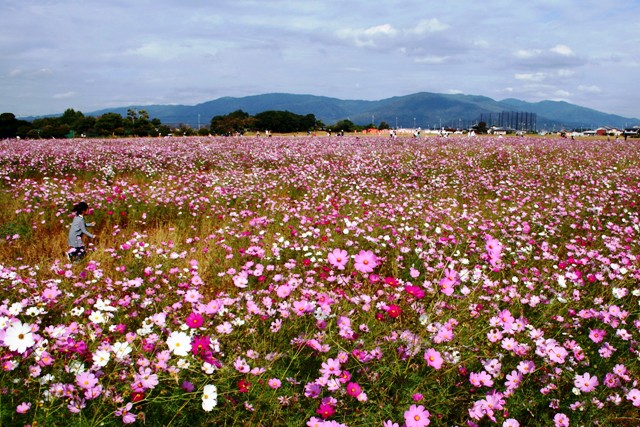
After staying in Nara City, we moved to Kashihara City, about 30 kilometers south of Nara. Along with Nara, Kashihara is known as Japan's ancient capital named Fujiwara-kyo. The period of Fujiwara-kyo was from 694 to 710. It was after Asuka-kyo (592-694) and before Heijo-kyo namely Nara (710-784). Fujiwara-kyo was a 5 kilometers square grid-patterned city, which had an estimated population of 20,000. Today, the imperial palace ruins are only seen, but I could feel the existence of a vast ancient capital city there. The site of the former city center is now a vast cosmos field. It was filled with a carpet of cosmos flowers when we visited. They were magenta, pink and white-colored, and were shaking with the wind in the sunshine. We saw that many people were visiting to enjoy this autumn field.

To get to this ancient capital, the gateway station is Kashihara-jingu-mae on the Kintetsu-Kashihara line. Our vehicle was the EMU Kintetsu 1233 series. It's a standard commuter train composed of a motorcar and a trailer (1M1T). It was commissioned in 1989. 15 sets in total were built by Kinki-sharyo. The 1233 series belongs to the 1230 series group trains. Different from the original 1230 series, the 1233 series has a new type of bogies named KD-96B (M) and KD-96C (T) developed by Kinki-sharyo. These bogies have a shorter wheelbase to manage curve tracks. Technical specifications of the Kintetsu trains vary depending on the train, so, it's hard to understand even for trainspotters like me.

Fujiwara-kyo ancient capital is now a vast cosmos field 

Official information about the EMU Kintetsu 1230 series (in Japanese):