![]() |
| Interior of car number 2, set 5505 of the EMU Izu-Hakone 5000 series |
Friday, 18 June 2021
Mint-colored Train on the Daiyuzan Line
Monday, 14 June 2021
Preserved Streetcar in Yokohama City, Part 5
![]() |
| Electric car 1300 series (unit 1311) is exhibited in the Yokohama Tram Museum |
A long time has passed since I introduced streetcars exhibited in the Yokohama Tram Museum last time. Today, I'm going to continue to show you the other streetcar exhibited in the museum.
The electric car 1300 series was one of the main fleets owned by the Transportation Bureau of Yokohama City. 30 units in total were built by Kisha-kaisha in 1947. It was Yokohama's last streetcar, which a conductor was on board. In other words, the driver had to take the role of conductor as well later on this model. The 1300 series has a 13.62 meters-long and 2.48 meters-wide body with two bogies named Kisha-kaisha Type D14. The gauge size is 1,372 millimeters. There are six doors on the body. They are four sliding and two folding doors. The 1300 series can accommodate 120 passengers. I like the beige and light blue two-toned body. I think this color design gave local people hope for the future after the end of WWII. The 1300 series was about to retire in 1971 while it was missed by local people and rail-fans.
Incidentally, Yokohama is the second-largest city in Japan. This mega-city once had an extensive tram network. The first route was opened in 1914 by Yokohama Electric Railway Company. Although the tram was a useful transportation means for local people, it was unfortunately abolished in 1972 due to heavy traffic congestion in the urban area. The representative streetcars are now preserved and exhibited in the Yokohama Tram Museum.
![]() |
| Interior of the electric car 1300 series (unit 1311) |
Thursday, 10 June 2021
Nature Park near Hakodate City

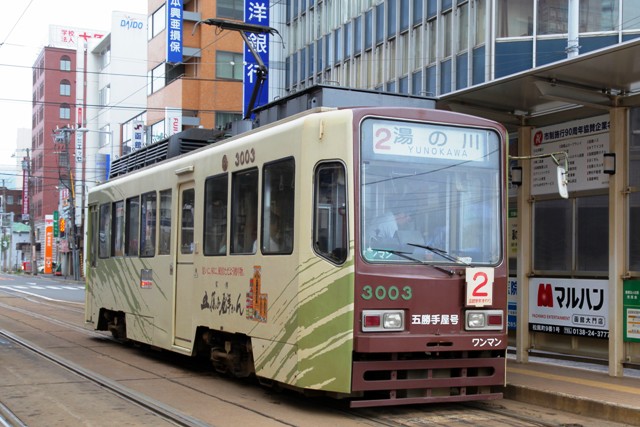
Electric car Hakodate Transportation Bureau 3000 series (August, 2012)
Onuma is a nature park located in Nanae Town, a northern suburb of Hakodate City on Hokkaido Island. Onuma Park encompasses Lake Onuma and a volcanic mountain named Komagatake. It was designated as a quasi-national park in 1958. Onuma was created as a dammed lake by mudflows due to eruptions of Komagatake Volcano between 50,000 and 30,000 years ago. The lake is surrounded by birch and maple forests. I visited this breathtaking and quiet park with my family in the summer of 2012. We rented bicycles, and went around the lake at first. We then enjoyed strolling and canoeing at our favorite spots.
Taking this opportunity, I'm going to continue to show you the other tramcar in Hakodate City. Along with the 2000 series, the electric car 3000 series is one of the main fleets on the tramlines operated by Hakodate City Transportation Bureau. Four units in total were built by Alna-koki from 1993 to 1996. The outer design and the technical specifications of the 3000 series are mostly the same as those of the 2000 series, but the 3000 series has air conditioners and a regenerative braking apparatus. I'm not sure why two kinds of tramcars namely the 3000 and the 2000 series were built at the same time.
For your information, all the 3000 series tramcars were renovated from 2016 to 2020 due to deterioration. The frontal lights were changed and the frontal destination display devices were also changed from rollsigns to the LED displays.
| Lake Onuma |
Sunday, 6 June 2021
Glass-themed Park on the Joetsu Line
![]() |
| EMU JR East 211-3000 series travels on the Joetsu line along Tone River |
Wednesday, 2 June 2021
Trappistine Convent in Hakodate City
![]() |
| Electric car Hakodate Transportation Bureau 2000 series (August, 2012) |
Following the electric car 9600 series, I'm going to continue to show you the other tramcar and a beautiful must-see spot in Hakodate City.
The 2000 series is an electric car operated by Hakodate Transportation Bureau. Only two units in total were built by Alna-koki in 1993 and 1994. It's a 12.32 meters-long tramcar with a VVVF inverter (variable frequency drive) electric control system. It has two 60 kW induction motors per unit. One unit can accommodate up to 58 passengers. I like this tramcar, but the only problem is the defense against the summer heat. Even in the cool northern city, it becomes hot in summer probably because of recent global warming. Passengers need the air conditioner.
Taking the tram line, I visited the Trappistine Convent, which is located in the eastern part of Hakodate City, with my family in 2012. The Trappistine Convent was established by eight nuns from France in 1898. It's Japan's first women's monastery. The existing church building was built in 1927, featuring the mix of the Gothic and Romanesque styles, such as the brick exterior and the semicircular-arched windows.
Visitors are allowed to tour only the forecourt and the museum, as there are currently about 60 nuns in the convent. Of course, we should walk around the convent quietly. The statue of Virgin Mary was especially beautiful and impressive for us. At the shop for visitors, we could get the tasty cookies "Madalena (Madeleine)", butter candies and rosaries made by the nuns.