Showing posts with label Seibu. Show all posts

Monday, 22 June 2026

Seibu's SAMURAI BLUE TRAIN

Set 40156 of Seibu’s 40000 series EMU fleet, the SAMURAI BLUE TRAIN

Is the FIFA World Cup creating a huge buzz in your country?

In Japan, yes. As evidence, the Bureau of Waterworks of the Tokyo Metropolitan Government recently released data on “match-day changes in water distribution volume” and found that water usage increased sharply just before kickoff, during halftime, and immediately after the final whistle. I hope you can imagine what that means.

I’m not a soccer enthusiast, but as a train enthusiast, I can’t get World Cup-related trains out of my mind.

For example, on June 7, Seibu Railway introduced a specially wrapped train, the SAMURAI BLUE TRAIN.

Please take a look at the top photo—yes, this is the SAMURAI BLUE TRAIN. You can see the vibrant two-tone blue and green livery on the train. The blue represents the team color of Japan’s national team. Meanwhile, the blue and green also represent the corporate colors of the sponsor, Credit Saison.

Along the sides of the train, you can see players from the national team. For example, the bottom photo shows Kubo Takefusa, who plays as a right winger. He is very popular with children because he is kind to them. He has a small build, but he is very fast—like JR East’s Series E6 Shinkansen EMU. Is this analogy a bit of a stretch?

As a train enthusiast, I would also like to touch briefly on the technical aspects of the train itself. The SAMURAI BLUE TRAIN is Set 40156 of Seibu’s 40000 series EMU fleet. The 40000 series entered service in 2017. A total of 26 sets, or 248 cars, were introduced between 2017 and 2025. Each car has a 20-meter aluminum-alloy body and an IGBT-based VFD traction system with 190 kW fully enclosed permanent-magnet synchronous motors. The 40000 series trainsets have a special space called the “Partner Zone” for wheelchair users and passengers with prams.

For your information, there are several variations within this fleet. For example, 20 sets, including Set 40156, are composed of 10 cars, while the other six sets consist of 8 cars. Another difference is that six sets have convertible cross/long seats and a wheelchair-accessible restroom, while the other 20 sets, including Set 40156, have longitudinal seating only. Furthermore…

Sorry to be so specific... I always geek out over this kind of topic.

Close-up view of the SAMURAI BLUE TRAIN

Monday, 20 April 2026

New LEO LINER on the Yamaguchi Line

Seibu L00 series EMU, LEO LINER (Set L11)

Today, I would like to introduce a new train model in the Tokyo metropolitan area: Seibu Railway’s L00 series EMU, called the LEO LINER, for the Yamaguchi Line. This new model entered service on March 27 and replaces the older 8500 series EMU.

First, let me briefly introduce the Seibu-Yamaguchi Line.

The line is a rubber-tyred automated guideway transit (AGT) system that runs across the border between Tokyo Metropolis and Saitama Prefecture. It connects Tamako (Lake Tama) and Seibu-Kyujō-mae (Seibu Baseball Stadium) stations, and its total length is only 2.8 km. The entire route is single-track and uses a 750 V DC third-rail power supply. Unlike other AGT lines such as the Seaside Line, and the Nippori-Toneri Liner, trains on this line are operated by a driver. It is not a driverless system.

The top photo shows the L00 series. Each trainset consists of four aluminum-alloy cars, each 8.5 meters long (two motor cars and two trailer cars). The traction system uses variable frequency drives with 110 kW induction motors. One of the differences from the older 8500 series is that the L00 series has double-leaf external sliding doors. Seibu Railway plans to introduce three trainsets of the L00 series by the end of March 2028.

My first impression was that it looks similar to the Yurikamome 7500 series EMU. It also reminds me of JR East’s HB-E220 series. The polygonal shape of the front of the train seems to be a trend in the design of recent rolling stock.

Regarding the interior, please look at the photo below. There is a transverse seat located just behind the driver’s cab. It is called the “Kids Seat,” and it is designed for a parent and a child. They can enjoy watching the driver operate the train and looking out the front. Recently, more Japanese railway companies seem to be installing special seats for parents and children, and I think this is a very good idea.

I enjoyed observing Seibu’s new LEO LINER very much.

“Kids Seat” in the L00 series train

Related link:

Saturday, 6 December 2025

Autumn Visit to the Silent Tracks of the Ahina Line

An abandoned track of the former Seibu-Ahina Line

Are there any ruin enthusiasts in your country? In Japan, there are quite a few. They love exploring deserted towns, mines, factories, and things like that. I’m not exactly a ruin enthusiast, but I’m at least fond of abandoned railway tracks. Let me share one of my memorable abandoned tracks with you today. My thanks go to the Chairperson of the KuHa 703 Preservation Society, who kindly told me about this heartfelt ruin.

The Ahina Line was opened in 1925 as a branch line of what is now the Seibu-Shinjuku Line. The route originally functioned to transport gravel from the Iruma River riverbed to large cities for construction. Connecting Minami-Ōtsuka and Ahina, the route length was 3.2 kilometers. The track was single and electrified. After 38 years of operation, the Ahina Line was closed in 1963.

Please take a look at the photo above. This is the former Seibu-Ahina Line. The track has been left untouched for a long time, and in this season it was covered with fallen leaves. It would be impossible to revive it now. I felt sad as a rail fan, but at the same time, the abandoned track looked beautiful and somehow made me feel calm. It was different from other abolished tracks I have visited in urban areas, such as the Sagami Branch Line, parts of the Toyoko Line, and the Yokohama Harbor Line.

Finally, I have to say that ruin enthusiasts must follow rules when visiting abandoned tracks. Many dangerous spots lie in prohibited or private areas. Please be careful.

The former Ahina Line (left, a green area) and the Shinjuku Line (right) at Minami-Ōtsuka Sta.

Monday, 3 November 2025

It Was Gone Before I Knew It

“The 100th Anniversary of Kiyose Station” commemorative train (December 2024)

This may sound sudden, but just imagine: there was someone you were fond of — someone who caught your attention. One day, they suddenly moved away and never came back. You feel a quiet loneliness without them. Have you ever experienced something like that?

So, what am I trying to say?

On October 2nd, Seibu Railway announced that the regular services of the 2000 series EMUs would be withdrawn from the Ikebukuro, Toshima, Sayama, and Chichibu lines by October 15th.

Let’s take a quick look back at the Seibu 2000 series. The 2000 series EMU debuted in 1977 to strengthen Seibu Railway’s transportation capacity. There were two types: the original 2000 series, which were retired in June this year, and the newer 2000N series. This time, it’s the 2000N series that have left the Ikebukuro and related lines.

As you know, the Ikebukuro Line is Seibu Railway’s main artery. The 2000N series, with their bright yellow bodies, were the quintessential Seibu trains. This combination was inseparable — and yet, it has come to an abrupt end. I can’t help but feel a bit lonely without them.

Pulling myself together — please take a look at my photos.

This is the special poster train featuring Set 2071 of the 2000N series EMU, celebrating the 100th anniversary of Kiyose Station on the Ikebukuro Line. The commemorative train ran from June 2024 to March 2025. In the end, it turned out to be my last chance to photograph the 2000N series on the Ikebukuro Line.

Thank you, the 2000N series on the Ikebukuro Line. Let’s meet again on the Shinjuku Line.

Side view of the commemorative train using the 2000N series EMU (December 2024)

Sunday, 28 September 2025

Yamitetsu Part 2: Shinkiba Railyard

Night view of Shinkiba Railyard, with Set 6102 on the right

Do you remember my post about “yamitetsu” last month? Today, I’d like to share an update on my activities.

Let’s start with a quick overview. Yamitetsu refers to a railfan who loves photographing trains in the dark. The word is a blend of “yami” (meaning “darkness”) and “tetsu” (meaning “iron”). In Japanese, we call a railway "tetsudō", which literally means “iron road". Without realizing it, I’ve long enjoyed taking photos at underground stations, at night on the surface, and in other low-light settings. Still, I think of myself as just a beginner yamitetsu.

Now, let’s move on to the main topic. I recently stopped by Tokyo Metro’s Shinkiba Railyard on the Yurakucho Line for a yamitetsu outing. I chose this spot because there’s a pedestrian bridge crossing the yard. On the bridge, a pleasant evening breeze made the air feel refreshing. Below, I saw many trains being readied for service. Under the yard lights, they gleamed beautifully—the Tokyo Metro 10000 and 17000 series EMUs, as well as the Seibu 40000 series, which directly operates onto the Seibu-Ikebukuro Line.

And one more… Set 6102 of the Tokyo Metro 6000 series! As you know, all 6000 series EMUs have already disappeared from Japanese tracks, but Set 6102 is still preserved here at the yard. Its interior lights were off, but its aluminum alloy body shone faintly under the floodlights. Set 6102, it’s been a while! How have you been?

View from a different angle, with Set 6102 in the right corner

Wednesday, 20 August 2025

130th Anniversary of Kawagoe Railway

Set 2085 of the Seibu EMU 2000N series displays a special commemorative sticker

Do you remember when I posted that Seibu Railway was celebrating the 130th anniversary of Kawagoe Railway? Today, I’d like to give you an update on this topic.

Let’s start with a quick look at the Kawagoe Railway. It was one of the predecessors of today’s Seibu Railway. Parts of the Seibu Shinjuku and Kokubunji lines were originally opened by the Kawagoe Railway in 1895. The Kawagoe Railway merged with the Musashino Railway in 1945 and was reborn as Seibu Railway in 1946. Six cities—Kawagoe, Higashimurayama, Tokorozawa, Sayama, Kodaira, and Kokubunji—are located along the former Kawagoe Railway line.

One of the anniversary events includes displaying special commemorative stickers on the front of EMU 2000N series trainsets. These stickers were designed by local residents and selected by the six cities mentioned above. Please look at the top photo. The round sticker displayed on Set 2085 was designed by a resident of Higashimurayama City. It features symbols of the city: the white wagtail, azalea, zelkova tree, and fruit. Colorful and beautiful! Next, look at the photo below. The sticker on Set 2079 was designed by a child from Tokorozawa City. It features Tokorozawa Aviation Memorial Park, the official city mascot “Tokoron,” and a train. As a rail fan, I’m delighted to see the iconic yellow Seibu train (EMU 2000N or 9000 series) featured in the design.

If you have time, please check the URL at the bottom of this post, where you can see all six sticker designs. Congratulations to the Kawagoe Railway on its 130th anniversary!

Set 2079 of the Seibu EMU 2000N series displays a special commemorative sticker

Official information on the 130th anniversary of Kawagoe Railway by Seibu (in Japanese):

Wednesday, 30 July 2025

EMU "Seibu" 8000 Series: Start of Commercial Operation

Set 8103 of the EMU Seibu 8000 series travels on the Haijima Line

Do you remember when I introduced Seibu Railway’s new train, which had been purchased second-hand from Odakyu Electric Railway? Three months have passed since then, and Seibu has now put this commuter train into commercial operation under the name “Seibu” 8000 series (see the top photo).

Let me first review the history of this train during the Odakyu era. The Seibu 8000 series originally debuted as the EMU “Odakyu” 8000 series in 1983. A total of 32 sets, 160 units, were built by Nippon Sharyo, Tokyu Sharyo, and Kawasaki Heavy Industries. It is the oldest train still operating on the Odakyu line, and is also known as the last steel-bodied commuter train on the line. Incidentally, after renovation, the 8000 series was equipped with a variable frequency drive electric control system.

Forty-one years later, it was decided that seven sets, 42 units in total, of the Odakyu 8000 series would be transferred to Seibu Railway. This helps Seibu reduce the cost of acquiring new trains. In addition, maintenance costs will also be lower, since the 8000 series is already equipped with a variable frequency drive system, which, as you know, reduces electricity consumption.

Lastly, please don’t forget that the EMU Odakyu 8000 series is still in operation on the Odakyu line (see the photo below). This makes railfans like me happy, as we can ride and compare both the Odakyu 8000 and the Seibu 8000 series. I hope both versions of the 8000 series will continue running for as long as possible.

Set 8262 of the EMU Odakyu 8000 series travels on the Odawara Line

Official information about the EMU Seibu 8000 series (in Japanese):

Sunday, 4 May 2025

Two Topics on the Seibu Railway

Test run of the EMU Seibu 8000 series (ex-Odakyu 8000 series)

I’d like to continue with the topic of Seibu Railway today.

I recently visited Tokorozawa Aviation Memorial Park in Tokorozawa City, Saitama Prefecture. I’m not particularly an airplane enthusiast, but I enjoyed visiting the birthplace of Japanese aviation, as it is the site of Japan’s first airfield. On my way home, I switched back to being a trainspotter when I came across an unfamiliar train at Kokukoen (Aviation Park) Station on the Seibu-Shinjuku Line. What was that train?

It immediately rang a bell—I realized I had seen it before: the ex-Odakyu 8000 series! As I mentioned in a previous post, Seibu Railway purchased 100 secondhand train cars from Odakyu Electric Railway and Tokyu Corporation in 2024. These included the EMU Odakyu 8000 and Tokyu 9000 series. Eight months later, the ex-Odakyu 8000 series was modified into the “EMU Seibu 8000 series” and began its test runs. According to Seibu Railway, the reborn 8000 series is scheduled to debut at the end of this month. I can’t wait!

Just after the ex-Odakyu train departed, a yellow-colored train with a special plate on its front arrived at the station. What was that? It turned out to be the special “130th Anniversary of Kawagoe Railway” train. The Seibu-Shinjuku and Kokubunji Lines were originally inaugurated by the Kawagoe Railway in 1895. I found that the anniversary plate was displayed on the front of train set 2065 of the EMU Seibu 2000N series. The round plate was provided by Sayama City for the celebration. Congratulations on the 130th anniversary!

Seibu Railway is full of fascinating topics.

"The 130th anniversary of Kawagoe Railway" train departs from Kokukoen station

Official information about the 130th anniversary of Kawagoe Railway (in Japanese):

Thursday, 1 May 2025

The 4th Generation L-train

The 4th generation L-train arriving at Higashi-Kurume station

Seibu Railway has launched the fourth-generation “L-train.” I’m going to introduce this newly wrapped train today.

Let’s start with a brief review of the “L-train.” The L-train (short for Lions Train) is Seibu Railway’s ad-wrapped train designed to support their professional baseball team, the Saitama Seibu Lions. Its design is based on Legend Blue, the team’s official color, and the train’s body is decorated with team emblems and characters.

Historically, the first-generation L-train appeared in 2010 using the EMU 3000 series. The second generation entered service in 2016 on the EMU 9000 series, and The third generation debuted in 2018 on the EMU 20000 series.

On March 15 this year, trainset 40152 of the EMU 40000 series was introduced as the fourth-generation L-train. The EMU 40000 series is Seibu’s high-end commuter train, launched in 2017. A total of 23 sets (224 cars) were built by Kawasaki Heavy Industries. The first batch of six sets features multi-purpose seats that can be switched from longitudinal to transverse seating via remote control. The remaining 17 sets, including trainset 40152 (the L-train), have only longitudinal seats.

I noticed that the traditional Lions character “Leo” appears on the front of the L-train—it’s the same design used on the EMU 8500 series operating on the Seibu-Yamaguchi Line. Leo, how have you been? It’s been a while!

Incidentally, I recalled that trainset 40152 had previously been used for other ad-wrapped trains such as "Kanahei" and “Moi! Moomin Hanno”. It seems this particular trainset is always busy promoting tourism along the Seibu lines.

Side view of the 4th generation L-train

Official information about the 4th generation L-train by Seibu Railway (in Japanese):

Friday, 28 February 2025

Preserved Locomotive in Tokorozawa City

Locomotive unit B15 of the Seibu Class B11 is preserved in Tokorozawa City

You may remember when I introduced the Seibu Yamaguchi Line in 2014 and again in 2023. Today, I’d like to add a small supplement to that topic.

Let’s start with a brief review of the Seibu Yamaguchi Line. It is a rubber-tyred Automated Guideway Transit (AGT) system that runs along the border between Tokyo Metropolis and Tokorozawa City in Saitama Prefecture. The line is only 2.8 kilometers long, connecting Tamako (Lake Tama) and Seibu-Kyujo-mae (Seibu Baseball Stadium) stations. The Yamaguchi Line opened in 1985 as Japan’s fifth AGT route. The entire line is an electrified single track with one signal station for train passing. Its power supply is 750V DC, using a third rail.

Now, let’s look back on the history of the Seibu Yamaguchi Line before it became an AGT route. The original line opened in 1950 as an attraction railway called Otogi Densha (“Fairy Train”) inside an amusement park. It was later formalized as a regular railway, renamed the Yamaguchi Line, under the Railway Business Act in 1952.

At that time, the main locomotive type was the Class B11. A total of five units were built by the Seibu Tokorozawa Factory and Nakajima Electric Cars. These were accumulator (battery-powered) locomotives with a 0-4-0 wheel arrangement (Whyte notation), each equipped with two 11 kW DC motors. The batteries were manufactured by Yuasa.

Today, unit B15 of the Class B11 is preserved in front of the “Emi Terrace” shopping mall in Tokorozawa City. Emi Terrace was constructed on the site of the former Seibu Tokorozawa Factory — the very birthplace of unit B15. It’s truly a homecoming for this little locomotive, isn’t it?

Old photos of Seibu Class B11 locomotives are displayed in Emi Terrace

Thursday, 16 January 2025

The 55th Anniversary of the Seibu-Chichibu Line

The “55th Anniversary Train” of the Seibu-Chichibu Line

On October 14th, 2024, Seibu Railway celebrated the 55th anniversary of the Seibu-Chichibu Line. To commemorate this milestone, the company held several special events.

Let me start with a brief review of the Seibu-Chichibu Line. This mountain railway runs through the Chichibu Mountains, located in the northwestern part of the Tokyo metropolitan area. Connecting Agano and Seibu-Chichibu, the line is 19 kilometers long. It consists mostly of single track and is electrified at 1,500 V DC with a gauge of 1,067 millimeters.

The route was opened on October 14th, 1969, to serve both tourists and cement transportation. For your reference, Mt. Buko in the Chichibu area is well known for its limestone production, a key material used in cement. The limited express train “Laview (EMU 001 series)” and the local train (EMU 4000 series)” are the main rolling stock currently operated on the line.

Now, let’s move on to the main topic. On November 11th, 2024, Seibu began operating a special “55th Anniversary Train” on the Seibu-Chichibu Line. The train uses set 4017 of the EMU 4000 series, painted in an eye-catching red and beige livery. According to Seibu, this color scheme was inspired by the Class E851 electric locomotive, which once operated on the Seibu-Chichibu Line until its retirement in 1996.

The E851 was a Bo+Bo+Bo-type DC electric locomotive equipped with six 425 kW motors. In its prime, it could haul 1,000-ton cement trains in double-heading operation. You can get an idea of its powerful appearance from the replica displayed at Seibu-Chichibu Station (see the photo below). The E851 is on the left.

Congratulations to the Seibu-Chichibu Line on its 55th anniversary!

Replica of Seibu’s Class E851 electric locomotive (left)

Official information about the 55th anniversary Train (in Japanese):

Friday, 20 December 2024

Dr. Multi: Seibu Inspection Car

Seibu's inspection car "Dr. Multi" stands at HIgashi-Nagasaki Station

I visited Higashi-Nagasaki on the Seibu Ikebukuro Line last week for a personal errand. After finishing my meeting, I happened to come across a rare train—Dr. Multi—at Higashi-Nagasaki Station on my way home.

Let’s take a quick look at Dr. Multi. It is Seibu Railway’s inspection car, designed to examine overhead wires and track conditions. Built in 2006 by Plasser & Theurer in Austria, its model number is EM120, serial number 164. The car measures 17.25 meters in length and weighs 54,000 kilograms.

Inspection cars may remind you of JR Central’s Dr. Yellow, JR East’s East i and East i-E, Tokyu’s TOQi, Keio’s DAX, Odakyu’s Techno-inspector, and so on. All of these are operated as EMUs (electric multiple units). Dr. Multi, on the other hand, is a single diesel railcar. Although it is equipped with a pantograph, it is used only for inspecting overhead wires—not for drawing power. In this sense, it is similar to JR East’s East i-D, isn’t it?

When I spotted Dr. Multi at the station, its diesel engine was roaring as it shuttled back and forth on a siding in the station yard. Several railway engineers were having serious discussions while checking the equipment. Seibu does not publish timetables for work trains, but I suppose that the actual inspection runs will be conducted in the middle of the night after the last passenger train.

“Dr. Multi, have a good rest! Starting at midnight, you’ll be busy with inspections. I’m counting on you to do a great job. Good luck with your midnight work.”

Side view of Dr. Multi

Sunday, 29 September 2024

EMU Seibu 6000 Series: Variations, Part 3

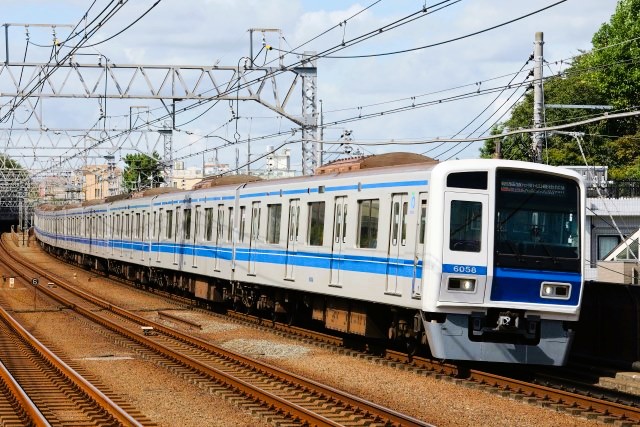
Set 6158 of the EMU Seibu 6000 series without door pocket windows

Sorry for jumping from one topic to another, but I would like to follow up and explain the variations of the EMU Seibu 6000 series in a little more detail.

Please take a look at the photos. This train, Set 6158 of the 6000 series, does not have windows in the door pockets. It belongs to one of the last three sets. As I mentioned before, the 6000 series consists of a total of 25 sets (250 cars). They are well known for their great variety (see my posts dated 31/1/2020 and 23/9/2024). For example, the first 17 sets have stainless-steel bodies, whereas the last 8 sets have aluminum alloy bodies. The first 2 sets have silver-colored front faces, while the remaining 23 sets have white front faces. The first 22 sets have windows in the door pockets, whereas the last 3 sets do not.

In short, Set 6158 has aluminum alloy bodies, white front faces, and no windows in the door pockets.

Finally, let me briefly explain the technical specifications. Each set of the 6000 series consists of six motor cars and four trailer cars. It was Seibu’s first train series to adopt variable-frequency drives with induction motors. GTO (Gate Turn-Off thyristor) VVVF inverters were initially used, but they were later replaced with SiC (silicon carbide) VVVF inverters. It was also the first time Seibu adopted bolsterless bogies. More importantly, the 6000 series transformed the image of Seibu Railway’s trains from somewhat dowdy yellow ones into more urban and sophisticated rolling stock.

Close-up of Car 6058 in Set 6158

Monday, 23 September 2024

EMU Seibu 6000 Series: Variations, Part 2

EMU Seibu 6000 series with aluminum alloy bodies and door pocket windows

Following the EMU JR East E233-8500 series, I’m going to post the other surefire topic for old-school trainspotters today.

The EMU Seibu 6000 series is a commuter train on the Seibu and its direct operation lines. A total of 25 sets, 250 units, were built by Tokyu-sharyo and Hitachi. As I showed you before, the 6000 series is famous for having great variety. Firstly, the early 2 sets have silver-colored front faces; meanwhile, the late 23 sets have white-colored front faces. Secondly, the early 17 sets have stainless-steel bodies (see my previous post); meanwhile, the late 8 sets have aluminum alloy bodies (see the top photo). Thirdly, the early 22 sets have windows on the door pockets; meanwhile, the late 3 sets don’t have such windows. Are you with me so far?

Next, let’s see the early 22 set, which have windows on the door pockets, in more detail. Among the 22 sets, the late 5 sets are extra rare. Their windows on the door pockets are useless! In other words, passengers can’t see out the windows (see the photo below). What happened to this train? The gimmick is as follows. These 5 sets originally had windows on the door pockets; however, the inner windows were then replaced by the walls to display advertisements. Advertising revenue in the train should be larger than the renovation cost of the trains. Seibu must have calculated the specific details of cost performance.

Hats off to Seibu’s business effort!

Door pocket windows of set 6054, the EMU Seibu 6000 series

Saturday, 1 June 2024

The Seibu-Toshima Line: An Urban Local Route

"Studio Tour Tokyo Express" travels on the Seibu-Toshima line

I'm going to show you an urban local route followed by the Keio-Keibajo line. What's an "urban local route" in the first place? There is no definition for it, but I think "an urban railway line with little passenger transportation volume". For example, the JR East-Nambu branch line is a typical urban local route. The Tobu-Daishi line is also a good example.

Enough with the preamble. Let's get down to the main topic. The Seibu-Toshima line is also an urban local route. It's a branch line of the Seibu-Ikebukuro line. Connecting Nerima and Toshimaen, its route length is only 1.0 kilometer. The track is single. Trains are operated every 12 to 15 minutes. What's at Toshimaen terminal? You will find a popular theme park, named Warner Bros. Studio Tour Tokyo, near the terminal. In other words, the main function of the Seibu-Toshima line is transportation for holidaymakers, who visit Warner Bros. Studio Tour Tokyo.

Taking the Seibu-Toshima line, you can enjoy a special poster train, named Studio Tour Tokyo Express, before reaching Toshimaen terminal. This train has large posters of Harry, Hermione and Ron on the bodies. It will lift your mood before visiting the theme park. Once you get off at the Toshimaen terminal, shining Patronus (Harry's Spirit Guardian) statues will welcome you. By the way, you may ask me, "Have you ever been to Warner Bros. Studio Tour Tokyo?" Unfortunately, not yet. I'm always busy. My family are also pressed for time, and... (so many excuses!).

Patronus (Harry’s Spirit Guardian) statues in front of Toshimaen terminal

Official information about Toshimaen terminal (in Japanese):

Monday, 8 April 2024

Advent of Spring on the Seibu-Tamagawa Line

EMU Seibu New 101 series travels on the Tamagawa line

It's getting warmer and warmer in Tokyo. The maximum daytime temperature is nearly 20 degrees Celsius. The spring outing season has just started. I recently visited the Seibu-Tamagawa line for the first time in three years.

To start, let me quickly review the Seibu-Tamagawa line. It's a short local route in the western part of Tokyo. Connecting Musashi-Sakai on the JR East Chuo line and Koremasa near Tama River, the route length is 8.0 kilometers. The track is a 1,067 millimeter-size single and electrified. The electric system is 1,500 V DC with overhead catenaries. 4-car trains are operated every 12 minutes. This route was opened in 1917 to transport gravel from the Tama riverbed to large cities for construction. It's similar to the history of the JR East Nambu line. The route was, then, changed to a commuter line in 1967.

I got off at Shin-Koganei station, and headed to Nogawa river. On the way to the river, I found a fantastic shooting spot of the Tamagawa line trains. It was a straight track in a trench surrounded by a residential area, and had good visibility. The even more good news was that numerous yellow-colored canola flowers were blooming beautifully along the track. The land for the future double track project is especially a suitable space for canola planting. Another of my favorite shooting spots was Nimaibashi bridge over Nogawa river. I could enjoy both the colorful New 101 series trains and the beautiful stream. Spring is here on the Seibu-Tamagawa line.

EMU Seibu New 101 series crosses Nimaibashi bridge over Nogawa river

Wednesday, 20 March 2024

A Small Topic on the Seibu Lines

The seat fabric of the EMU Seibu 20000 series is being temporarily repaired

Generally speaking, Japanese trains have comfortable seats. Fabrics for passenger seats are clean and strong; however, they are not perfect. I recently found that the seat fabric of the Seibu train was being temporarily repaired. Please look at the top photo. The bright blue-colored seat is very beautiful, but the seat surface is covered by a special cloth for temporal repair. The train illustration looks to be "crying"; however, there is a message on the cloth, saying "This seat can be used safely". Passengers will be relieved, but the train illustration is so lovely. Can you sit on the cloth without hesitation? No, I can't. Am I an overthinker?

Joking aside, the train under seat repair is the EMU Seibu 20000 series. It was commissioned in 2000 as a new-generation commuter train to replace the deteriorated 101 series. The design concept is simple and clean. One set is composed of 8 or 10 cars. The motorcars to trailers ratio is 1. The body is made of aluminum with a double skin structure, so, they're light and sturdy. The electric control system is an IGBT-VVVF (variable-frequency drive) with 135kW/h induction motors and regenerative brakes. Needless to say, the 20000 series promotes energy saving.

Let me tell you one last thing. Don't you think that the Seibu 20000 series is like the Tobu 50000 series? It's not surprising because both the Seibu 20000 and the Tobu 50000 series were designed by Hitachi based on the concept of the "Hitachi A-train".

The EMU Seibu 20000 series travels on the Ikebukuro line

Monday, 12 February 2024

52 Seats of Happiness

Set 4009 of the EMU Seibu 4000 series, "52 Seats of Happiness"

After posting "Final Chapter of the Seibu 4000 series", I remembered that another type of the 4000 series is operated on the Seibu lines. That's the Seibu restaurant train, named "52 Seats of Happiness". I'm going to introduce to you this special train today.

52 Seats of Happiness was developed by Seibu Railway in 2016 celebrating their 100th anniversary. That's basically a sightseeing train like JR East's "Irodori" and "Resort Yamadori", but it also functions as a restaurant train. All seats are reserved and passengers can enjoy luxurious meals on the train. As its name suggests, the maximum capacity of the vehicle is only 52 passengers. 52 Seats of Happiness is operated between downtown Tokyo and Seibu-Chichibu on an irregular basis. It takes about two hours and a half each way. It's very slow because passengers need sufficient time for dining. It costs 100 USD per person on average with a meal. The vehicle for 52 Seats of Happiness is set 4009 of the EMU Seibu 4000 series. It's the 4-car train consisting of two passenger coaches, one kitchen car and one multi-purpose car. Technically, it's composed of two control trailers and two motorcars. Its specifications are rather old, because it's a renovated train originally built in 1989. For example, its electric control system is traditional rheostatic.

You may ask, "Have you ever been on 52 Seats of Happiness?" Unfortunately, not yet. It quickly fills up with reservations before I know... I'm always busy and... (so many excuses!).

Top car of "52 Seats of Happiness"

Official information about the Seibu restaurant train, "52 Seats of Happiness" (in Japanese):

Wednesday, 31 January 2024

Final Chapter of the Seibu 4000 Series

Set 4019 of the EMU Seibu 4000 series travels on the Chichibu line

What are the joys of railway travelling? For me, one is "ekiben", which is a lunch box sold at train stations, and another one is passing scenery from train windows. Today, I'm posting about the latter.

The EMU Seibu 4000 series is a standard local train operated on the Chichibu line in the countryside of the metropolitan area. It was commissioned in 1988 for direct operation between the Seibu-Chichibu line and the Chichibu main line of Chichibu Railway. It's still a main fleet on the Chichibu line. Different from the other Seibu commuter trains, which have commonplace long-seats, the 4000 series has comfortable cross-seats and large windows to capture the beautiful outside. I definitely prefer cross-seat trains to long-seat ones. Taking in the view is the great pleasure of railway travelling for me; however, ...

Seibu Railway recently made a press release announcing that approximately 100 units of used trains will be moved from Tokyu Railways and Odakyu Electric Railway in the near future. Among these trains, the Tokyu 9000 series is planned to be introduced onto the Chichibu line. The Tokyu 9000 series is high performance and energy saving cars, but urban commuter trains. Regrettably, its seats are mostly long-seats. It isn’t designed to evoke feeling of travel.

On January 11th, the first retiree of the 4000 series, namely set 4015, disappeared from the commercial line. The remaining 11 sets will also be retired step by step. The final chapter of the 4000 Series has started. Time will quickly pass me by.

Interior of the EMU Seibu 4000 series

Sunday, 19 November 2023

The 40th Anniversary of the Seibu-Yurakucho Line

Set 6017 of the EMU Seibu 6000 series with yellow-colored stripes

On October 1st, 2023, Seibu Railway celebrated the 40th anniversary of their Seibu-Yurakucho line. In commemoration, Seibu will operate an anniversary train until March, 2024.

Let me review the Seibu-Yurakucho line to start. It's a connecting line between the Seibu-Ikebukuro line and the Tokyo Metro-Yurakucho line. Connecting Nerima on the Seibu-Ikebukuro line and Kotake-Mukaihara on the Tokyo Metro-Yurakucho line, its route length is 2.6 kilometers. The track is underground and double. There is an intermediate station, Shin-Sakuradai on the line. 8-car or 10-car trains are operated every 5 to 10 minutes. The line name is "Seibu-Yurakucho line", but the route doesn't pass through "Yurakucho" in the central part of Tokyo. Why? Because, the Seibu-Yurakucho line was initially planned as a part of Subway Line 8, namely the Yurakucho line, by Transport Council of the Japanese government in 1970. It's integrated with the Tokyo Metro-Yurakucho line, which passes through "Yurakucho". As you know, the trains on the Seibu-Yurakusho line are currently operated onto the Tokyo Metro-Fukutoshin line as well, so, the situation has changed.

The anniversary train is set 6017 of the EMU Seibu 6000 series. It has yellow-colored special stripes on the bodies. As you know, yellow is the line color of the Tokyo-Metro Yurakucho line; meanwhile, the standard Seibu 6000 series trains have blue-colored stripes. The anniversary train also has a special plate on the front celebrating the 40th anniversary. Congratulations on the 40th anniversary of the Seibu-Yurakucho line! It's the short connecting line, but the great transportation artery in the western part of Tokyo.

Special plate of "the 40th anniversary of the Seibu-Yurakucho line"

Official information about the memorial train (in Japanese):