Showing posts with label Toei. Show all posts

Sunday, 28 June 2026

Refurbished Tramcar 8501

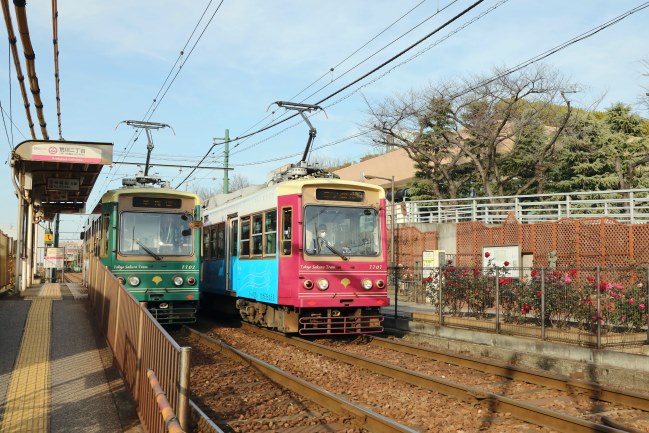
Refurbished Toei tramcar 8501 at Arakawa Depot

You may remember that, almost two months ago, I wrote about the Toei 8500 series running past the roses in full bloom on the Arakawa Line. At that time, I mentioned that I would save the refurbishment story of the 8500 series for a future post.

Now, I finally have the chance to introduce it here. So, let’s take a closer look.

The photo above shows refurbished tramcar 8501 of the Toei 8500 series, operated on the Arakawa Line by the Tokyo Metropolitan Bureau of Transportation (Toei).

Tramcar 8501 was built by ALNA in 1990. When new, it carried a pearl-white body with a green stripe, but after 36 years of service it has now received a major refurbishment under the concept of “a fun tramline.” The car returned to service on April 16 this year.

Its new chrome-yellow livery is based on the colour scheme once seen on Tokyo tramcars around the 1970s, so it gives the car a distinctly nostalgic look. I think this style will be especially popular with long-time tram and railway fans. I was also surprised to see that even the pantograph has been painted chrome yellow. By the way, “TODEN” on the body refers to Tokyo’s historic tram system.

The interior of tramcar 8501 is even more distinctive. Please take a look at the photo below. The first thing that stands out is the elaborate wood-grain design used throughout the saloon. I forgot to mention this earlier, but both the exterior and interior were designed by Eiji Mitooka, well known for his work on many Japanese trains, including JR Kyushu’s KiHa 72 series DMU, the 787 series and the 800 series EMUs.

I was very impressed by the design itself, but as a railway enthusiast I was also curious about the materials used inside the car. At first glance, the interior looks as if it is made almost entirely of wood, so I wondered how it had passed Japan’s strict fire-safety standards for railway vehicles. In fact, the surfaces are not solid timber; flame-retardant wood-grain films have been applied over metal fittings and panels. It is a clever way of creating a warm heritage-style atmosphere while still meeting modern safety requirements.

One more point worth mentioning is that tramcar 8501 is not a special event car or a one-off display vehicle. It runs in ordinary passenger service, which makes it even more enjoyable for enthusiasts. Its daily operation can be checked via the official app, “Tokyo Sakura Tram (Toden Arakawa Line) Real-Time Location Information.”

I am sure I will be riding tramcar 8501 again before too long.

Interior of tramcar 8501

Thursday, 4 June 2026

Precious Shared Track around Asukayama

Toei 7700 series Unit 7705 climbing the shared track

It may sound sudden, but do you have a place that never fails to spark joy?

For me, Asukayama is that place as a rail fan. Today, I’d like to share a small story about this area.

■ What is Asukayama?

Asukayama—literally “Asuka Mountain”—is a small hill and public park in the northern part of Tokyo. It was opened in 1732 by Yoshimune Tokugawa as a cherry blossom viewing spot for the people of old Edo.

The closest station is Ōji Station, about 17 minutes from Tokyo Station via JR East’s Keihin–Tōhoku Line. You can also access it via the Tokyo Metro Namboku Line and the Toei Arakawa Line.

■ Why is Asukayama special for rail fans?

First, two preserved vehicles stand inside the park: Toei tramcar Unit 6080 and former JNR steam locomotive D51 853 (I hope to introduce them properly in a future post).

Second, the well-known train-viewing spot Kitatopia is close by.

And third, a charming free monorail called Ascargot carries visitors up the hillside.

■ The precious shared track on the Arakawa Line

While these attractions are wonderful, there's another feature I’d love to highlight—the shared track section on the Toei Arakawa Line.

Most of the line runs on exclusive tracks, but there is one exception: the 0.5 km stretch between Ōji-ekimae and Asukayama stops.

In the photo above, Unit 7705 of the 7700 series is about to begin its climb up the shared track. Even with its 120 kW output, the incline becomes a challenge when the car is crowded. A small automobile easily passes it. Hang in there, Unit 7705!

In the photo below, after conquering the slope, Unit 9001 of the 9000 series is just about to return to the exclusive track. Bathed in the spring sunlight, it looks almost relieved. Nice work on the hill climb!

Asukayama’s charm truly never ends—including this rare shared track.

Toei 9000 series Unit 9001 running on the shared track

Monday, 11 May 2026

2026 Rose Season on the Arakawa Line

Toei 8500 series Unit 8502 near Otsuka-ekimae Stop

It is rose season in Tokyo now, and we can see beautiful blossoms in many places. This year, I visited the Toei (Bureau of Transportation, Tokyo Metropolitan Government) Arakawa Line and enjoyed the roses along the tracks. As a rail fan who loves flowers, it was a perfect place for me.

First, let me briefly introduce the Arakawa Line and its rose history.

Tokyo once had a tram network of 181 km, but most routes were closed because of heavy traffic. The Arakawa Line is a precious survivor, since most of it was built on an exclusive track. It runs between Waseda and Minowabashi, with a total length of 12.2 km. The entire route is double-track. The track gauge is 1,372 mm, and the electric system is 600 V DC.

The Arakawa Line is also known for its roses. Rose planting began in 1985 by Arakawa Ward. Later, Toshima Ward and local volunteers joined, and they have continued planting and taking care of many kinds of roses along the tracks.

Now, let’s stop and smell the roses! Please look at the photo above.

I took it near Otsuka-ekimae Stop. Roses are planted in the narrow space between the tracks and the road, using the fence as support. The deep red roses were in full bloom. When the tramcar slowly passed by, a gentle breeze carried their sweet fragrance. It was wonderful.

Next, please check out the photo below. I took it at Minowabashi Stop, which is a must-visit spot. This year, I photographed a different flower bed from the one I saw eleven years ago. There are so many flowers that the tramcar looks a bit modest. Maybe that is too much to say, since this is a railway blog.

By the way, the tramcar in both photos is Unit 8502 of the 8500 series. It is a mid-sized 13-meter tramcar equipped with Toei’s first VFD traction system and two 60 kW induction motors.

The 8500 series began service in 1990, but production stopped after only five cars because of financial issues in the Tokyo Metropolitan Government.

Finally, I have some news. The first unit of the 8500 series, Unit 8501, was recently refurbished. I am running out of space here, so I will write about it in a future post. Please look forward to it!

Toei 8500 series Unit 8502 at Minowabashi Stop

Sunday, 21 December 2025

2025 Merry Christmas from the Arakawa Line

Interior of Christmas Tramcar 9002 of the Toei 9000 series

I recently had a chance to visit the Toei Arakawa Line for the first time in a year. Like the Keio Inokashira Line, which I introduced in my previous post, I found that one of the trams on the Arakawa Line was also decorated for Christmas. Please take a look at the top photo. Isn’t it charming?

This year, the well-known florist Hibiya-Kadan designed the Christmas decorations for the tram. You can see wreath-like stickers on the tram windows. The smiling character you see is Toaran, the mascot of the Arakawa Line, chosen in a public contest. Toaran usually wears a single-arm pantograph on its head, but for this Christmas season it has been playfully topped with a red and white Santa hat. I’m very observant, aren’t I? Though I know I shouldn’t toot my own horn.

Incidentally, the tram with the Christmas decorations is Tramcar 9002 of the Toei 9000 series (see the photo below). The 9000 series is a retro-inspired model commissioned in 2007. Only two cars were built by Alna Sharyo. Each unit has a different color scheme: brownish red (Tramcar 9001) and indigo blue (Tramcar 9002). The 9000 series is mid-sized (13 meters long) and mounted on two bogies with double axles. The trams are equipped with an IGBT variable-frequency control system and two 60 kW induction motors. Although the technical specifications of the 9000 series are modernized, the exterior design and interior atmosphere remain nostalgic.

I will continue sharing my encounters with railway vehicles.

Tramcar 9002 of the Toei 9000 series displaying a “Merry Christmas” plate

Tuesday, 26 August 2025

Night-time Walk on the Ooedo Line

EMU Toei 12-000 series departing Ueno-Okachimachi Station on the Ooedo Line

It’s already late August, but the lingering summer heat is still intense. The daytime high in Tokyo has been over 35 degrees Celsius almost every day. To avoid the harsh sunlight, I enjoyed a night-time walk in the metropolitan area.

My destination this time was Harumi Port Park. It was part of the Athletes’ Village during the 2020 Tokyo Olympic and Paralympic Games. The park features fountains, a café, a playground, and a seaside terrace overlooking the Rainbow Bridge and central Tokyo’s waterfront. I also saw the illuminated “TOKYO” wordmark monument glowing in white light (see photo below). The sea breeze at night was pleasant and refreshing.

The nearest station to this scenic port park is Kachidoki on the Toei Ooedo Line. This subway line is known as a “linear motor subway.” Linear motor technology is used in its propulsion system. Unlike a conventional rotary motor, a linear motor has no shaft and generates motion in a straight line. This innovation allowed for a smaller tunnel cross-section.

The line first opened in 1991 with a short 3.8-kilometer section between Hikarigaoka and Nerima. It was extended to Tochomae (Tokyo Metropolitan Government Building) in 2000. Today, the line consists of a circular section (Tochomae – Ryogoku – Tochomae, 28.6 km) and a branch line (Hikarigaoka – Tochomae, 12.1 km), making a total length of 40.7 km. Two types of trains currently operate on the line: the EMU 12-000 series (see top photo) and the newer 12-600 series.

Night view of Harumi Port Park near Kachidoki Station on the Toei Ooedo Line

Tuesday, 22 April 2025

Preserved Tramcar in the Open-air Architectural Museum

Unit 7514 of the Toei 7500 series tram preserved in Koganei City

The Edo-Tokyo Open-Air Architectural Museum is a lovely place where you can see many historic Japanese buildings. It’s located in Koganei City, about 30 kilometers west of central Tokyo. Since the 17th century, Tokyo has lost a number of precious old buildings because of fires, floods, earthquakes, and even wars. To protect and share what’s left, the Tokyo Metropolitan Government opened this museum in 1993 as an annex of the Edo-Tokyo Museum. The museum’s goal is to relocate, rebuild, and preserve buildings of great cultural value, and to hand down these treasures to future generations. One of my favorite spots is the public bathhouse Kodakara-yu (see the photo below).

The museum doesn’t just display old buildings. Please take a look at the top photo — this is unit 7514 of the Toei 7500 series tram. The 7500 series was introduced in 1962 as a mid-sized (12.52-meter-long) double-bogie tramcar for the Tokyo streetcar lines. Each car had two 60 kW DC motors and could run up to 40 kilometers per hour. After running for 16 years, unit 7514 was retired in 1978.

By the way, unit 7504, which I showed in a previous post, is a “sister car” of this one. You may notice that the color of the body stripe is different. The red stripe on unit 7514 was the original design used when the series debuted in 1962. On the other hand, the blue stripe on unit 7504 appeared around 1975, when one-man (driver-only) operation started.

Kodakara-yu (center) in the Edo-Tokyo Open-Air Architectural Museum
 
Official information about unit 7514 (Edo-Tokyo Open-Air Architectural Museum)
(Please scroll to the bottom of the page)

Wednesday, 25 December 2024

Merry Christmas from the Arakawa Line

Tramcar Unit 9002 of the Toei 9000 series displaying a “Merry Christmas” plate

Merry Christmas! How are you spending the holidays this year? Christmas is a religious event in many countries around the world, but in Japan it’s more like a seasonal celebration. For example, people enjoy Christmas lights—also known as winter illuminations—glittering here and there across Tokyo.

Now, let’s move on to the main topic. I found that a tramcar on the Toei Arakawa Line is decorated for Christmas again this year, just like in previous years. Please take a look at the photos. Isn’t it charming? The tramcar is Unit 9002 of the Toei 9000 series. The 9000 series is a retro-inspired model introduced in 2007. Only two units were built by Alna Sharyo, each in a different body color: brownish-red (Unit 9001) and indigo blue (Unit 9002). Its electric control system is an IGBT-VVVF inverter driving two 60 kW induction motors. Although its technical specifications are modern, the exterior design and interior ambiance remain nostalgic—and that’s exactly what makes it fun.

Incidentally, the Toei Arakawa Line is a precious survivor among Tokyo’s tram routes. Operated by the Bureau of Transportation of the Tokyo Metropolitan Government (Toei), the line was originally two separate routes, Nos. 27 and 32. They were combined into the present Arakawa Line in 1974. Running between Waseda and Minowabashi, the line stretches 12.2 kilometers. The track gauge is 1,372 millimeters, and the line is electrified at 600 V DC.

Side view of Unit 9002 with Christmas decorations

Official information about Unit 9002’s Christmas decorations is available from the Tokyo Metropolitan Government’s Bureau of Transportation (in Japanese).

Saturday, 11 May 2024

Advent of Spring: Nippori-Toneri Liner

Set 38 of the EMU Toei 330 series, Nippori-Toneri Liner

Japan has four distinct seasons. Each season is beautiful in its own way. Cherry blossoms might be famous in spring, but they can't be the only beautiful flowers. In recent years, nemophila has become popular among people. It's an annual herb native to North America. The plant grows only up to 20 centimeters tall, and produces tiny blue flowers. The small flowers mean nemophila usually play a supporting role in gardens, but several parks are famous for nemophila flowers as their stars. Toneri Park in the northern part of Tokyo is one of such places. We can see a vast nemophila field in spring. It looks like a beautiful blue carpet on a gentle hill.

To get to Toneri Park, the nearest station is Toneri-koen on the Nippori-Toneri Liner operated by Bureau of Transportation, Tokyo Metropolitan Government. The route is known as the rubber-tired AGT (Automated Guide way Transit) system. Connecting Nippori in the downtown area and Minumadai-shinsuikoen, its operating length is 9.7 kilometers. Track is double and the electric system is 600V three-phase AC, 50 Hz. ATO (Automatic Train Operation) system is adopted, so there is no driver and conductor on the train. As a result, the front seat on the train is vacant, so passengers can freely sit on it. The EMU Toei 330 series was my vehicle to Toneri Park the other day. Needless to say, I sat on the front seat of the 330 series, and fully enjoyed the view ahead to Toneri-koen station. I felt awesome!

Nemophila field in Toneri Park near Toneri-koen station, Nippori-Toneri Liner

Saturday, 3 February 2024

Winter Roses on the Arakawa Line

Electric car unit 8804 of the Toei 8800 series and the rose blossoms

It is mid-winter in Japan. In this season, the backbone mountains block the cold and wet wind blowing from the northwest, which causes heavy snow to fall on the Japan Sea side. In contrast, it's clear every day in Tokyo on the Pacific Ocean, because the only dry air jumped over the backbone mountains. The maximum daytime temperature is lower than 10 degrees Celsius in Tokyo; however, I found that the roses were blooming beautifully here and there outside the downtown area. One of the examples is on the Arakawa line, which is operated by the Tokyo Metropolitan Government (Toei).

Let me review the Arakawa line. It's a precious survivor of the tram route in Tokyo. It was once operated as two routes, namely Routes 27 and 32; however, they were merged into one route, the Arakawa Line, in 1974. Connecting Waseda and Minowabashi, its route length is 12.2 kilometers. The track is 1,372 millimeter-size gauge and double. Its electric system is 600 V DC with catenaries.

After looking at the magenta-colored rose blossoms, I decided to shoot both the roses and the magenta-colored tram in the same image. If my memory serves me correctly, there are 7 units of magenta-colored trams on the line, namely unit 8801 to 8805, 8905 and 8906. Five minutes later, the tram, which I was looking for, was approaching me. That's unit 8804 of the electric car 8800 series. Its body color was completely same as those of the roses beside the track (top photo). Hooray!

Electric car Toei 7700 series and the rose blossoms

Friday, 20 October 2023

Goodbye for Good: The Ueno Zoo Monorail Line

EMU 40 series travels on the Ueno Zoo Monorail line (June, 2012)

On July 21st, the Tokyo Metropolitan Government submitted an abolition notification of the Ueno Zoo Monorail line to the Minister of Land, Infrastructure and Transportation. Something that I didn't want to happen, happened. As I posted before, the operation of the Ueno Zoo Monorail line had been suspended since October 2019 due to the aging of the rolling stock.

Let me quickly review the Ueno Zoo Monorail line. It was opened in 1957 as the oldest suspension monorail line in Japan. Connecting the East and West gardens, the route length is only 332 meters. A lovely 2-car train was operated by the Transportation Bureau of the Tokyo Metropolitan Government. Although it looked like a ride in an amusement park, it was official public transportation based on the Railway Business Act.

The major reason for the abolition of the monorail line was the high manufacturing cost of the new train. The specification of the Ueno Zoo Monorail line is very unique; therefore, its rolling stock should be a special order one. To make matters worse, the required number of trains is only one set, 2 units. According to the media, it will cost about 6 million USD. The metropolitan government currently plans the other transportation instead. It will be opened in the fiscal year 2026.

I still remember that I took the Ueno Zoo Monorail line with my classmates on an elementary school trip. That might have marked my starting point as a rail fan. Thank you and goodbye for good... the Ueno Zoo Monorail line.

History of the rollingstock on the Ueno Zoo Monorail line (June, 2012)

Friday, 8 September 2023

Preserved Subway Train in Toshima Ward

12-001 of the EMU Toei 12-000 series is preserved in Chihaya Flower Park

Do you remember that I enjoyed strolling around Kachidoki station on the subway Ooedo line last month? After posting it, I had a feeling I was forgetting to introduce some more on the Ooedo line. I finally remembered! That's a unique prototype train before inauguration of the Ooedo line.

The Ooedo line was opened in 1991 as the first subway line applying the linear motor technology in Tokyo. Before applying this advanced technology, the subway operator, namely the Transportation Bureau of the Tokyo Metropolitan Government (Toei), introduced a prototype train, and repeated test runs in their Magome railyard. That prototype train is set 12-001 of the EMU Toei 12-000 series. Set 12-001 was built by Tokyu Sharyo in 1986. It's composed of one motorcar (12-002) and one trailer (12-001). It has stainless-steel bodies with a magenta-colored stripe. Initially, set 12-001 was built as a standard motor train, but modified to the linear motor train in 1987. That's because the linear motor technology was developing quickly at that time. After one year of test runs, Toei decided to construct the Ooedo line as a linear motor subway line.

What happened to set 12-001 after that? It was not operated as a commercial train on the Ooedo line, and retired from the track in 1988. It was then transferred to Toshima Ward in 1991, and preserved in Chihaya Flower Park. Visitors can freely observe this precious prototype train during the daytime. I would like to thank everyone involved in preserving set 12-001.

Hydrangea flowers and the preserved prototype train in Chihaya Flower Park 

Official information about Chihaya Flower Park (auto translation):

Friday, 18 August 2023

Kachidoki: Rapidly Changing Station and Cityscape

New platform of Kachidoki station on the subway Toei-Ooedo line

The hot summer continues in the Tokyo metropolitan area. The temperature is often over 35 degrees Celsius. Although I tend to stay in airconditioned rooms during the daytime, I sometimes visit the waterfront area to be exposed to the sea-breeze in the evening. My recent destination was Kachidoki on the subway Ooedo line.

To start, let me review the Ooedo line. It's the second-newest subway line in Tokyo. The train operator is the Transportation Bureau of the Tokyo Metropolitan Government (Toei). The Ooedo line was partially opened between Hikarigaoka and Nerima (3.8 kilometers) in 1991. Currently, the route consists of the loop section (Tochomae - Ryogoku - Tochomae) and the branch section (Hikarigaoka - Tochomae). Its total length is 40.7 kilometers. The greatest feature of this line is that linear motor technology is adopted for the train driving system. This high-tech has allowed the downsizing of the tunnel section.

Kachidoki is located in the loop section. When I arrived at the station, I was surprised that a new platform has been added on the outer track. In other words, the existing platform has come to be used only for the inner track. Why? That's because the number of passengers in Kachidoki station has drastically increased in recent years. The patronage of Kachidoki station is currently about 54,000 per day. After I got onto the ground, I understood the situation. I found that many new high-rise apartments, new office buildings, and new shopping malls have appeared. Kachidoki... it's a rapidly changing waterfront area in the metropolitan area.

Cityscape of the waterfront area near Kachidoki station

Saturday, 12 August 2023

Cafe 193 in Arakawa Ward

Unit 6152 of the tramcar Toei 6000 series, "Cafe 193", in Arakawa Amusement Park

After observing the preserved tramcar in Bunkyo Ward of Tokyo Metropolis, I remembered that the same type of vehicle is exhibited in Arakawa Ward as well. That's unit 6152 of the tramcar Toei 6000 series.

Unit 6152 was built in 1949 by Nippon Sharyo. Although most of the 6000 series tramcars were scrapped in the early 1970's, unit 6152 had exceptionally survived for 52 years, and was retired from the track in 2001. Why outlived? That was because unit 6152 had been used for special missions such as chartered trains for local festivals.

After its retirement, unit 6152 was transferred to Arakawa Ward, and opened to the public in Arakawa Amusement Park in 2003. It was then renovated due to deterioration, and reopened as a coffee shop named "Cafe 193" in 2022. What's the meaning of "193"? It's a mnemonic of "single-light tramcar" in Japanese. As its name suggests, unit 6152 has a large rounded light on the front. That's lovely, isn't it? Unit 6152 still retains its body color design from the 1950's. It's two-toned of dark green and beige... so beautiful!

I remembered that "Cafe 193" is similar to "Cafe 107", which I posted before in this blog. Cafe 107 is also a coffee shop using a retired electric car of Hakone Tozan Railway in Kanagawa Prefecture. Visitors can enjoy the atmosphere of the good old days while tasting drinks and local foods in the car. A cafe in a converted car... that's a paradise for railfans.

Interior of unit 6152, "Cafe 193" 

Sunday, 6 August 2023

Preserved Tramcar in Bunkyo Ward, Part 2

Tramcar unit Otsu-2 of the Otsu-1 series

After observing the preserved tramcar, unit 6063 of the Toei 6000 series, I moved to the other tramcar, which is exhibited next to unit 6063 in Shinmei Toden-shakoato Park. What's that green-colored tramcar?

The answer is an electric open wagon, unit Otsu-2 of the Otsu-1 series. Unit Otsu-2 was built in 1941 at Shibaura Factory of the Electricity Bureau, Tokyo City (present Transportation Bureau, the Tokyo Metropolitan Government). It had been used for freight transport such as ballast for the tram lines. It's a 7.65-meter-long and 3.453-meter-high vehicle with a wooden body. It has a two-wheeled bogie, named Brill 21E, which was made by J. B. Brill and Company in the United States. Two 18.7 kW direct current motors are equipped, and can bear up to 5 tons of freight. The dead weight is 7 tons. After operating for 30 years, unit Otsu-2 was retired from the track in 1971. I was very happy to observe this very precious vehicle being preserved in good condition.

Incidentally, I found a fun play facility in front of the two tramcars. It's a shallow pond with fountains, named "Jabujabu-ike" (Splash Pond). Children can safely play in the pond. A slide and a bridge are also equipped along the pond. I saw that many local kids were screaming and enjoying it there. The historical vehicles and the fun pond... Shinmei Toden-shakoato Park is a unique spot in Bunkyo Ward of Tokyo Metropolis. I would like to thank everyone involved in this park improvement project.

Jabujabu-ike (Splash Pond), unit Otsu-2 (left) and 6063 (right)

Thursday, 3 August 2023

Preserved Tramcar in Bunkyo Ward

Unit 6063 of the tramcar Toei 6000 series

On February 19th, 2023, Bunkyo Ward of Tokyo Metropolis reopened its Shinmei Toden-shakoato Park after renovation. Accordingly, the preserved tramcar named Toei 6063 was also opened to the public again.

Let me review the tram lines in Tokyo to start. Tokyo once had a 181-kilometer-long extensive tram network, which functioned as commuter transportation arteries in the mega-city. Time has passed and most routes have already been abolished due to heavy traffic jams. Today, only the Toei-Arakawa line (12.2 kilometers) and the Tokyu-Setagaya line (5.0 kilometers) survive, as those lines were constructed as exclusive tracks.

To learn the history of trams in Tokyo, the best way is to observe the preserved tramcars. For instance, the Toei (the Transportation Bureau of the Tokyo Metropolitan Government) 6000 series is a good example. The 6000 series was launched in 1947 as a 12-meter-long street car for the 600 V DC electric system. A total of 290 cars were built by several manufacturers, but only six cars are currently preserved in several public parks.

Shinmei Toden-shakoato Park, where unit 6053 is preserved, was once a depot of the Toei tramcars. Unit 6063 was built in 1949 by Fuji Sangyo (present SUBARU). After operating for 29 years, it was retired from the track in 1978. This year, it was perfectly renovated, and reopened to the public as if it's a new car. The body and windows of unit 6063 are shiny in the park. I would like to thank everyone involved in this renovation project.

Side view of unit 6063

Saturday, 29 July 2023

Tama Riverside Walking, Part 9: Keio-Inadazutsumi

EMU Toei 10-300 series crosses Tama River on the Keio-Sagamihara line

The Japan Meteorological Agency made an announcement that this year's rainy season ended on July 22nd in the Tokyo metropolitan area. It means that the 2023 mid-summer has begun. It's very hot every day, but I visited Tama River again, and enjoyed strolling blown by the south wind. My destination this time was Keio-Inadazutsumi. Keio Electric Railway has two railway bridges over Tama River. One is on the Keio main line, and the other one is on the Keio-Sagamihara line. My destination this time was the latter.

As soon as I reached the embankment, what jumped into my eyes was a double-track railway bridge on the Keio-Sagamihara line. The other landmark was the bicycle racing track on the other side of the river. One more, I saw a man who was sitting on the bank under intense sunlight. It's surprising that he was concentrating on the fishing in that heat.

A stainless-steel train with a light-green-colored stripe was soon approaching the bridge. That was the EMU 10-300 series, directly operated from the Toei-Shinjuku line. The 10-300 series was launched in 2005 replacing the old 10-000 series. There are several types of the 10-300 series. The top photo is the fourth batch train. It has two separate frontal lights on the lower part of its "face". Thick green and dark blue colored stripes are seen on the face. After shooting several shots of trains, I found that I was drenched in sweat. I had no room to talk about the angler.

EMU Keio 9000 series crosses Tama River on the Keio-Sagamihara line

Thursday, 13 April 2023

Railway Bridge on the Tokyu-Toyoko and Meguro Lines

The EMU Toei 6500 (left) and the Tokyo Metro 17000 series (right)

I still enjoy strolling along Tama River. After observing the preserved streetcar on the ex-Kawasaki City tramline, I went upstream another day. My destination was Tamagawa station on the Tokyu-Toyoko and Meguro lines. I walked along the river, and stopped by a shrine named Sengen-jinja, which is located on a hill adjacent to the riverbank.

There was a reason for visiting this shrine. That's because a railway bridge across Tama River can be viewed from the shrine. I could see a bridge of a double-double track. Many kinds of trains constantly crossed the bridge. For example, I saw two kinds of subway trains at one time. They were the EMU Toei 6500 series and the Tokyo Metro 17000 series. The former was directly operated from the Toei-Mita line; meanwhile, the latter was from the Tokyo Metro-Fukutoshin line. The subway trains of two different operators meet each other on the bridge... it's rarely do you ever get to see. I felt this superb view like a reward given by the God of railways. Is that a bit of an exaggeration?

For your information, both the Toei 6500 and Tokyo Metro 17000 series trains debuted in 2021. The former has free Wi-Fi service on the train. That would really help passengers take specifically subway lines. On the other hand, the latter was elected as a winner of the Laurel Prize by the Japan Rail Fan Club last year. It's implemented an advanced train information monitoring and analysis system.

Sengen-jinja near Tamagawa station on the Tokyu-Toyoko and Meguro lines

Wednesday, 29 March 2023

2023 Cherry Blossom Season in Tokyo

Electric car 9002 of the Toei 9000 series travels on the Arakawa line 

On March 14th, the Meteorological Agency of Japan declared that this year's sakura (cherry) blossoms had started blooming in Tokyo. The agency then reported that they fully blossomed on March 22nd. Spring has sprung! As I posted year after year, Japanese people harbor romantic emotions towards cherry blossoms. Cherry blossom viewing is a part of Japanese culture. This year, I again visited a tram route, the Toei-Arakawa line, to enjoy cherry blossoms and streetcars.

Let me quickly review the Toei-Arakawa line. Tokyo once had a 181-kilometer-long tram network; but most routes were abolished due to heavy traffic jams. Along with the Tokyu-Setagaya line, the Toei-Arakawa line is a precious tramline survivor, as it was constructed as an exclusive track. Connecting Waseda and Minowabashi, its operating length is 12.2 kilometer. The track is 1,372-milllimeter-wide and double. The electric system is 600V DC with an overhead catenary system.

I got off at Omokagebashi stop and visited a row of cherry trees along the Kanda River. They were in full bloom, and providing visitors with some glorious scenery. I came across a tramcar 9002 of the Toei 9000 series at Takato Bridge. The tramcar 9000 series is the retro-inspired model, which was commissioned in 2007. A total of 2 units were built by Aluna Sharyo. Each unit has a different color, namely brownish-red (car number 9001) and indigo-blue (car number 9002). Although the technical specification of the 9000 series is modernized, the exterior design and interior atmosphere of this model remains nostalgic.

A row of cherry trees along Kanda River near Omokagebashi stop

Transportation Bureau of the Tokyo Metropolitan Government (Toei):

Saturday, 10 December 2022

Side View of the Ooedo Line Trains

EMU Toei 12-600 series (the 4th batch) arrives at Tochomae station

Subway trains are annoying for rail photo lovers like me. One of the problems is its dark environment on the railway track. If possible, we wish to shoot subway trains on the surface tracks during the daytime; however, such "subway" tracks are limited in Tokyo. The next hurdle is the design and structure of the station. We wish to shoot the whole train including the bogies. A separate platform is an idealized condition, because we can shoot the whole train from the opposite platform; however, we still have obstacles, which are pillars between our position and the subway train. The third problem is platform doors to prevent passengers from falling off the platform edge at stations. They're essential for the safety of passengers, but, hamper the train photographs.

The Ooedo line is the most difficult subway line in Tokyo for train photography. Specifically, we seldom see the side view of trains. Is there anything that can be done about it? After observing all stations on the Ooedo lines, I found that Tochomae is the best station for photography. Example is better than precept. Please look at the top photo. You can see the side view of the Ooedo line trains at this station. It's not perfect, but I was able to know what the side view of the EMU 12-600 series is like. It had a simple silver-colored body with wine-red-colored accents on the door pockets.

I don't have to think about the side view of the Ooedo line trains anymore. I felt relieved.

EMU Toei 12-000 series arrives at Tochomae station

Wednesday, 26 October 2022

Final Chapter of the White-colored Elegant Train

Set 5320 of the EMU Toei 5300 series travels on the Keikyu line
(October, 2022)

Many rail-fans currently rumor that the EMU 5300 series will soon be retired from the Toei-Asakusa line. At last, the time has come.

Let me review the Toei-Asakusa line and the EMU 5300 series. The Toei-Asakusa line is the oldest Toei (the Tokyo Metropolitan Government owned) subway line. Connecting Oshiage and Nishi-Magome, its operating length is 18.3 kilometers. Trains on the Asakusa line are directly operated onto the Keikyu, Keisei and the other railways around the line. The EMU 5300 series was commissioned in 1991. It's known as the first model with a variable frequency drive electric control system on the Toei-Asakusa line. 27 sets, 216 cars in total, were built by Hitachi and the others, but most of them had already been replaced by a new model namely the 5500 series. Only one set (5320F) is currently operated on the line.

Sorry for the late description just before their retirement, but have you ever heard of two kinds of cowcatchers on the 5300 series? One is small and the other is large. Please look at the following photo. We rail-fans often call them "long-skirt" and "mini-skirt". The first 14 sets have mini-skirts; while the other 13 sets have long-skirts. I'm definitely fond of the long-skirt as it's more elegant. That long-skirt goes well with the white-colored bodies of the 5300 series.

After operating for 31 years, the 5300 series will be retired from the track in a month or so. Arigato (thanks) and sayonara (goodbye), to the EMU 5300 series.

EMU Toei 5300 series with long (left) and mini (right) skirts
(November, 2019)

Official Toei transportation movies:
Official website, Toei transoportation: