Showing posts with label Locomotive. Show all posts

Sunday, 30 November 2025

Class C10: A Super-Rare Working Steam Locomotive

Unit 8 of the Class C10 steam locomotive standing at Shin-Kanaya Station

I recently had a chance to visit the Tokai region with my family for the first time in six years. The Tokai area is relatively warm, allowing visitors to enjoy autumn colors for a long period. Since it was a family trip, I had been refraining from trainspotting. However, when I saw an extremely rare working steam locomotive at Shin-Kanaya Station on the Ōigawa (Ooigawa) Railway, I couldn’t help immersing myself in photographing it.

Please take a look at the top photo. Here it is — Unit 8 of the Class C10 steam locomotive (hereafter C10 8). It is neither preserved nor on display; it is still very much active on the tracks. How beautifully maintained it is!

The Class C10 debuted in 1930 to replace the Japanese Government Railways’ aging locomotives. It is a 2-6-4 tank locomotive (Whyte notation), and a total of 23 units were built. C10 8 was manufactured by Kawasaki Sharyō. The Class C10 looks similar to its younger colleague, the Class C11, but for example, the bottom of the driver’s cab door on the C10 is higher than that of the C11 (see the photo below). More importantly, the C10 has a larger axle load than the C11, so the Class C10 locomotives were mainly operated on trunk lines.

After 31 years of service, C10 8 was retired from the Japanese National Railways (formerly the Japanese Government Railways) in 1961 and was transferred to the Ōigawa Railway in 1997. Today, C10 8 is the only surviving Class C10 steam locomotive. None have been preserved or exhibited in museums or parks.

C10 8 filling up with water at Ieyama Station

Related link:

Friday, 31 October 2025

Two Locomotives in Warabi City

Unit 304 of the Class C11 locomotive preserved in Ooarata Traffic Playground

Do you have a place you’ve always wanted to check out? For example, somewhere you often pass by on the train but have never actually visited. Ooarata Traffic Playground in Warabi City was one such place for me. I had sometimes passed it by on JR East’s Keihin-Tohoku Line, but I had never stopped there until recently. One day, I got off at Warabi Station and walked along the track. About ten minutes later, what caught my eye was a preserved steam locomotive surrounded by a chain-link fence. This is it!

The preserved locomotive was Unit 304 of the Class C11. This model debuted in 1932 to reinforce the transportation capacity of the Japanese Government Railways’ local lines. It’s a small 2-6-4 type tank locomotive (Whyte notation). A total of 381 units were built. Unit 304 was manufactured in 1945 by Nippon Sharyo as part of the fourth production batch of the Class C11. After mainly operating on the Sagami Line, it was retired in 1965 and has since been preserved in Warabi City, Saitama Prefecture.

You can see the box-shaped steam and sand “domes” on the top center of the boiler, can’t you? They look different from those on earlier Class C11s such as Unit 227 and 245. This design change came in the last days of WWII. At that time, these box-shaped domes were adopted to simplify the manufacturing process under urgent wartime conditions. The war had even influenced locomotive design — how sad.

Incidentally, I found another C11 steam locomotive in the playground. Please take a look at the photo below — it’s for kids! How nice it is to live in peace.

Another "Class C11 steam locomotive (playground equipment)”

Tuesday, 16 September 2025

Preserved Tobu Steam Locomotive in Miyashiro Town

Tobu B4 Class Unit 40 preserved in front of Miyashiro Town Office

I recently visited Miyashiro Town in Saitama Prefecture, about 50 kilometers north of Tokyo. Miyashiro isn’t very well-known, even among Japanese people. However, if you mention it as “the town of Tobu Zoological Park,” most people will recognize it—or rail enthusiasts may know it better as the home of the Nippon Institute of Technology, which has an industrial museum preserving valuable rolling stock.

This time, though, my destination in Miyashiro was neither the zoo nor the museum. Instead, I headed to the town office. Why? Because a historic steam locomotive is preserved right in front of the town hall. Take a look at the top photo: this is Unit 40 of the Tobu B4 Class. This locomotive was originally built in 1898 by Sharp, Stewart and Company in England for Japan’s first private railway company, Nippon Railway. It was later taken over by the Government Railways in 1906 and then transferred to Tobu Railway in 1922, where it became Unit 40 of the B4 Class.

The B4 Class is a 4-4-0 type (Whyte notation) steam locomotive with a tender. After years of hauling freight trains, it was retired in 1966 and moved to its current location at the Miyashiro Town Office in 1994. I’m not an expert on steam locomotives, but I was especially impressed by its elegant leading wheels and connecting rods (see the photo below).

If you’re interested, please also check out my previous posts on preserved Tobu steam locomotives: Class B1, Class B3, and Unit 1.

Side view of Unit 40

Friday, 6 June 2025

Mini Locomotive on Kyushu Island

JR Freight’s diesel locomotive Unit 51 of the Class DB500 (DB500-51)

Sorry for jumping from one topic to another, but today I’d like to share a follow-up about my recent visit to Miyazaki Prefecture.

I took JR Kyushu’s limited express train Hyuga from Miyazaki Airport Station and headed north. My destination was Nobeoka City in the northern part of Miyazaki Prefecture. When I got off the train at Nobeoka Station, I spotted an unfamiliar locomotive in the station yard. What was that? The answer turned out to be JR Freight’s diesel locomotive, Class DB500. JR Freight (JRF) is one of the JR Group railway companies. Unlike the others, JRF operates its freight trains nationwide using tracks owned by the other JR companies.

The Class DB500 was introduced in 2016 as a switcher for freight stations. As I mentioned in a previous post, JRF launched a hybrid switcher, Class HD300, in 2011. It’s a quiet and eco-friendly locomotive, but too large for small freight stations. To solve this, JRF developed the compact Class DB500. It’s only 7.65 meters long and weighs 26,900 kilograms. A total of four units were built by Hokuriku Heavy Industries, two of which are assigned to freight stations on Kyushu Island. In terms of technical specifications, the Class DB500 is classified as a diesel-hydraulic locomotive with an axle arrangement of A-A (JNR notation). Unit 51 (see photos) is equipped with a Volvo diesel engine and can haul up to 500,000 kilograms of container wagons within freight yards.

The Class DB500… a mini locomotive, but quite a hard worker, isn’t it?

Diesel locomotive DB500-51 with container cars at Nobeoka Freight Station 

Tuesday, 3 June 2025

News from Indonesia: The 100th Anniversary of "Bonbon"

Electric locomotive Unit 3201 “Bonbon” of Class ESS 3200 in Indonesia
(Photo: Faris Fadhli)

I’m temporarily shelving the topic of Japanese trains to share some pictures from Indonesia today. I recently received news from an Indonesian railfan. Indonesia has just celebrated the 100th anniversary of its electric railways. My thanks go to Faris Fadhli, who kindly sent me the recent photo.

To start, let me quickly review the history of Indonesian railways. The country’s first railway opened in 1867 under a Dutch railway company. Fifty-eight years later, in 1925, the first electric railway was completed in Jakarta. This year marks its 100th anniversary. I was stationed in Jakarta from 2007 to 2011 as an exploration geologist for a petroleum and natural gas company. Back then, nothing made me happier than enjoying the railways with local railfans on weekends.

Now to the main topic. On April 22, a centennial celebration was held in Jakarta, and many special trains were operated. Among the historical rolling stock was electric locomotive (EL) Unit 3201 of Class ESS 3200 (see the top photo). The ESS 3200 is a '(1B)(B1)' type EL (UIC notation) for 1,500 V DC tracks. Locally, it is nicknamed “Bonbon.” A total of six units were built by Werkspoor from 1925 to 1927, but only Unit 3201 has been preserved.

I still remember coming across Unit 3201 in April 2009 (see the photo below). It was shortly after the reopening of Tanjung Priok Station. I was fascinated by this elegant EL. With its white-colored body, it matched beautifully with the gleaming white platform. Congratulations to Indonesian electric railways—and to Bonbon—on their 100th birthday!

Unit 3201 on display on Track 6 at Tanjung Priok Station, Indonesia (April 18, 2009)

Thursday, 22 May 2025

Enjoy Saitama: Shirley Poppies and a Shining Locomotive

Unit 61 of the electric locomotive Class EF58 on display at the Railway Museum

My spring outing is still going on. Next destination after the rose garden in Kanagawa Prefecture was a Shirley poppy (corn poppy) field in Saitama Prefecture. It's located on the Arakawa riverbed in Konosu City, about 50 kilometers north of Tokyo. As soon as I reached the embankment, what jumped into my eyes was a vast vermilion-colored field. It was second to none, even compared to the other famous Shirley poppy fields in the metropolitan area such as Matsudo and Chichibu. Oh, hold on please. Please look at the photo below. This field is different from the others. Light-purple-colored flowers are mixed. What are those? The answer was “Hazerisou (Phacelia?)”. No problem. Mixing of vermilion and light purple flowers was more beautiful.

I can't finish here as this is a railway blog. On my way home, I got off at Omiya station and stopped by the Railway Museum for the first time in 6 years. What was new with this holy place for rail-fans? I found that a new exhibit was added. Please look at the top photo… Unit 61 of the electric locomotive Class EF58 (hereafter EF58 61). EF 58 61 was Japanese National Railways’ special locomotive. It was built by Hitachi in 1953 for VIP trains. For example, the King and Queen of Norway took a train pulled by EF58 61 with the Emperor and Empress of Japan in 2001. Regarding the technical specifications of the Class EF58, please review my past post.

I enjoyed the flowers and the locomotive in Saitama Prefecture on the same day.

Shirley poppy (vermilion) and Hazerisou (light purple) field in Konosu City

Official information, The Railway Museum: https://www.railway-museum.jp/e/

Monday, 28 April 2025

Preserved Electric Locomotive in Hitachi City

Electric locomotive Hitachi Mining Railway No. 13 preserved in Hitachi City

Hitachi is known as the city where Hitachi Ltd. was founded. It’s located in the northern part of Ibaraki Prefecture, about 150 kilometers north of Tokyo. The origin of this city traces back to the Hitachi Copper Mine, which was discovered in the late 16th century. The area developed rapidly in the early 20th century after the introduction of machinery such as rock drills, but this historic mine was unfortunately closed in 1981 after its resources were exhausted.

The Hitachi Mining Railway played an important role in the modernization of the Hitachi Copper Mine. This railway opened in 1908 to transport passengers, materials, and ore. Connecting Sukegawa (present-day Hitachi) and Daiou-in, its total operating length was 5.4 kilometers, and its track gauge was 762 millimeters. In 1957, the line carried 6,500 passengers per day, but it was unfortunately abolished in 1981 as part of streamlining efforts.

Please look at the top photo. This is Electric Locomotive No. 13, which is preserved at the Nippon Mining Museum in the city. It was built by Hitachi in 1926 and was mainly used for freight trains. The locomotive weighs 8,000 kilograms and is equipped with two 33 kW direct current motors. Its wheel arrangement is Ao-Ao. After 34 years of operation, it was retired from service in 1960.

What impressed me most was its pantograph—it looks like a tower! I wondered how the engineers insulated it to prevent current leakage and short circuits. It remains a mystery to me. Anyway, I enjoyed observing this precious electric locomotive from the early days of Japanese industrial history.

Pantograph of Electric Locomotive No. 13

Official website, "Nippon Mining Museum": https://www.jx-nmm.com/english/museum/

Monday, 3 March 2025

Petrol Transportation Trains in the Metropolitan Area

JR Freight's petrol transportation train travels along the JR East-Musashino line 

I sometimes come across petrol transportation trains running through the metropolitan area. Pulled by electric locomotives, they flash past me in the blink of an eye and soon disappear among clusters of urban buildings. Today, I’d like to share a little about these petrol transportation trains.

There are several oil refineries in and around the metropolitan area — for example, in Kawasaki, Yokohama, and Chiba cities. Do you know how refined petrol is carried to the regions where it’s consumed? The main transport methods are coastal tankers, tank trucks, and petrol transportation trains.

These trains mainly operate toward inland regions such as Gunma, Yamanashi, and Nagano prefectures. The Type TaKi1000 is well known as the petrol transportation freight car. It was introduced in 1993 to replace the older Type TaKi43000. A total of 1,008 cars were built by Nippon Sharyo and Kawasaki Heavy Industries, all belonging to JR Freight’s railyards.

The green-colored cars are owned by Japan Oil Transportation Company (see the top photo), while the dark blue ones belong to Japan Oil Terminal & Logistics Company (see the photo below). The most notable feature of the TaKi1000 is its high speed — 95 kilometers per hour. It may not sound very fast, but please remember that Japan’s inland railways run through many mountainous areas, and the track gauge is only 1,067 millimeters — a narrow gauge.

If you’re interested in the locomotives that haul these trains, please have a look at my previous posts, where I introduced the Class EH200EF210 and EF210-300.

JR Freight's petrol transportation train passes through HIgashi-Matsudo station

Friday, 28 February 2025

Preserved Locomotive in Tokorozawa City

Locomotive unit B15 of the Seibu Class B11 is preserved in Tokorozawa City

You may remember when I introduced the Seibu Yamaguchi Line in 2014 and again in 2023. Today, I’d like to add a small supplement to that topic.

Let’s start with a brief review of the Seibu Yamaguchi Line. It is a rubber-tyred Automated Guideway Transit (AGT) system that runs along the border between Tokyo Metropolis and Tokorozawa City in Saitama Prefecture. The line is only 2.8 kilometers long, connecting Tamako (Lake Tama) and Seibu-Kyujo-mae (Seibu Baseball Stadium) stations. The Yamaguchi Line opened in 1985 as Japan’s fifth AGT route. The entire line is an electrified single track with one signal station for train passing. Its power supply is 750V DC, using a third rail.

Now, let’s look back on the history of the Seibu Yamaguchi Line before it became an AGT route. The original line opened in 1950 as an attraction railway called Otogi Densha (“Fairy Train”) inside an amusement park. It was later formalized as a regular railway, renamed the Yamaguchi Line, under the Railway Business Act in 1952.

At that time, the main locomotive type was the Class B11. A total of five units were built by the Seibu Tokorozawa Factory and Nakajima Electric Cars. These were accumulator (battery-powered) locomotives with a 0-4-0 wheel arrangement (Whyte notation), each equipped with two 11 kW DC motors. The batteries were manufactured by Yuasa.

Today, unit B15 of the Class B11 is preserved in front of the “Emi Terrace” shopping mall in Tokorozawa City. Emi Terrace was constructed on the site of the former Seibu Tokorozawa Factory — the very birthplace of unit B15. It’s truly a homecoming for this little locomotive, isn’t it?

Old photos of Seibu Class B11 locomotives are displayed in Emi Terrace

Wednesday, 29 January 2025

Preserved Mini Electric Locomotive in Fuchu City

Unit 1 of the electric locomotive Class JNR EB10 preserved in Fuchu City

Fuchu City is located in the western part of Tokyo Metropolis, about 30 kilometers west of central Tokyo. It has a population of around 260,000, making it the third largest among the 25 cities in the metropolis. The city is known for several famous spots such as Tokyo Racecourse, but my favorite place is Traffic Park, where visitors can see many valuable historical vehicles.

Among them, my favorite exhibit is Unit 1 of the Class EB10 (hereafter EB10 1). The EB10 was developed in 1927 by the Ministry of Railways (later Japanese National Railways) as Japan’s first accumulator (rechargeable battery) locomotive, originally named the Class AB10. It was operated on the Suka Line in Tokyo. Two units were built by Kisha Seizo and Shibaura Denki, and the accumulator was manufactured by Yuasa.

Why was an accumulator locomotive needed in the first place? Good question! There was a gunpowder factory along the Suka Line at that time, and using steam locomotives was considered dangerous due to the risk of fire.

Although it was state-of-the-art when built, the AB10 was later converted in 1931 into a standard direct-current electric locomotive, reclassified as the Class EB10, when the Suka Line was electrified. The EB10 operated on 1,500 volts DC and had an axle arrangement of Ao-Ao. It measured 8.2 meters in length and weighed 22,640 kilograms, with a maximum speed of 40 kilometers per hour.

EB10 1 was retired from regular service in 1971 and brought to Fuchu City for preservation. Since then, this small but charming electric locomotive has been carefully maintained in good condition.

Side view of Unit 1 of the Class JNR EB10

Official information about Fuchu City Traffic Park (machine translation):

Wednesday, 1 January 2025

Preserved Locomotive in Nirasaki City

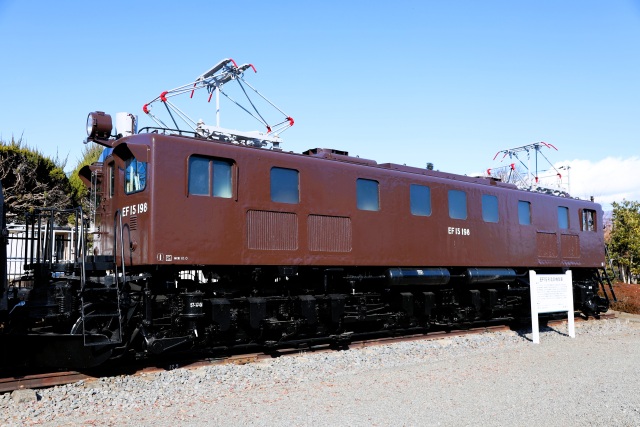
Electric locomotive JNR EF15 198 preserved in Nirasaki Central Park

Happy New Year! The year 2025 has begun. I wish all railfans around the world good health and happiness during this festive season and throughout the coming year. At the start of the New Year, I’m going to show you a beautifully preserved locomotive in Nirasaki Central Park, located in Nirasaki City, Yamanashi Prefecture, about 150 kilometers west of Tokyo.

The Class EF15 is a 1,500-volt direct-current electric locomotive with a 1C+C1 axle arrangement (AAR wheel arrangement). It was developed by the Ministry of Transport in 1947 for hauling freight trains. A total of 202 units were built, but today only four remain preserved in Japan. The EF15 measures 17 meters in length and weighs 102 tons. Its maximum speed was 75 kilometers per hour.

Unit 198 (see the top photo) was built by Toyo Denki and Kisha Seizo in 1958. After operating for 28 years on Japanese National Railways (JNR) lines, it was retired in 1986 as the very last active EF15. Its total running distance reached an impressive 2.12 million kilometers. Please compare it with the Class EF57, which I introduced last November.

I’m not done yet. Please look at the photo below as well. You can see four freight cars coupled behind Unit 198. They consist of three open wagons of the ToRa 70000 series and one caboose of the Yo 5000 series. The ToRa 70000 was JNR’s standard open wagon. A total of 5,100 units were built, but today only 13 still survive. ToRa701 and ToRa702 on the Mojiko Retro Sightseeing Line are precious survivors of the ToRa 70000 series, preserved after renovation.

Caboose JNR Yo 5000 and open wagons JNR ToRa 70000

Saturday, 30 November 2024

Utsunomiya’s Hidden Treasure: The Preserved EF57

Electric locomotive Unit 7 of Class EF57 preserved in Utsunomiya City

Utsunomiya is the main city of Tochigi Prefecture, located about 110 kilometers north of Tokyo. It sits in the northern part of the Kanto Plain, and is widely known for its machinery and food industries. Speaking of railways, you may remember that Japan’s newest tramline opened in Utsunomiya last August. The cumulative number of passengers reached six million on November 19th this year—four months earlier than expected. It has been a great success.

Utsunomiya is certainly an advanced railway city, but it also has its own nostalgic charm. If you walk around the city, you may come across a precious old locomotive. Please take a look at the photos. This is Electric Locomotive (EL) Unit 7 of Class EF57, preserved in Utsunomiya-higashi Park. The Class EF57 is a 1,500V direct-current electric locomotive with a 2C+C2 (AAR) wheel arrangement. It was developed by the Ministry of Railways in 1940 for hauling express trains on main trunk lines. Its maximum speed was 95 kilometers per hour. A total of fifteen units were built by Hitachi and Kawasaki Sharyo.

Unit 7 was manufactured by Hitachi in 1942 and retired from the Japanese National Railways (JNR) in 1978. It is the only surviving member of the Class EF57 and has been preserved in this park since 1980.

Please look at the top photo again. The pantograph sticking out from the body is really cool! The special deck in front of the cab is also unique. I was truly fascinated by this precious EL.

Front view of Unit 7, JNR Class EF57

Friday, 8 November 2024

Tama Riverside Walking: Part 12 – Minami-Tama

Set N24 of JR East’s E233-8000 series, crossing the Tama River

It was already November. The air had turned crisp, making it an ideal season for a quiet walk. I resumed my regular strolls along the Tama River, and this time I chose Inagi City in western Tokyo as my destination. After getting off at Minami-Tama Station on JR East’s Nambu Line, I headed straight toward the riverbank.

Before continuing, let me briefly introduce Inagi City. Located along the middle reaches of the Tama River, it is a residential area that was largely developed in the 1970s. When I was a child, I occasionally visited this area with my schoolteacher and classmates for autumn pear picking. I remember being told that Inagi’s well-drained soil makes it suitable for pear cultivation. Much of the city spreads across the river terrace formed by the Tama River.

As soon as I stepped onto the embankment, a six-car EMU crossed the river on the Nambu Line bridge. It was a northbound service operated by Set N24 of the EMU JR East's E233-8000 series. This series is the mainstay of the Nambu Line today, featuring stainless-steel car bodies with the familiar yellow, orange, and black stripes. I see these trains almost every day, yet watching one glide across the wide Tama River offers a slightly different and refreshing impression.

I continued walking upstream at a relaxed pace. About three minutes later, a freight train appeared on the adjacent bridge reserved for freight traffic. Leading the train was a blue electric locomotive, Unit 337 of JR Freight's Class EF210-300, widely known by its nickname, “Momotaro.” I attempted to capture the entire consist in a single frame, but the container train was longer than the bridge itself. In the end, I focused on a close-up of the locomotive, highlighting its powerful yet clean-lined design.

JR Freight Class EF210-300 electric locomotive, Unit 337, leading a container train

Saturday, 12 October 2024

Extra Rare Steam Locomotive Preserved in Sendai City

Steam Locomotive Unit No. 1 of the Class C60 preserved in Sendai West Park

After observing trains on the Namboku Line of the Sendai City Subway, I visited Sendai West Park in the city center. My objective was to see Steam Locomotive Unit No. 1 of the Class C60 (hereafter referred to as C60 1), which is preserved in the park.

Let us take a brief look at the Class C60. It is a 4-6-4 (Whyte notation) steam locomotive with a tender. The C60 was originally developed as the Class C59 by the Ministry of Railways in 1941 and was later converted into the Class C60. What was the background behind the appearance of the C60?

The Class C59 originally designed to haul express trains on trunk lines. However, many of these trunk lines were electrified during the 1950s. As a result, the C59 locomotives had to be reassigned to local lines. The problem was that local lines had weaker load-bearing capacity. Therefore, the heavy axle load of the C59 needed to be reduced to allow operation on these lines. To achieve this, the wheel arrangement was changed from the 4-6-2 configuration of the C59 to the 4-6-4 configuration of the C60 by adding one trailing axle.

C60 1 was originally built in 1941 at the Hitachi Kasado Works as C59 27. It was later converted into C60 1 at the Japanese National Railways Hamamatsu Works in 1953. After operating for 15 years as C60 1, it was retired from service in 1968 and moved to Sendai West Park. It is an extremely rare steam locomotive, as it is the only preserved Class C60 in Japan. I would like to express my sincere appreciation to everyone involved in preserving C60 1 in Sendai City.

Rear view of C60 1

Related link:

Friday, 20 September 2024

C57 57: My Neighboring Locomotive

Unit 57 of the steam locomotive Class C57 is preserved in Okura Athletic Park

There is an expression in Japanese that says "it is darkest under the lighthouse". I am not a native English speaker, but “the darkest place is under the candlestick” in English may have similar meanings. For me, Unit 57 of the Class C57 (hereafter C57 57) is exactly the steam locomotive preserved "under the lighthouse”. C57 57 is preserved in Okura Athletic Park in Setagaya Ward of Tokyo Metropolis. This public park is near my house, but I had never been to there until recently. 

Let me review the Class C57 to start. The C57 is a 4-6-2 (Whyte notation) type steam locomotive that has a tender attached. It was developed by the Ministry of Railways in 1937 for pulling passenger trains. It is 20.28 meters long, and weighs 67.5 tons. The driving wheel diameter is 1,750 millimeters. A total of 201 units were built by Kawasaki-sharyo and the other companies. The Class C57 is called "the lady" among rail-fans. I agree with it, because its design is beautiful. For example, the boiler is slender, in contrast, the driving wheels are large.

C57 57 was built in 1938 by Kawasaki-sharyo. It was mainly operated in the northern part of Japan, so, there is a large snow plow on the front. After operating for 38 years, C57 57 was retired from the track in 1976. Its total driving distance was 3,365,110 kilometers, which is equivalent to 4.5 round trips from the Earth to the Moon. C57 57… thank you for your hard work.

Back view of C57 57

Thursday, 5 September 2024

Old Locomotives Used in a Steelworks

Steam locomotive NUS 5 is preserved in Chiba Park

Chiba City is located some 40 kilometers east of Tokyo, and the prefectural capital of Chiba Prefecture. The current population is about 1 million. This large city is famous for heavy industries such as the steel industry. Chiba Steelworks of Kawasaki Steel Company (present JFE Steel Company) is the representative steelwork in the city. This steelwork once had steam locomotives, named NUS 5, 6 and 7. I’m going to show you NUS 5 (the top photo) and 6 (the photo below) today.

NUS 5 and 6 are 0-6-0 (Whyte notation) type tank locomotives. They were built by Kawasaki Sharyo in 1948 for in-yard material transportation. Most notable point of these locomotives are their couplers. These locomotives have two kinds of couplers, namely automatic couplers and Willison couplers. After operating for 20 years, NUS 5 and 6 were retired from the track. Chiba City took over these locomotives in 1977. NUS 5 is currently exhibited in Chiba Park. On the other hand, NUS 6 is exhibited in Komoike Park. Two locomotives are both preserved in good condition. I would like to thank everyone involved in preserving these locomotives in Chiba City.

Incidentally, do you see any difference between the two locomotives? It might be difficult to find, but one of the answers is shape of smokestacks. NUS 5 has a smooth smokestack with a gold-colored ring. On the other hand, NUS 6 has a stepped smokestack. I hope that you will be happy to perceive this kind of fine difference among the locomotives as a trainspotter.

Steam locomotive NUS 6 is preserved in Komoike Park

Thursday, 15 August 2024

Preserved Steam Locomotive just along the Railway Track

Steam locootive C57 66 is preserved just along the JR East Keihin Tohoku line

Do you have any spot you want to check out? For example, you often pass by that spot by train, but you have never been there. Iriarai-nishi Park in Tokyo was one such spot to me. I often passed by there by the JR East's Keihin-Tohoku line train, but I didn't visit there until recently.

What is Iriarai-nishi Park like? It's a public park for children to learn about transportation. For that purpose, several vehicles are exhibited in the park. Unit 66 of the steam locomotive Class C57 (hereafter C57 66) is one such exhibit. It's preserved just along the Keihin-Tohoku line track in a "semi-dynamic state". It means that the driving wheels can be rotated by compressed air. In fact, this special "wheel rotating show" is held twice a day. Needless to say, it's a popular event among local children.

For your information, the Class C57 is a 4-6-2 (Whyte notation) type steam locomotive that has a tender attached. It was developed by the Ministry of Railways in 1937 for pulling passenger trains. It is 20.28 meters long, and weighs 67.5 tons. The driving wheel diameter is 1,750 millimeters. A total of 201 units were built by Kawasaki-sharyo and the other companies. The Class C57 is called "the lady" among rail-fans. I agree with it, because its design is beautiful. For example, the boiler is slender, in contrast, the driving wheels are large. Please check out my previous post on the Class C57 as well, if you have time.

Side view of C57 66 in Iriarai-nishi Park

Monday, 1 July 2024

Steam Locomotive Preserved by Shochu Brewery

Unit 48647 of the Class 8620 is preseved in Takachiho Town
(Photo: Nicolai Okkels)

I've received interesting pictures from a Danish rail-fan. He traveled Shikoku and Kyushu islands of Japan, and shot a preserved steam locomotive. My thanks go to Nicolai Okkels, who kindly sent me these photographs.

Unit 48647 of the Class 8620 is a precious steam locomotive (hereafter SL) preserved in Takachiho Town of Miyazaki Prefecture, Kyushu Island. Unit 48647 is preserved on the railway bridge. Why is it there? Because, this bridge is a part of an uncompleted railway line, which was canceled before completion. On the other hand, there is another way to use this uncompleted railway line. That's a shochu (a kind of Japanese liquors) storage using a tunnel. In short, this uncompleted line is used as both the preservation spot of the SL and the storage of shochu bottles by Shochu Brewery. Takachiho is thought to be a founding place of Japan, as there are many mythologies, so, many tourists visit there. This SL is a good landmark for tourists to visit the brewery.

For your information, the Class 8620 is a 2-6-0 (Whyte notation) type SL that has a tender attached. It was developed by the Ministry of Railways in the early 1910's for express trains on the semi-trunk lines. Unit 48647 was built in 1921, and retired from the track in 1973. One of the epoch-making events for this SL was pulling the Emperor's train in 1969. The Japanese flag on the front of this SL is a memorial of its glorious history.

Side view of Unit 48647 (Photo: Nicolai Okkels)

Thursday, 13 June 2024

Class D52: Preserved SL in Sagamihara City

Unit 235 of the steam locomotive Class D52 is preserved in Kanuma Park

Following the "slug locomotive" in Nagareyama City of Chiba Prefecture, I'm going to show you the other rare steam locomotive (SL). That's Unit 235 of the Class D52 (D52 235), preserved in Kanuma Park, Sagamihara City of Kanagawa Prefecture.

To start, let me quickly review the Class D52. It's a 2-8-2 (Whyte notation) type SL that has a tender attached. A total of 285 units of the Class D52 were built from 1943 to 1946 in the closing days of World War II. It's 21.105 meters long, and weighs 74.42 tons. The driving wheel diameter is 1,400 millimeters. It produces an output of 1,433kW and a maximum speed of 85 kilometers per hour. Their main function was to pull 1,200 ton-class heavy freight trains.

Let's get down to the main topic. D52 235, which is currently preserved in Kanuma Park, was built by Kawasaki-sharyo in 1946. After operating for 27 years, it was retired from the track in 1973. D52 235 was then taken over by Sagamihara City in 1975. When I saw it in the park, I was surprised that this SL has a very large boiler. In contrast, the smokestack was very small. It's probably because the size of the D52 had to be kept under the limits of the vehicle. Another surprise was D53 235 had a very good state of preservation. It's maintained by a local volunteers' group named "Sagamihara D52 Preservation Society". I would like to thank everyone involved in preserving D52 235 in Sagamihara City.

Back view of D52 235 in Kanuma Park of Sagamihara City, Kanagawa Prefecture

Tuesday, 14 May 2024

The Slug Locomotive in Nagareyama City

Steam locomotive D51 14 is exhibited in Nagareyama Sports Park

Do you like slugs? In Japan, they appear with the advent of spring. I try to stay away from them as they are so slimy and disgusting. I like snails, though. Speaking of which, I remembered that a "slug locomotive" is exhibited in the metropolitan area.

Unit 14 of the Class D51 (hereafter D51 14) is a precious steam locomotive preserved in Nagareyama City, Chiba Prefecture. D51 14 was built by Kisha-seizo Osaka Factory in 1936 as the first batch of the Class D51. After 37 years' commission on the Japanese Government Railways (later the Japanese National Railways), it was retired from the track, and has been preserved in Nagareyama Sports Park since 1976. I would like to thank a local volunteers' group, who preserve D51 14 in a very good condition. Many rail-fans affectionately refer to D51 14 as "the slug locomotive". Why? Because, its smokestack, feed water heater, sandbox and steam reservoir are integrated, and look like a slug. This shape is different from that of the later batches of the Class D51. Please review my previous posts on the later batches of the Class D51, such as Unit 408, 498 and 516.

Incidentally, the steam locomotive (SL) Class D51 was Japan's largest force of SL fleet. 1,115 units in total were built until 1950. It's a 2-8-2 (Whyte notation) type SL that has a tender attached. It's 19.73 meters long. The driving wheel diameter is 1,400 millimeters. The maximum operating speed was 85 kilometers per hour.

D51 14 is a "slug-shaped" steam locomotive