Sunday, 30 April 2023

Revisit to the City of the Strait

EMU JR Kyushu 415-1500 series stands at Moji station on the Sanyo main line

After visiting Kitakyushu, I continued traveling by train. My next destination was Shimonoseki, which is the major city of Yamaguchi Prefecture, about 1,100 kilometers west of Tokyo. The population is about 247,000. I visited there for the first time in six years. Shimonoseki is famous for its fishing industry, specifically, blowfish. It's a very luxury food in Japan.

To get to Shimonoseki, I took the JR Kyushu Sanyo main line from Moji station. My vehicle was an inter-island train between Kyushu and Honshu (the mainland of Japan) islands via Kanmon Undersea Tunnel. What was new with this undersea railway? I realized that the EMU JR Kyushu 415-0 series, which was an aged standard commuter train, had already disappeared from the track. Replacing the 415-0 series, the 415-1500 series was being commissioned as an inter-island train. Different from the 415-0 series, the 415-1500 series has stainless-steel bodies and bolster-less bogies. The same model had already been retired from the JR East lines in the Tokyo metropolitan area, but it's still full of energy on the JR West lines. Long time no see, the 415-1500 series!

After arriving at Shimonoseki station, I visited an observation deck of Kaikyo Yume Tower, which is a landmark of Shimonoseki City. What jumped into my eyes there was Kanmon Strait on the border between Honshu and Kyushu islands. The maximum tidal speed in this strait is about 4.8 meters per second, making it one of the foremost straits for swift currents in Japan.

To be continued...

A view of Kanomon Strait from Kaikyo Yume Tower in Shimonoseki City

Thursday, 27 April 2023

The Urban Monorail and the Castle in Kitakyushu City

EMU Kitakyushu Urban Monorail 1000 series arrives at Kokura station

My spring train journey continued. After visiting Kibitsu, the next destination was Kitakyushu City on Kyushu Island. Kitakyushu is located in the northeastern part of Fukuoka Prefecture, about 1,100 kilometers west of Tokyo. It's ranked 2nd in the prefecture in population number after Fukuoka City, and famous for its heavy industries. The current population is about 920,000.

One of the main modes of transport in the city is by monorail. Kitakyushu Urban Monorail Company, which is owned by Kitakyushu City, operates the Kokura line (Kitakyushu Monorail line) in the city. Connecting Kokura and Kikugaoka, the route length is 8.8 kilometers. The route was opened in 1985 as a straddle-beam system. The train is operated every 7 minutes during rush hours; meanwhile, 10 minutes during daytime. The track is double. The electric system is 1,500V direct current. The EMU 1000 series is the sole model on the line. It has been operated since the route was opened. One set is composed of four 15-meter-long cars, and a total of 10 sets are commissioned.

After enjoying the monorail, I visited Kokura Castle in the city center. It was originally built in 1608 by a samurai, Hosokawa Tadaoki. Although the present building is a replica, it's a palimpsest, where you will get a sense of Japan of long ago. The castle tower is quite unique in that the 5th floor (top floor) is wider than that of the 4th floor. It's called "Nanban-zukuri (exotic-style)".

I enjoyed the local train and the historical spot again.

Kokura Castle in Kitakyushu City

Official website, the Kokura Line (Kitakyushu Monorail Line):

Tuesday, 25 April 2023

2023 Cherry Blossom Season: The JR West Kibi Line

DMU JR West KiHa 47 series arrives at Kibitsu station on the Kibi line

After visiting Kurashiki City, I continued travelling to enjoy trains and cherry blossoms. My next destination was Kibitsu on the JR West Kibi line.

Kibitsu is located in the northern suburb of Okayama City, about 740 kilometers west of Tokyo. It's the place of origin of a famous folklore, "Momotaro (peach boy)". Momotaro was said to be born from a large peach in the Kibitsu area. He defeated the ogres, who were causing troubles in the area, and became a local hero. To acknowledge his achievements, Kibitsu Shrine was said to be constructed later at the ex-frontline base of Momotaro. When I visited the shrine, cherry trees along the corridor were in full bloom. It must be the best season of the Kibitsu area.

To get to this legendary place, the nearest station is Kibitsu on the JR West Kibi line. This local line was opened in 1904. Connecting Okayama and Soja, the route length is 20.4 kilometers. The track is unelectrified and single. Diesel railcars were operated every half an hour to one hour. My vehicle was the DMU JR West KiHa 47 series. The KiHa 47 series was commissioned by the Japanese National Railways in 1977. 370 units in total were built by Niigata Tekko and Fuji Heavy Industries. A 162kW diesel engine is carried on the unit. Different from their brothers, namely KiHa 40 and 48 series, it takes the appearance of a single cab car with double doors.

The train journey continues.

The corridor of Kibitsu Shrine and cherry trees in full bloom

Sunday, 23 April 2023

2023 Cherry Blossom Season in Kurashiki City

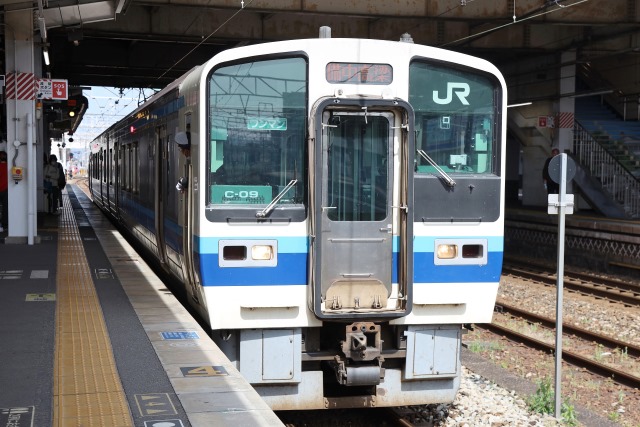
Set C09 of the EMU JR West 213 series stands at Kurashiki station

Let me continue from where I left off my last post. When I visited Kurashiki City, it was the best season for cherry blossom viewing. There were many cherry trees in full bloom along the stream of the historical quarter. They were very gorgeous against the old white walls and the blue sky. Spring was in full swing.

Taking this opportunity, I'm going to introduce a train, which comes to Kurashiki station. The EMU 213 series is the last model, which the Japanese National Railways (JNR) developed in 1987. It's a stainless-steel train for 1,500V direct current tracks. A total of 65 units were built by Nippon-sharyo, Hitachi and others. After the breakup and privatization of JNR, these trains were transferred to JR West and JR Central. The trains belonging to JR West have blue-colored stripes; meanwhile, the JR Central's ones have orange and green-colored stripes.

The 213 series on the JR West lines was originally commissioned as an inter-island train between Honshu (the mainland of Japan) and Shikoku islands. After operating for 16 years, it was replaced by the JR Shikoku 5000 and the JR West 223-5000 series in 2003. The 213 series was then moved to the local lines. The top photo is a train, set C09 of the EMU 213 series, bound for Bicchu-Takahashi on the Hakubi line. This trainset is composed of one motorcar (KuMoHa 213-9) car and one trailer (KuHa 212-103).

Enjoying the cherry blossoms and the local trains, I continued travelling. I really enjoyed myself.

Cherry trees in full bloom, Kurashiki Bikan historical quarter

Friday, 21 April 2023

The Historical Quarter and Train in Kurashiki City

EMU JR West 115 series arrives at Kurashiki station on the Sanyo main line

After visiting Okayama, I continued traveling to feel the spring. My next destination was Kurashiki City. It's the second largest city in Okayama Prefecture, about 750 kilometers west of Tokyo. The population is about 470,000. Kurashiki is famous for its heavy industries, but that isn't everything. There's a famous sightseeing area, "Kurashiki Bikan historical quarter". This area stands out for its townscape of white walls and has been recognized as an Important Preservation District of Historical Buildings, which can be enjoyed for its Edo Era (1603 - 1867) scenery. A small river flows in the center, and its scenery is also very popular among tourists. When I walked along the river, newly-weds were enjoying a boat tour wearing a kimono (traditional Japanese cloth). Congratulations on your wedding! Best wishes for a happy marriage.

Now, let's get down to the main topic. When I arrived at Kurashiki station on the JR West Sanyo main line, I came across a nostalgic yellow train, the EMU 115 series. It's a direct current standard commuter train, commissioned in 1963 by the Japanese National Railways (JNR), so, it's a train that has had a very long life. Nearly 2,000 units were built by Kisha seizo, Nippon sharyo, Kawasaki Heavy Industries and others. After the breakup and privatization of JNR, the 115 series was transferred to five companies, but they have been retired one after another due to deterioration. For example, they eventually disappeared from the JR East lines in 2022.

I could enjoy the historical quarter and the train on that day.

Wedding boat in the Kurashiki Bikan historical quarter