Saturday, 11 April 2015

Inauguration of Hokuriku Shinkansen

Set number W9 of the EMU JR West W7 series stands at Tokyo Station

On March 14th, a new shinkansen line was inaugurated between Nagano and Kanazawa. It has cut the travel time between Tokyo and Kanazawa from 4 hours 20 minutes to 2 hours 28 minutes.

The new route, Hokuriku Shinkansen, attains a length of 228 km. The most distinctive feature of this line is a trans-mountain route penetrating steep mountainous areas such as Echigo Mountains. It is a bridge-tunnel railway, which connects cities located on the Pacific Ocean and the Sea of Japan.

The main fleet of the Hokuriku Shinkansen is the EMU JR East E7 and the JR West W7 series. They are 25,000 V AC trains with a 50Hz/60Hz dual frequency system. The E7 series was launched in 2014 as a Nagano Shinkansen train; meanwhile, the W7 series newly debuted at the timing of inauguration of the Hokuriku Shinkansen. The specifications of the E7 and the W7 series are mostly the same. The maximum speed is only 260 km/hour, but they can climb up the Usui Pass (a steep incline of 30 per mil) at a speed of 210 km/hour. A total of 27 sets, 324 units, has been manufactured so far.

The fastest train stopping at only major stations is named as Kagayaki (brightness). The other trains are Hakutaka (white halk), Tsurugi and Asama (famous mountains on the line). All trains have Gran and Green Class cars. Construction work is going on to extend the line to Fukui and Tsuruga, which is expected to open around 2020.

Display on the side body of the EMU JR West W7 series

More information about Hokuriku Shinkansen (in Japanese):
Test run movie, "Driver's View", shot between Nagano and Kanazawa:
Promotion video of the JR East E7 series:

Thursday, 9 April 2015

Cherry-filled Night Sky on the Toei-Shinjuku Line

Set number 230F of the EMU Toei 10-000 series stands at Sasazuka Station on the Keio Line
 
The peak sakura (cherry blossoms) season came in Tokyo last week. We could see fully bloomed cherry trees here and there. I visited Chidorigafuchi Greenway near my office for viewing Yozakura as had happened in the past. It was different from previous years, because I saw more and more foreigners there this year.

What is Yozakura? It is a fully bloomed cherry tree illuminated at night. In some famous sakura spots, we can enjoy Yozakura viewing. Look at the following picture. It is artfully illuminated sakura along Chidorigafuchi Greenway. It was fantastic and dreamy. The cherry-filled night sky with a half-moon would be my best memory in the 2015 sakura season. For your information, all illuminations are supplied by solar photovoltaic power generators in consideration of the environment.

To visit Chidorigafuchi Greenway, it is convenient to get off at Kudanshita Station on the Subway Toei-Shinjuku Line. The Toei-Shinjuku Line was opened in 1978 as Tokyo's 10th subway route. Connecting Shinjuku, a subcenter of Tokyo and Motoyawata, an interchange station with the JR East Sobu Line, the total operating length is 23.5km.

Set number 230F is the oldest active train on the line. It was manufactured in 1988 as a part of the fourth batch of the EMU 10-000 series. Different from the current standard commuter trains in Tokyo, the electric control system of the 10-000 series is a little old... the armature chopper, but I like this train, specifically its nostalgic corrugated stainless steel body.
 
Cherry-filled night sky near Kudan-shita Station on the Toei-Shinjuku Line
 
More information about the Toei Trains (in Japanese):

Tuesday, 7 April 2015

The Fourth Anniversary of Tokyo Railway Labyrinth

EMU JR East E4 series stands at Tokyo Station on the Joetsu Shinkansen
 
Tokyo Railway Labyrinth had its fourth anniversary today. I thank all my blog readers for visiting this website over the last four years. I have been introducing you to the labyrinthine railway routes and their trains in the Tokyo metropolitan area. I think that process is going to go on. In commemoration of the fourth anniversary, I am going to show you a train with the number "4" in the name... the EMU E"4" series. Is it a bit of a stretch?

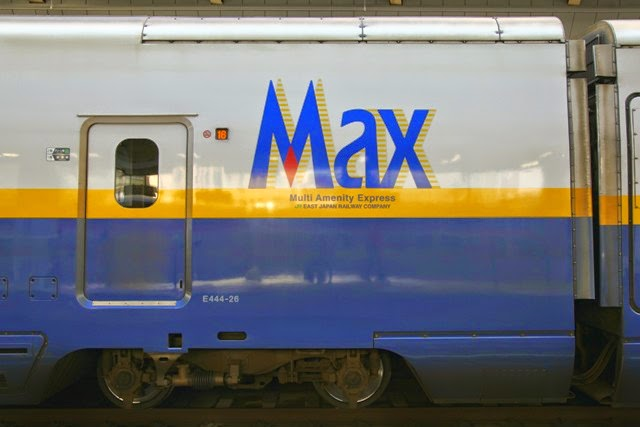
The EMU JR East E4 series is a duplex shinkansen train launched in 1997. Currently, they are only operated on the Joetsu Shinkansen for limited express trains, Max-Toki and Max-Tanigawa. Joetsu Shinkansen is the main transportation artery between the Tokyo metropolitan area and Niigata Prefecture. The E4 series consists of 8 cars, which can accommodate 817 seats in one set. So, a maximum of 1634 seats are available, when two sets of trains are connected. Although its speed is limited to a maximum of 240km/hour, they are utilized as shinlkanesen trains to transport large numbers of passengers during rush hour.

I sometimes ride the E4 series and found that it's more comfortable than I imagined. The best advantage was its good view from the upstairs window, but the design of this train is not my cup of tea, as it looks like a giant squid in the deep sea.

The EMU E4 series... it is a dependable duplex monster train for daily Tokyo.

 
Side view of the E4 series
 
More information about the EMU JR East E4 series (in Japanese):

Saturday, 4 April 2015

2015 Sakura Season on the Takasaki Line

EMU JR East 651-1000 series passes through Miyahara Station on the Takasaki Line 

Sakura (cherry blossoms) season has come in the Tokyo metropolitan area again. We can see beautiful faint pink blossoms here and there. Tokyoites are feeling the herald of spring now. With so many cherry blossom viewing spots available, it's hard to select which one is the best. After wavering, I headed to Kumagaya City in Saitama Prefecture last weekend.

Kumagaya is an inland city along the Arakawa River. This city is famous for its National Treasure, Shodendo, in Kangi-in Temple. Apart from the National Treasure, a long row of cherry trees on the bank of Arakawa River is reputable as a sightseeing spot in the city. They were supposed to bloom gloriously with beautiful flowers this season... but, most of the trees had not come into flower yet, when I visited there on the last weekend. Instead of the reputable spot, I visited Kumagaya Central Park, where an early-blooming cherry was seen. It was a small tree, but I could enjoy graceful branches with flowers in full bloom. Spring has come!

To get to this cherry blossom viewing city, please take the JR East Takasaki Line and get off at Kumagaya Station. It takes about one hour from downtown Tokyo. During my journey, I came across a limited express train, Kusatsu, the EMU 651-1000 series at Miyahara Station. The 651 series was once retired from the Joban Line, but came back onto the track
 under the name of the 651-1000 series in 2014 after a full renovation.
 
Cherry blossoms are seen in the Kumagaya Central Park near Kumagaya Station
 
More information about limited express train, Kusatsu (in Japanese):

Thursday, 2 April 2015

EMU Sotetsu 7000 Series: The Evergreen Train

EMU Soetsu 7000 series, limited express train, travels on the Isumino Line
 
Sagami Railway (Sotetsu) is one of major private railways in the Tokyo metropolitan area. Starting from Yokohama, the main city in Kanagawa Prefecture, Sotetsu connects Ebina on the Main Line and Shonandai on the Isumino Line. There are 25 stations over a total operating length of 35.9km.

It is slightly old news, but Sotetsu changed the timetable on April 27th last year. The highlight of this new timetable was the launch of the "limited express train" on the Main and Isumino lines. As a result of this new timetable, we came to see a limited express train using the company's oldest model, the EMU 7000 series. The 7000 series is the Sotetsu's longest-serving active model, which was launched in 1975. A total of 80 units have been manufactured.

I absolutely love this train, because the 7000 series has an afterglow of the 1970s. Its design is rough with angular bodies, simple rounded front lights, and bare jumper cables in the front. From the present viewpoint, its equipment is also rather old, such as DC motors, bare disc brakes, and a resistance control system; however, everything fills me with nostalgia. What's worth more than anything else is that the 7000 series is still commissioned as the company's promotional train, limited express.

When I visited Sotetsu last year, I came across the limited express train using the 7000 series at Ryokuen-toshi Station on the Isumino Line. It was shining in the glare of the spring sun.
 
EMU Sotesu 7000 series, limited express train, passes through Ryokuen-toshi Station
 
More information about Sotetsu Trains (in Japanese):