Wednesday, 15 February 2017

A Hint of Spring on the Enoshima Line

5011F of the EMU Shonan Monorail 5000 series arrives at Shonan-Fukasawa Station

Enoshima is famous for its temperate climate. It faces the Pacific Ocean to the south. The influx of the Kuroshio warm current influences this mild climate. We can see many flowers there even in winter. One of the well-known flowers is a weeping plum in Joritsu-ji temple. In Japan, plum is grown for fruit cultivation or just ornament. Weeping plum is a typical example of the latter. From January to February, the weeping plum tree in Joritsu-ji temple has many white blossoms. It heralds that spring is in the not-so-distant future. The plum blossoms are very beautiful backed by the blue sky.

To see this gorgeous tree, the nearest station is Shonan-Enoshima on the Shonan Monorail-Enoshima Line. The Enoshima Line was opened in 1974 between Ofuna and Shonan-Enoshima stations. The operating length is 6.6 km. The suspended system is adopted the same as the Chiba Urban Monorail Line and the Toei Ueno Zoo Line. The track is single and the electric system is 1,500 V DC. The EMU 5000 series is the only group of trains operated on the Enoshima Line. The top photo is 5011F, the 6th set of the 5000 series launched in 2015. It is easy to distinguish from the other trains, as it has black colored stripes.

Boarding the train, enjoy an aerial walk on the Enoshima Line!

Fully blossomed weeping plum tree in Joritsu-ji Temple near Shonan-Enoshima Station

Sunday, 12 February 2017

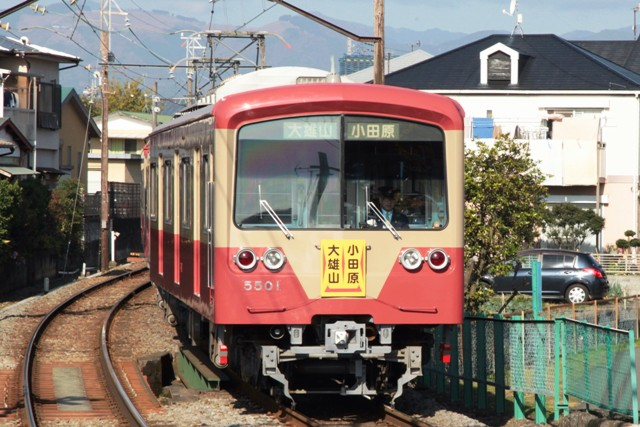
5501F: Revival Colored Train on the Daiyuzan Line

5501F of the EMU Izu-Hakone 5000 series arrives at Sagami-Numata Station

Revival color is the key trend on the Japanese Railways. Many companies are operating revival colored trains with previously used body colors to attract passengers. The main targets are sightseers and veteran rail-fans. One type of revival colored train is the "new modeled train painted with nostalgic revival colors". For instance, the Keio 8013F and the Tokyu 1017F belong to this category. We can enjoy extraordinary experiences, as the familiar trains change to nostalgic ones.

On October 1st, 2016, Izu-Hakone Railway launched a new revival colored train in commemoration of the 90th anniversary of the Daiyuzan Line. It was 5501F of the EMU 5000 series. 5501F is a 3-car train built by Tokyu Sharyo in 1984. The original color was white with blue stripes, but it has been changed to a dark rose-color with a beige stripe called Akaden (red electric car). This color design had been used until 1996 on the Daiyuzan Line. It suits the 5501F and is very nostalgic for me.

For your information, the Daiyuzan Line was opened in 1925 between Odawara and Daiyuzan stations. It was constructed to transport worshippers to the famous Saijo-ji Temple. The route length is 9.6 km. The track is 1,067 mm-size single and electrified. The electric system is 1,500 V DC overhead. Trains are operated every 12 minutes on average. Currently, the passengers are not only worshipers, but also local commuters and students going to Odawara, Yokohama, and so on.

5501F... it is a revival of Akaden on the Daiyuzan Line.

5501F arrives at Sagami-Numata Station on the Daiyuzan Line

Official information about the rolling stock on the Daiyuzan Line (in Japanese):

Thursday, 9 February 2017

Sayonara KiHa40 on the Karasuyama Line

Diesel rail-car KiHa 40 series (Karasuyama color) stands at Utsunomiya station yard

JR East recently made a press release announcing that three more sets of the state-of-art accumulator train, EV-E301 series, will be introduced to the Karasuyama Line on March 4th. The accumulator train is an EMU (Electric Multiple Unit), which has lithium ion accumulators. The power of this train is supplied from 1,500 V DC catenaries on an electrified track via pantographs; meanwhile, the train is operated with accumulators on a non-electrified track. The Karasuyama Line is a 20.4 km-long non-electrified route. 

As a result, the present diesel rail-cars won't be operated on the Karasuyama Line any longer. In other words, the present rolling stock, namely the KiHa40, will be retired soon. There is no fighting against the trend of the times. The diesel rail-car KiHa40 series was launched in 1977 by Japanese National Railways (JNR). JNR was Japan's largest railway network at that time, so, the KiHa40 series was soon introduced to lines all over Japan from Hokkaido in the north to Kyushu in the south. After JNR was split into seven railway companies in 1987, each regional company has started to introduce their own rolling stock. It means that the KiHa40 has started retirement bit by bit from this timing. Currently, the Karasuyama Line is the only route where we can see these JNR-type old rail-cars in the Tokyo metropolitan area.

The last run of the KiHa40 on the Karasuyama Line will be planned on March 3rd. Sayonara (good-bye) and Arigatou (thank you) the KiHa40.

Diesel rail-car KiHa 40 series (metropolitan color = right) stands at Utsunomiya station yard

Monday, 6 February 2017

Aka-soba Field on the Iida Line

EMU JR Central 213 series travels on the Iida Line

Japanese people are soba lovers. What is soba? It is a Japanese-style noodle made from buckwheat flour. They are eaten hot in broth or cold after being dipped in a soy-flavored sauce. Soba blossoms from summer to autumn. In the blooming season, all over the soba fields change to white, because soba has myriad white colored small flowers.

In recent years, unusual soba also became known among soba lovers. It is aka-soba (red colored noodle), originally from the Himalayan Range. As its name suggests, aka-soba produces red to pink colored flowers in autumn. It is quite unique so that many people visit aka-soba fields when they blossom. In other words, aka-soba fields are precious tourism resources as well. There is a famous aka-soba field in Minowa Town of Nagano Prefecture. We can see beautiful dark pink colored carpets in September.

To get to this beautiful spot, the nearest station is Ina-Matsushima on the JR Central Iida Line. The Iida Line was originally opened by four separate private railways. It was, then, purchased and merged by the government during WWII due to wartime control. One of the fleets on the Iida Line is the EMU 213 series. The 213 series was launched by the Japanese National Railways (JNR) in 1987. After breakup and privatization of JNR, the 213 series was transferred to JR Central. It has been operated on the Iida Line since 2011 after renovation. The 213 series is similar with the 211 series, but it has only four doors per unit.

Aka-soba field near Ina-Matsushima Station on the Iida Line

Friday, 3 February 2017

Students' Supporter on Shikoku Island

Diesel rail-cars JR Shikoku 1000 series arrive at Kochi Station in the morning sunlight

I had an opportunity to visit Kochi City for the first time in five years. Kochi is the main city of Kochi Prefecture on Shikoku Island. You can reach there from Tokyo by air or by trains passing through the Seto-ohashi railway bridge. Although I was very busy there, I could secure a short time in the early morning to visit Kochi Station on the Dosan Line to see what was going on at this gateway station to the main city.

Just before 8 o'clock, a 4-car train arrived at the station with a light engine sound. It was JR Shikoku's diesel rail-car, the 1000 series. The Dosan Line is un-electrified, so we can't see any catenaries or wire poles at the station yard. The passengers getting out of the train were mainly high school students coming from the suburban areas of Kochi City. The boys and girls headed to their schools chatting happily with their friends. It may be a usual morning scene. Five minutes later, the platform became quite again, and the next train arrived 10 minutes later.

The diesel rail-car JR Shikoku 1000 series was launched in 1990 for commuter transport in the Kochi and Tokushima areas. To date, a total of 56 units have been built by Niigata Tekkosho. It has six doors per car to make it easy for passengers to get on and off at the stations.

The diesel rail-car 1000 series... it is a strong supporter of students on Shikoku Island.

Diesel rail-cars JR Shikoku 1000 series stand at Kochi Station on the Dosan Line