EMU JR Kyushu 811 series stands at Mojiko station yard
JR Kyushu is the largest railway company on Kyushu Island. It was established in 1987 following the breakup and privatization of Japanese National Railways. When JR Kyushu was launched, many economic analysts pointed out that this company would soon face severe managing conditions, since its railway network was located in underpopulated areas with low transport density. 29 years later, however, the performance of JR Kyushu was much better than what the economic analysts had predicted. As a result, JR Kyushu was listed in the first section of the Tokyo Stock Exchange on October 16, 2016.
The EMU 811 series is the first commuter train developed by JR Kyushu. It is a 4-car train for 20 kV and 60 Hz alternate current tracks. A total of 28 sets, 112 units, were built by Kinki Sharyo, Hitachi and JR Kyushu Kokura Factory from 1989 to 1993. The 811 series has a thyristor phase electric control system with direct current motors. It was a rather old system, so that some of the 811 series were recently renovated with VVVF inverter (variable-frequency drive) electric control systems.
The EMU 811 series has become a driving force of JR Kyushu's company growth. Replacing the old 415 series, it has been playing the leading role of urban transportation in Fukuoka and Kita-Kyushu cities. Although new commuter trains, such as the EMU 813 and 817 series, have appeared one after another, the 811 series still keeps the main position of the JR Kyushu's standard commuter trains.
EMU JR Kyushu 813 series (left, red colored) and the 811 series
Electric car, unit number 7022 of the Toei 7000 series arrives at Shin-Koshinzuka Stop
One of the representative streetcars has disappeared from the Tokyo Metropolis. On June 11th this year, the final streetcar of the Toei (the Transportation Bureau of the Tokyo metropolitan Government) 7000 series finished its operation and retired from the track.
The 7000 series was Toei's longest-serving model launched in 1954. A total of 93 units were built by Alna Koki. The 7000 series was a 600V DC streetcar on the 1,372 mm gauge track of the Toei-Arakawa Line. The control system was a classic rheostatic, and the drive system was the classic nose suspended drive. I often visited the Arakawa Line and enjoyed the nostalgic beating sound generated from the nose suspended drive.
What has been the fate of the 7000 series? Most of them have already been scrapped or preserved in public parks, such as unit numbers 7001 and 7022. The good news is that eight units of the 7000 series have been renovated and come back to the track in the new name of the 7700 series, including unit numbers 7018, 7024 and 7026. Their doors have been widened to make it easier for passengers to get on and off, and their traveling system has been totally changed. For instance, the VVVF (variable voltage and variable frequency) inverter has been adopted as an electric control system to save electric power consumption.
Sayonara (good-bye) and arigatou (thank you) to the Toei 7000 series. The 7700 series, welcome to the Arakawa Line.
Electric car, unit number 7005 of the Toei 7000 series arrives at Gakushuin-shita Stop
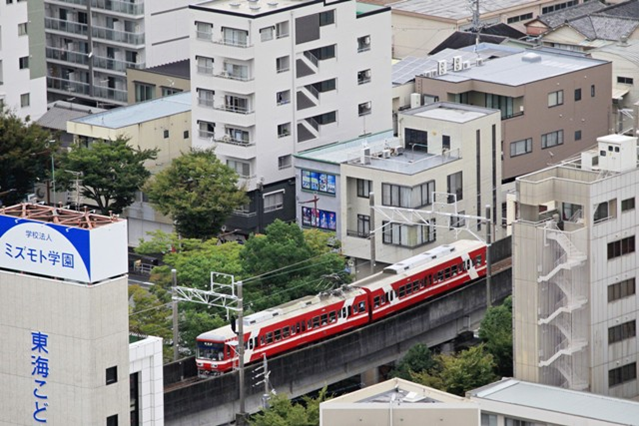
EMU Entetsu 1000 series arrives at Daiichidori Station
Hamamatsu is a major city in Shizuoka Prefecture, located about 260 km west of Tokyo. Currently, it has a population of 0.8 million, which is ranked at sixteenth in Japanese cities. In 1990, the population of Hamamatsu City exceeded that of Shizuoka City, which is the capital of Shizuoka Prefecture, to become the top in the prefecture.
Hamamatsu is known as an industrial city. Especially, production of musical instruments and transportation equipment are famous among Japanese people. Several major companies such as Yamaha and Suzuki have their headquarters in Hamamatsu City.
As a rail-fan, my attention is drawn to a local private railway company, Enshu Railway (Entetstu). Entetsu has a 17.8 km electrified single track, between Shin-Hamamatsu and Nishikashima stations. The gauge size is 1,067 mm and the electric system is 750 V DC overhead. Although Entetsu is a small local railway, the track is elevated to relieve traffic congestion in the city center. The trains are operated every 12 minutes on average during the daytime.
Trains of Entetsu are called "Akaden (red trains)" by local people. It is because all the Entetsu trains have red colored bodies with a white colored stripe. The EMU 1000 series is Entetsu's representative model. The 1000 series was launched in 1983. A total of 7 sets, 14 units have been built by Nippon Sharyo. Different from the old models such as the 30 series, the 1000 series has rectilinear bodies. The body length is 19 meters, which is quite unique in Japan.
Night view of Hamamatsu City
Set R15 + R16 of the EMU JR East 107 series arrives at Kanashima Station
One by one, the old trains have disappeared from the Tokyo metropolitan area. On July 27th this year, JR East Takasaki Branch Office gave a press release announcing that the EMU 107 series would be retired from the track by the end of September.
The EMU JR East 107 series is a direct current standard commuter train in the northern Kanto district. It was launched in 1988 to replace the old model, EMU Japanese National Railways (hereafter JNR) 165 series. A total of 27 sets, 54 units, were built from 1988 to 1991 by JR East Oomiya Factory, Ooi Factory and so on. The structure of the train body was applied from that of the EMU JNR 105 series, so that the 107 series is very similar to the 105 series in appearance.
In recent years, the 107 series has been retired from the track one after another. For instance, it was retired from the Nikko Line in March, 2013, being replaced by the 205-600 series. Eventually, the 107 series finished their regular commercial operation on 30th September.
On October 1st, JR East operated a special train using the 107 series. It was for rail-fans to say sayonara (good-bye) and arigatou (than you) to the 107 series. Although I lost in the draw to join the train tour, I could take pictures of it at Kanashima Station on the Agatsuma Line under the autumn sky of fine weather.
Sayonara and arigatou, the EMU 107 series.
Set R15 + R16 of the EMU JR East 107 series stands at Kanashima Station
Set 2002 of the EMU Tokyu 2000 series travels on the Denentoshi Line
You may think that all the train models in the Tokyo metropolitan area have already been shown in this blog, as I have already uploaded more than 1,000 posts here. Wait a moment please. There still remains an important model. What is that?
This is the first time to introduce the EMU Tokyu 2000 series to you. The 2000 series is a commuter train model for the Denentoshi Line. The 2000 series train is directly operated onto the Tokyo Metro Hanzomon Line, but not operated onto the Tobu Line. It is different from the other Tokyu models such as the 5000 series and the 8500 series on the Denentoshi Line.
The EMU Tokyu 2000 series looks the same as the 9000 series, which is operated on the Ooimachi Line. In appearance, design of the face and the body the 2000 series is very similar to that of the 9000 series. The difference is only the shape of the air-conditioner covers on the roofs. Please look it up yourself. The other differences are bogies, motors, electric control devices and so on.
As a rail-fan, I like the 2000 series, because it has value as a rarity. Only 3 sets, 30 units, were built by Tokyu Sharyo from 1992 to 1993. It will be lucky for you, if you come across the 2000 series, when you take the Denentoshi Line.
The EMU Tokyu 2000 series, is a rare commuter train model on the Denentoshi Line.
Set 2002 of the EMU Tokyu 2000 series leaves Tsukimino Station