 |
| Electric car, unit 107 of the MoHa 1 series is preserved in Odawara City I found a stylish café in Odawara City, Kanagawa Prefecture. It's "107 Cafe" on the National Highway 1. 107 refers to a retired electric car, unit 107, of the Hakone Tozan Railway MoHa 1 series. It's now used as a café for holidaymakers who visit the Hakone Mountains. The MoHa 1 series was originally launched in 1919 under the name of the ChiKi 1 series. It was then remodeled as the MoHa 1 series in 1950, when the voltage on the section between Odawara and Hakone-Yumoto stations was raised from 600 to 1,500 volts. In addition to the replacement of the electric parts, the material of the car bodies was converted from wood to steel. 6 units in total were remodeled by Kisha Kaisha. 2 units (104 and 106) are still operated on the track. Unit 107 of the MoHa 1 series was retired from the track in 2019 due to deterioration. It was then transferred to Suzuhiro Kamaboko Village in 2020, and opened to visitors as Cafe 107. Unit 107 still retains its classic design with a large rounded light on top of the face. I'm happy to say that unit 107 has air conditioners now. Needless to say, this classic electric car didn't have air conditioners when it was operated on the track. Visitors can take time to relax on the patio or in the car. This exclusive experience gives them the chance to enjoy the atmosphere of the good old days while tasting drinks and local foods.  Official information about Cafe 107: https://www.kamaboko.com/en/cafe-107/ |
Tuesday, 17 August 2021
Cafe 107 in Odawara City
Friday, 13 August 2021
New Model on the Oarai-Kashima Line
 Diesel Railcar Kashima Rinkai Railway 8000 series stands at Oarai station yard
Following my previous post, I'm carrying on a recent topic of the Oarai-Kashima line, Kashima Rinkai Railway.
On March 26th 2016, the company launched a new diesel railcar named 8000 series. The introduction of a new model was for the first time in 31 years on the Oarai-Kashima line. The purpose of this new model was to replace the decrepit model, 6000 series. Six carriages in total were built by Niigata Transys from 2016 to 2020.
With regard to the technical specifications, the 8000 series has a 20 meter-long steel body and a diesel engine, which was manufactured by IHI Power Systems, with a 330 PS / 2000 rpm output. The transmission system is hydraulic. The 8000 series is often operated with two cars, but can't be coupled with the 6000 series. It's because the 8000 series has an electric command pneumatic brake. In other words, these two models have different braking systems.
As you may know, the old 6000 series has cross seats and four passenger doors per carriage. It's comfortable for tourists. Different from the 6000 series, the new 8000 series has six passenger doors per carriage and only long seats. It might be good for local commuters and high school students for smooth getting on and off, but a bit boring for a tourist like me to be honest. To get a taste of what a holiday feels like, I prefer the 6000 series to the 8000 series. Sorry, this is entirely just my own personal opinion.
 Side view of the diesel railcar Kashima Rinkai Railway 8000 series
Official information about the rollingstock, Kashima Rinkai Railway (in Japanese):
Monday, 9 August 2021
The 35th Anniversary of the Oarai-Kashima Line

Diesel railcar, unit 6010 of the 6000 series, Kashima Rinkai Railway
I recently visited Kashima Rinkai Railway for the first time in five years. What's new with this local railway in Ibaraki Prefecture?
It's not the most recent, but in March, 2020, the company celebrated its 35th anniversary of the Oarai-Kashima line. Going back to the history of Kashima Rinkai Railway, it was established as a freight railway company in 1969. The company firstly opened a freight line named the Kashima-rinko line (19.2 kilometers) in 1970, then the company opened a passenger line, namely the Oarai-Kashima line in 1985. Connecting Mito, a major city in the prefecture and Kashima-jingu, the operating length of the Oarai-Kashima line is 53 kilometers. The track is single and non-electrified. The gauge size is 1,067 millimeters. Diesel railcars are operated every 20 to 90 minutes. Local people, specifically high school students, are the main users of the Oarai-Kashima line.
The main fleet for passenger transportation is the 20 meters-long diesel railcar, 6000 series, launched in 1985. 19 carriages in total were built by Nippon Sharyo and Niigata Tekko from 1985 to 1993. Eleven carriages are still operated on the line. It has a 230PS/1,900rpm with a liquid transmission. The maximum speed is 95 kilometers per hour. It can accommodate up to 120 passengers. The red colored body with a white colored stripe is the symbol of this railway company. The 6000 series has four doors and semi-cross seats.
In 2016, the company launched a new model, the 8000 series. I'm going to introduce it next time.

The 35th Anniversary poster of the Oarai-Kashima line
Thursday, 5 August 2021
Blue and Red Colors in Kodaira City

Set 9103 of the EMU Seibu 9000 series travels on the Tamako line in Kodaira City
The Japan Meteorological Agency made an announcement that this year's rainy season ended on July 16th in Tokyo. The mid-summer has begun. Under the strong sunlight, I visited a local farm in Kodaira City of Tokyo Metropolis with my family. My purpose of the visit was for blueberry picking. My eyes have lately been very tired. I heard that blueberries are good for the eyes, so, blueberry picking would improve my health. We could pick many blueberries there.
On my way back home, we took the Seibu-Tamako line. I came across a rare train, set 9103 of the EMU 9000 series at Omekaido station. The 9000 series was launched in 1993 reusing the old equipment of the retired 101 series. 80 cars in total were built by the Seibu Tokorozawa Factory. Set 9103 was once known as the Lucky Red Train on the Seibu-Ikebukuro line. That was the exchange of color designs and a mark of friendship between Seibu Railway and Keikyu Electric Railway. The Lucky Red Train was then cut short from a 10-car to a 4-car train this year, and moved to the Tamako line. The body color was slightly changed from red to dark red, like a tomato. The new red color is my favorite and I'm fond of this tomato-colored train.
Finally, I found another red-colored monument in Kodaira City. It was Japan's tallest barrel-type mailbox constructed by Japan Post Company to promote postal services. This mailbox is actually used by people. Kodaira is the blue and red-colored city, isn't it?
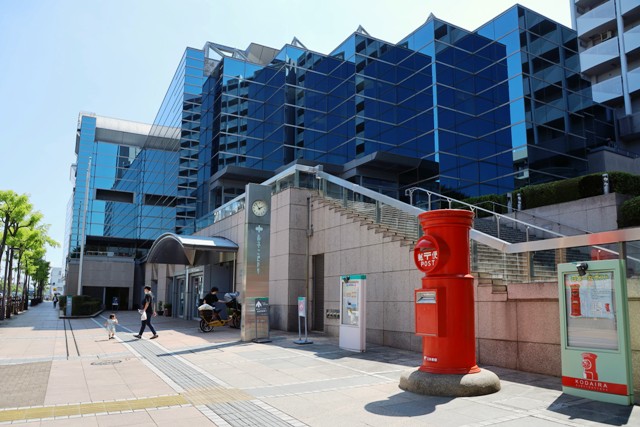 |
| Japan's largest mailbox in Kodaira City |
Sunday, 1 August 2021
Hokuto: Northern Limited Express Train

DMU JR Hokkaido KiHa 261-1000 series stands at Shinhakodate-Hokuto station
Our special holidays ended all too soon. After four days of our traveling on Hokkaido Island, we had to start homeward. On our way back home, we used JR Hokkaido's limited express train "Hokuto" on the Hakodate main line.
The train name "Hokuto" comes from the Big Dipper. As you know, the Big Dipper is a constellation pointing to the polar star. By extension, Hokuto is a representative train in the northern part of Japan. In fact, Hokuto is operated between Hakodate and Sapporo. They are major cities in Hokkaido, which is the northernmost island of Japan. When we visited Hokkaido Island in 2013, the DMU KiHa 281 series was commissioned as Hokuto. This time, not only the 281 series, but also a new model, the DMU KiHa 261-1000 series, was operated as Hokuto. The 261-1000 series was launched in 2006. It was then introduced onto the Hakodate main line as the limited express Hokuto in 2016. JR Hokkaido plans that all the Hokuto limited express trains will be operated by the 261-1000 series by March, 2023.
What are the differences between the older 281 and the newer 261-1000 series? With regard to the interior and the passenger services, they are almost the same. As to the technical specifications, a new technology, namely an air suspension type tilting system, is applied to the 261-1000 series instead of a pendulum type tilting system on the 281 series. The air suspension type tilting system is probably better value for the cost than the pendulum type tilting system.
 DMU JR Hokkaido KiHa 261-1000 series arrives at Shinhakodate-Hokuto station
Official information about the limited express train, Hokuto:
Official information about the limited express train, Hokuto (in Japanese):
Subscribe to:
Posts (Atom)