Tuesday, 31 March 2015

Four Years Since Then

EMU JR East 205-3100 series travels on the Senseki Line (January, 2012)
 
Four years have passed since the 3.11 giant earthquake hit the Tohoku District of Japan.

Fortunately, there were no victims of train passengers because of the quake. The railways were saved by earthquake resistant constructions and the earthquake warning system. But, some routes are still suspended due to the damage caused by the tsunami disaster.

I visited the disaster area in January, 2012, 8 months after the earthquake. I saw that most of the trains were being operated normally at Sendai Station, but the JR East Senseki line was fully-destroyed by the giant tsunami in the section between Takagi-machi and Yamoto stations. So, passengers had to use the bus services provided by JR East. The Senseki Line is one of the main commuting arteries along in the Sendai area. Connecting Aoba-dori, the city center of Sendai, and Ishinomaki, the second largest city in Miyagi Prefecture; the total length of the route is 52 km.

On January 29th this year, JR East made a press release announcing that restoration of the Senseki Line will be completed by May 30th. The new track was constructed on the inland hill around the tsunami disaster area.

As the saying goes, "out of disaster springs fortune." I believe that people in the Tohoku District will recover from the devastating casualties, because they have good patience and a strong social bond. The recovery has advanced steadily; however, we still have a lot to do.
 
EMU JR East 205-3100 series arrives at Nigatake Station on the Senseki Line (January, 2012)

Saturday, 28 March 2015

Opening of the Ueno-Tokyo Line

EMU JR East E657 series (left) and the E233-3000 series (right) travel on the Ueno-Tokyo Line

I was asked a question from one of my blog readers regarding the opening of the Ueno-Tokyo Line. In answer to his question...

Along with the Hokuriku Shinkansen, the opening of the Ueno-Tokyo Line was big news, when a new timetable started on the JR lines on March 14th. What is the Ueno-Tokyo Line? It is JR East's fourth double track between Ueno and Tokyo stations. Its length is only 3.6 km, but the form of train operation has drastically changed in the Tokyo metropolitan area after the opening of it.

Curently, most trains on the Tokaido Main Line are directly operated onto the northern routes such as the Takasaki, Utsunomiya and Joban lines via the Ueno-Tokyo Line. So, we can embark on the Joban Line limited express train (the E657 series), Hitachi and Tokiwa from Shinagawa Station on the Tokaido Main Line. It looks convenient for passengers.

Please wait a moment. The Ueno-Tokyo Line is not all good. For instance, one of my colleagues complains that it became difficult to get a seat on the train to travel home in Yokohama City on the Tokaido Main Line. Before the new timetable started, he could easily secure a seat from Tokyo Terminal, as it was a starting station of the Tokaido Main Line; however, it has become difficult, since the origin of the trains has changed to the northern routes, after the new timetable started.

Commuters in the Tokyo metropolitan area have mixed feelings about the Ueno-Tokyo Line.

 
EMU Izukyu 2100 series (left) and the JR East E657 (right) series stand at Tokyo Station

Thursday, 26 March 2015

Train to the Hot Spot on the Sakurajima Line

Special poster train, the EMU JR West 201 series stands at Universal City Station

When I visited Osaka with my family last year, our main purpose was to see a new attraction in an amusement park, Universal Studios Japan (USJ). Along with Tokyo Disney Resort, USJ is a famous amusement park in Japan. It was opened in 2001 as the fourth theme park of Universal Parks & Resorts. It had been popular among tourists; however, subsequent to the late 2000's, the number of visitors decreased sharply.

On July 15th, 2014, USJ opened a new attraction to the public as a revival measure... "The Wizarding World of Harry Potter". Needless to say, this attraction was taken from the famous fantasy novels called the Harry Potter series. The Wizarding World of Harry Potter has authentic-looking reproductions of the world of Harry Potter. I don't want to talk anymore about the attraction itself as you should just wait until you see it.

In the meantime, to visit USJ, please get off at Universal City Station on the JR West Sakurajima Line. It takes about 10 minutes from Osaka Station. Special poster trains, the EMU 201 series, are operated at intervals of 8 to 15 minutes. When I took the train last December, it was very crowded, like rush hour, even on a cold winter weekday. The only consolation was that we could use Suica and Pasmo (prepaid IC cards for railway passengers) of the Tokyo metropolitan area on this crowded line in Osaka.

The Sakurajima Line... it was a train to the hot spot in Osaka City.

 
"The Wizarding World of Harry Potter" in USJ near Universal City Station on the Sakurajima Line

Tuesday, 24 March 2015

Tokyu 8007F from Danish Rail-fan's Photo Album

Set number 8007F of the EMU Tokyu 8000 series travels on the Toyoko Line (1995 or 1996)
Photo: Nicolai Okkels 
 
I am going to show you an old train picture in the Tokyo metropolitan area from a Danish rail-fan's photo album again. My thanks go to Mr. Nicolai Okkels, who kindly sent me the picture.

The top photo is set number 8007F of the EMU Tokyu 8000 series on the Toyoko Line. When I was a high school student, I took the Toyoko Line to school. It was a 10-minute trip from Shibuya Terminal and I used the 8000 series every day. The 8000 series was the main fleet of the Toyoko Line at that time, but, the final set of the 8000 series was retired from the track in 2008.

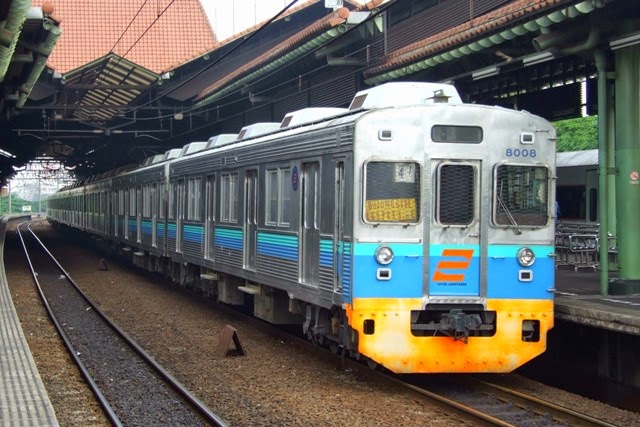
I was probably inseparable from the 8000 series. I ran into the 8000 series again in Jakarta, Indonesia, when I was stationed there several years ago. The local railway operator, PT KAI (Indonesian National Railways) was pursuing the modernization of the trains in Jakarta. Three sets of the 8000 series were moved there to spend a new life after retirement from Tokyu.

Specifically, 8007F was my favorite in Jakarta. Its shining corrugated stainless steel body with blue-colored stripes is engraved in my mind's eye (see the following photo). The interior of the train was nostalgic, as there were many remnants from the days of Japan in the train. For instance, some cautionary statement stickers, which were written in Japanese, were still inside the train.

The EMU Tokyu 8000 series... it is my unforgettable train.
 
Set number 8007F stands at Gambir Station, Jakarta, Indonesia (December, 2007)

Saturday, 21 March 2015

The Tsurumi Line: Urban Local Route

EMU JR East 205-1100 series arrives at Kokudo Station on the Tsurumi Line

If you want to get a feel for a local line in an urban area, please visit the JR East Tsurumi Line. The route consists of the Main Line (7 km), Umishibaura Branch Line (1.7 km) and the Ookawa Branch Line (1 km), extending to the eastern part of Yokohama and western Kawasaki cities in Kanagawa Prefecture.

The Tsurumi Line was originally opened as a freight line in 1926 by Tsurumi Rinko Railway. The objective of the railway was to transport materials and fuels to and from Keihin Industrial Area. After completion of the electrification in 1930, passenger transportation was also commenced for commuters, who worked for factories on the route. The Tsurumi Line was then merged into Japanese Government Railways in 1943 due to wartime shortage. Currently, the Tsurumi Line belongs to East Japan Railway Company (JR East).

Why can we get a feel for a local line on the Tsurumi Line? One of the reasons is that the trains are very infrequent on that line. For instance, there are only three trains a day leaving Ookawa Station on weekends. The other reason is its short trains, which are composed of only three cars.

The main fleet of the Tsurumi Line is the EMU 205-1100 series. A total of 9 sets, 27 units are operated on the route. They had been operated on the Saikyo Line, and were moved to the Tsurumi Line in 2004. The yellow and light blue colored stripes are distinct accents of these trains.

 
EMU JR East 205-1100 series leaves Asano Station on the Tsurumi Line