Thursday, 31 December 2015

Senior Runner on the Seto Inland Sea Coast

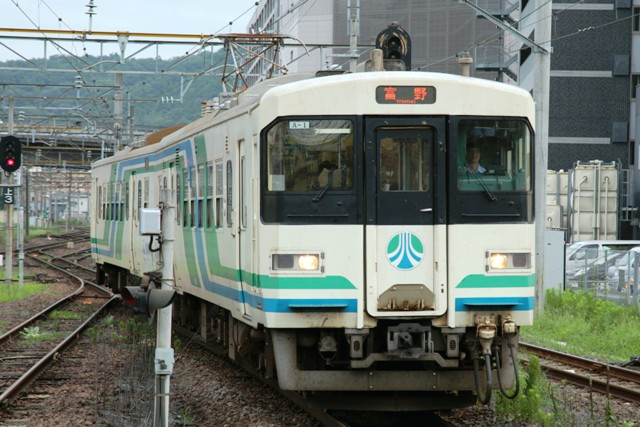
EMU Sanyo Electric Railway 3000 series (steel body cars) arrives at Sanyo-Shioya Station

Following my previous post, I am going to continue to introduce Sanyo Electric Railway today.

Sanyo Electric Railway Line was partially opened between Hyogo and Suma in 1910. The route was then fully opened in 1941. The company started the mutual direct operation with Kobe Rapid Transit Line via Nishidai Station in 1968.

The route is composed of the Main Line (54.7 km-long double track between Nishidai and Sanyo-Himeji) and the Aboshi Line (8.5 km-long single track between Shikama and Sanyo-Aboshi). The whole route is electrified with a 1,500 V DC overhead electric system. The gauge size is 1,435 mm. Trains are operated every 7 to 8 minutes on average.

My favorite train is the oldest one, EMU 3000 series launched in 1964. A total of 133 units had been built for 21 years by Kawasaki Sharyo. The subject of rail fans' scrutiny is its variation. There are many kinds of the 3000 series such as steel body cars, aluminum body cars, 3-car trains, 4-car trains and so on.

The steel body train is my most favorite. Its specification is rather old, but the body is beautifully painted ecru with orange and dark brown colored stripes. The rounded double frontal lights and panoramic windows are very nostalgic. The aluminum body train is also attractive, as it has a modern and urban feel.

The EMU Sanyo Electric Railway 3000 series... it is an evergreen senior runner on the Seto Inland Sea Coast.
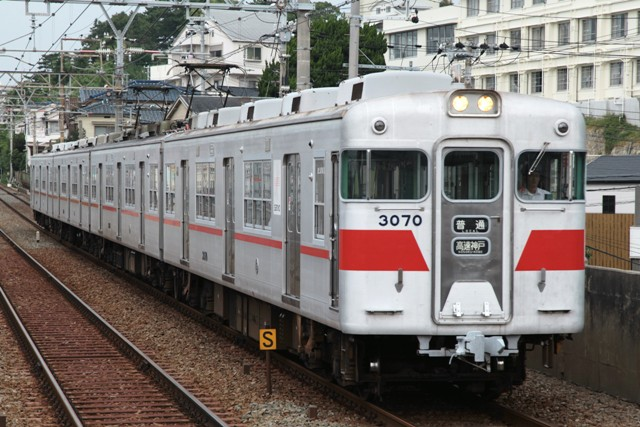
EMU Sanyo Electric Railway 3000 series (aluminum body cars) arrives at Sanyo-Shioya Station

Monday, 28 December 2015

Sanyo Electric Railway: The Third Way to Osaka City

EMU Sanyo Electric Railway 5000 series arrives at Sanyo-Shioya Station

One of the features in urban railways in Japan is that many companies are in competition to attract passengers. It might be hard to imagine for foreigners, but it is caused by the high-density railway network in the urban areas. It allows the passengers to choose the best route to get to their destinations.

For instance, let's suppose that you live in Himeji City, and need to visit Osaka, which is the business center of the western part of Japan. You can choose from three routes... the Shinkansen, the Sanyo Main Line or Sanyo Electric Railway.

JR West's Sanyo Shinkansen is the fastest transportation from Himeji to Shin-Osaka. It covers 92 km in only 29 minutes. The problem is its high cost. Another problem is that you have to transfer to the Tokaido Main Line at Shin-Osaka to get to Osaka Station.

The second route is JR West's Sanyo Main Line. It takes about one hour from Himeji to Osaka Station without having to transfer. The other good news is that you can use the rapid-service train without an extra charge.

The third route is taking Sanyo Electric Railway. It is a second-tier local private railway company. The Sanyo trains are directly operated into Kobe Rapid Transit and Hanshin Electric Railway, and get to Osaka-Umeda Terminal. It takes more than one hour and a half, a bit slow; however, the Sanyo train is the cheapest transportation from Himeji to Osaka.

To be continued...

EMU Hanshin 8000 series arrives at Sanyo-Shioya Station on the Sanyo Electric Railway
 
More information about Sanyo Electric Railway:

Friday, 25 December 2015

Sendai Airport Transit: Access to the Green City

EMU SAT 721 series stands at Sendai Station
 
Sendai is the largest city in the Tohoku District, some 350 km north of Tokyo. It has a population of 1.05 million. JR East's Tohoku Shinkansen is the most convenient transportation from Tokyo to this large city, but an airplane must be more convenient from other areas such as Osaka, Fukuoka and Sapporo.

Sendai Airport is located 17 km south of the city center. If you arrive at Sendai Airport, you can access the downtown area by train, called Sendai Airport Access Railway. This railway consists of two sections. One of them is Sendai Airport Line of Sendai Airport Transit (SAT). The other is a part of JR East's Tohoku Main Line. The tracks are both electrified (20,000 V AC – 50Hz). The gauge size is 1,067mm, and the Sendai Airport Line is single, but the Tohoku Main Line is double. Both SAT and JR East operate their own trains alternately every half an hour on average.

SAT operates the EMU 721 series on this route. It is a sister train of the JR East E721 series. The SAT 721 series was launched in 2007, when the Sendai Airport Line was opened. Its sky blue colored body with a yellow stripe is vivid and is my favorite.

In the meantime, Sendai is known as the Green City. It is densely populated, but many green forests are preserved here and there. Zelkova tree-lined streets such as Jozenji and Aoba are also reputable and famous among Japanese people.
 
Scenic view of Sendai City near Sendai Station
 
More information about Sendai Airport Transit: http://www.senat.co.jp/en/top

Tuesday, 22 December 2015

Abukuma Express: Local Railway in the Tohoku District

EMU Abukuma Express 8100 series arrives at Fukushima Station

Abukuma Express (Abukyu) is a local railway company in the Tohoku District. The route extends to the northern part of Fukushima and the southern part of Miyagi prefecture. Connecting Fukushima and Tsukinoki, its operating length is 54.9 km. The track is electrified and single. The gauge size is 1,067 mm. The electric system is 20,000 V – 50Hz AC overhead.

Abukyu Line was originally opened under the name of the Marumori Line between Tsukinoki and Marumori station by Japanese National Railways in 1968. The route was then transferred to the newly established Abukuma Express Company in 1986. This company had constructed the remaining route between Marumori and Fukushima. The route was fully opened in 1988. The trains are operated every half an hour to one hour. In the morning, some trains are directly operated into the JR East Tohoku Main Line to Sendai, which is the largest city in the Tohoku District.

Abukyu's main fleet is the EMU 8100 series, which is a 2-car train consisting of one motor car and one trailer. A total of 9 sets, 18 units, were built by Nippon Sharyo in 1988. This model is similar to the JR Kyushu's EMU 713 series, but I prefer the 8100 series, as the front design of the 8100 series is more stylish.

Abukyu shares the station with Fukushima Kotsu at Fukushima Terminal, so you can see both Abukyu and Fukushima Kotsu trains at the same platform. It is a great pleasure for rail fans.

EMU Fukushima Kotsu 7000 series (left) and Abukuma Express 8100 series (right)

Saturday, 19 December 2015

2015 Tobu Fan Festa in Minami-Kurihashi Rail Yard

From left to right, EMU 350, 1800, 200 and 100 series, Tobu express trains

Following the Toyoda Train Festival held by JR East, I am going to show you the other event recently held for rail fans.

On December 6th, Tobu Railway held an annual event, the "2015 Tobu Fan Festa", in Minami-Kurihashi Rail Yard on the Nikko Line. I saw that several thousands of rail fans and families visited this event. Joining a photo session, I could get beautiful shots of Tobu train formations. One of them was a whole formation of the Tobu express trains, namely the EMU 350, 1800, 200 and 100 series. The other one was a commuter train formation including the EMU 8198F, 8111F and the latest model 60000 series.

Specifically, the revival colored train, 8198F of the EMU 8000 series, was dazzling. It was painted dark blue with a yellow stripe. This coloring was the revival of the "Flying Tojo" train, which was operated from 1949 to 1962 on the Tojo Line. As its name suggests, Flying Tojo was said to be named after the famous British express train, the Flying Scotsman.

In the meantime, do you know how to transport the Tojo Line train onto the Isesaki Line; nevertheless these two lines are separated? The gimmick is as follows. The two lines are connected via Chichibu Railway at Hanyu and Yorii stations. To pass through the Chichibu Railway, some Tobu trains have a special safety device for Chichibu Railways, namely the ATS-Chichibu-type. This special deadheaded operation is also very popular among rail photo lovers.

From left to right, EMU 8198F, 8111F and 60000 series, Tobu commuter trains