Sunday, 30 October 2016

EMU 8000 Series: Owl on the Shin-Keisei Line

EMU Shin-Keisei 8000 series arrives at Kita-Narashino Station

It is a cliché of this blog, but the railway business in Japan is by no means easy. Many companies are involved in tough competition. Rivals are not only the industry peers, but also private cars, bus services and airlines.

With that kind of background, many railway companies have recently introduced common design commuter trains to reduce the initial cost. For instance, the EMU Sotetsu 10000 series has the same design and the technical specifications as those of the JR East E231 series. Differences between the two models are only the faces, body colors and interiors. As a result, we often see the same kinds of trains here and there. It is not favorable for rail-fans, as the variations decrease. Rail-fans are bizarre lovers.

One of the unique commuter trains in the Tokyo metropolitan area is the EMU Shin-Keisei 8000 series. This model was launched in 1978 as Japan's first adjustable voltage and adjustable frequency (VVVF) train, but the uniqueness is not only its technical specifications but also its face. It looks like an owl. It is definitely my favorite.

The 8000 series is a 6-car train, built by Nippon Sharyo. So far, a total of 9 sets, 54 units have been introduced and 6 sets of these are still operated on the track. Each unit is 18 meter-long with 6 doors. The gauge size is 1,435 mm and its electric system is 1,500 V DC overhead.

The EMU 8000 series... it is a unique owl train on the Shin-Keisei Line

EMU Shin-Keisei 8000 series stands at Takifudo Station

Thursday, 27 October 2016

View of Japanese Tyrol on the Iida Line

EMU JR Central 373 series, limited express "Inaji", travels on the Iida Line

Japan is a mountainous country. 73% of the territory is covered by mountains or hills. Generally speaking, mountains are not suitable for residential areas.

Wait a minute! There is an exception. Please look at the following photo. It is "Shimoguri-no-sato (Shimoguri Village)" in Nagano Prefecture, about 290 km west of Tokyo. You can see houses and cultivated land on the ridge of a steep mountain with up to 38 degrees of the maximum inclined angle. According to the local people, their ancestors migrated into this village about 1,000 years ago. They have been carrying out an agricultural business and forestry over many generations.

The situation has recently drastically changed. One geographer "found" Shimoguri Village, and named it the "Japanese Tyrol", because the scenery and the lives of the people are similar to those of Tyrol State in Austria. Since then, many holidaymakers have been flocking to this small village. I was one of those people.

To access the Japanese Tyrol, I took the Iida Line from Toyohashi Station on the Tokaido Shinkansen. It takes about 2 hours 40 minutes from Toyohashi to Iida, which is the access station to Shimoguri Village. My vehicle was a limited express train, Inaji. It is operated by JR Central using the EMU 373 series. The 373 series is a 3-car direct current train launched in 1995. A total of 14 sets, 42 units have been built by Nippon Sharyo and Hitachi. This model is also commissioned on the Minobu Line as a limited express train, Fujikawa.

Shimoguri-no-sato, access from Iida Station on the JR Central Iida Line

Monday, 24 October 2016

The Johoku Line: Local Route in the Nagoya Urban Area

Diesel rail-car TKJ KiHa 11-300 series arrives at Owari-Hoshinomiya Station

Local railways in urban areas stir up rail-fans' interest. They are quite unique. One of the typical examples is the Johoku Line in the Nagoya Urban area, some 370 km west of Tokyo.

As you know, Nagoya is the largest station in the central part of Japan. The tracks were always crowded with various kinds of trains all day long. To solve the congestion, Japanese National Railways (JNR) planned to construct a freight line bypassing Nagoya Station in the 1960s. Later, the situation had drastically changed. Due to the evolution of truck transport, construction of the freight line had been suspended.

JNR and the government eventually changed the plan, and constructed the Johoku Line as a commuter route connecting the Tokaido Main Line and the Chuo Line. The entire route was completed in 1993. Its total operating length is 11.2 km. The track is elevated and double, but un-electrified. The gauge size is 1,067 mm. A 1-car diesel rail-car, the KiHa11-300 series, is operated only once an hour on average by Tokai Transport Service Company (TKJ), which is a subsidiary of JR Central.

I found a big problem on the Johoku Line. All the connecting lines, such as the Meitetsu and the Nagoya Municipal Subway, are located far from the stations on the Johoku Line. Transfers are inconvenient. It was probably because the Johoku Line was originally planned as a freight route.

The Johoku Line... it is a useless treasure. Please do something about it!

Diesel rail-car TKJ KiHa 11-300 series stands at Biwajima Station on the Johoku Line

Friday, 21 October 2016

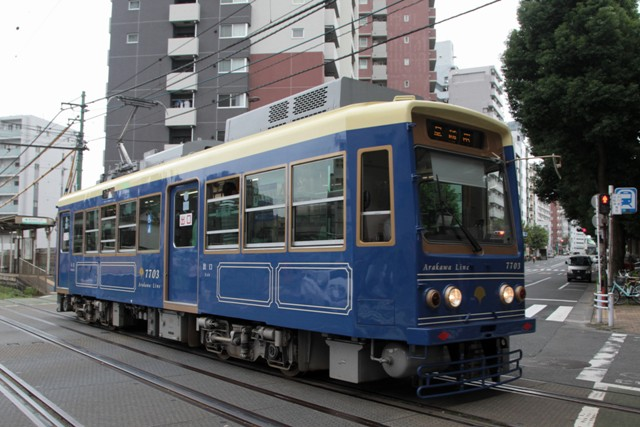
Toei 7700 Series: Renovated Model on the Arakawa Line

Unit number 7704 of the Toei 7700 series stands at Zoshigaya Stop

In parallel with the introduction of a new model. the 8900 series, the Transportation Bureau of the Tokyo Metropolitan Government (Toei) is conducting the renovation of an old model, the 7000 series on the Arakawa Line. The first renovated streetcar was launched on May 30th under the new name of the 7700 series. The 7000 series is the Toei's longest-serving active model launched in 1954. A total of 93 units have been built by Alna Koki. 10 of the 93 units are still operated on the track, but because they are decrepit, Toei plans to renovate 8 units of the 7000 series to the 7700 series.

What are the differences between the 7000 and the 7700 series? Firstly, the outer design has been changed to so-called modern-retro. For instance, unit number 7703 (ex-7015) and 7704 (ex-7031) are painted dark blue. It is chic and stylish. The doors have been widened for easily going in and out of passengers. Secondly, the traveling system has been totally changed. For instance, VVVF (variable voltage and variable frequency) inverter has been adopted as an electric control system to save electric power consumption. The bogies have also been changed to the advanced model, Type-FS91C, manufactured by Nippon Steel & Sumitomo Metal Corporation to enhance the riding comfort. Thirdly, the interior has been renovated. For instance, the displays have been changed from the single LED to the double LCDs to enhance the visibility.

According to Toei, the renovation cost of each unit is about $1.25 million.

Unit number 7703 of the Toei 7700 series leaves Higashi-Ikebukuro 4-chome Stop

Tuesday, 18 October 2016

Great Waterfall on the Yoro Line

Set D12 of the EMU Yoro Railway 610 series arrives at Mino-Matsuyama Station

Yoro-no-taki is a famous waterfall in Gifu Prefecture, about 420 km southwest of Tokyo. It is 32 meters high and 4 meters wide, and chosen as one of Japan's Top 100 Waterfalls by the Japanese Ministry of the Environment in 1990. Although it is not a large waterfall, Yoro-no-taki is reputable as it has a long history in the region. For instance, the female Emperor Gensho (680 - 748) visited there and praised it. She then changed the era name to Yoro in 717.

To visit Yoro-no-taki, please take the Yoro Line of Yoro Railway, and get off at Yoro Station. Yoro Railway is a local private company, which belongs to the Kintetsu Group. It was spun off from Kintetsu in 2007. Connecting Kuwana and Ibi, its route length is 57.5 km. The track is single and electrified. Its electric system is 1,500 V DC overhead. Different from the other Kintetsu lines, its gauge size is 1,067 mm.

One of the main fleets on the Yoro Line is the EMU 610 series. It is a 2 or 3-car train with one motor car. A total of 11 units were moved from Kintetsu in 1993 and 1994. Although its technical specifications, such as the classic rheostatic electric control systems, is rather old, 9 of the 11 units are still operated on the line. The solid maroon colored 20 m-long bodies provide a heavy feeling, and are definitely my favorite.

The waterfall and the railway, there are two great spots in the Yoro area.

Yoro Waterfall near Yoro Station on the Yoro Railway