Sunday, 27 October 2013

Turtle Stone on the Kintetsu Line

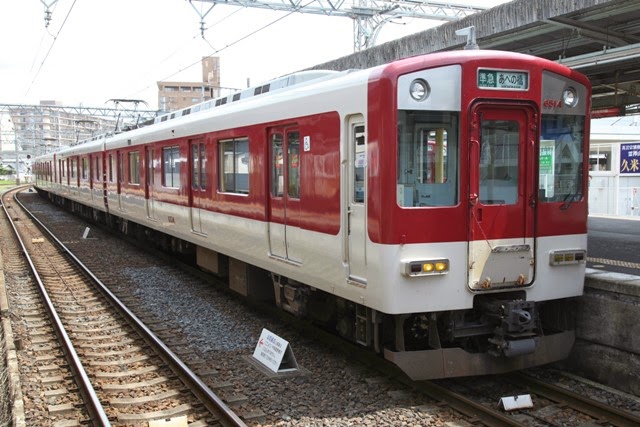
EMU Kintetsu 6400 series stands at Kashiharajingu-mae on the Minami-Osaka Line
 
I am going to show you some more pictures of my summer trip this year to Nara Prefecture.

Look at the following photo. It is "Kame-ishi (Turtle Stone)" in Asuka Village. As I mentioned before, Asuka is the roots of our country. It was the Japan's capital from 592 to 694. In the village, we can see many historical buildings and Buddha statues. Turtle Stone is one of the monuments in this area. The size is 2.8m in width, 3.6m long and 1.8m high. It weighs 10 tons.

The stone is shrouded in mystery. Nobody knows what the purpose of the megalithic structure was, and when it was made. There is a description about Turtle Stone in an ancient temple document, which was written in 1196. The Asuka area has many megalithic structures other than Turtle Stone. Some of them were found from ancient burial mounds, which were constructed from the second to the 8th century. So, I think that Turtle Stone was also made at that time.

To see this mysterious stone, take the Kintetsu Line and get off at Kashiharajingu-mae Station. It takes about 40 minutes from Osaka City by the narrow gauge (1,067mm) train on the Minami-Osaka Line. The EMU 6400 series is one of the main fleets on the line (see the top photo). It was launched in 1986 to replace the old model. A total of 33 sets, 66 units, have been manufactured so far.

 
Turtle stone in Asuka Village near Kashiharajingu-mae Station

Saturday, 26 October 2013

C61 20: Glory Days on the Michinoku Tracks

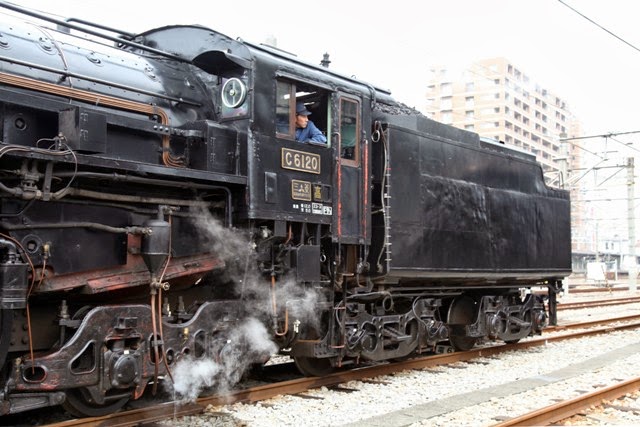
Steam locomotives C61 20 (left) and D51 498 (right) stand at Takasaki Rail Yard
 
Following the electric locomotive, EF 55 1, I am going to show you the other exhibition on Takasaki Railway Communication Day. Look at the top photo. It is a steam locomotive (SL), type C61, a 4-6-4 (Whyte notation) type SL that has a tender attached. A total of 33 units were manufactured from 1947 to 1949 by Mitsubishi Heavy Industries and Nippon Sharyo. Currently, unit number 20, namely C61 20 is the only one that is operated on the track.

C61 20 has a glorious history. It was manufactured in 1949 by Mihara Factory of Mitsubishi Heavy Industries in the western part of Japan. The mission of C61 20 was to pull limited express trains, such as Hatsukari (flight of geese) and Hakutsuru (white crane). It was indeed a star on the Michinoku (the northeastern part of Japan) tracks.

In the meantime, C61 20 was once retired from the tracks in 1973 with the progression of electrification throughout Japanese railways. It had been preserved in a park in Isesaki City, Gunma Prefecture since 1974.

In 2010, C61 20 was sent to Oomiya Rail Yard to resume the operation. Thanks to the rail fans in Isesaki City, this SL had been kept in good condition for 36 years in the public park. It was NOT damaged by vandalism. There was no property-loss.

Currently, C61 20 spends its second working life, pulling sightseeing trains in the Takasaki area. The star SL has come back to the iron tracks.

 
Cockpit and tender of C61 20

Thursday, 24 October 2013

Night View of Tokyo Station Yard

EMU JR Central N700 and 700 series stand at Tokyo Station on the Tokaido Shinkansen
 
As I mentioned before, my office is located on the 21st floor of the building next to Tokyo Station. I can see many kinds of trains from my desk every day ... it's indeed fun at work.

Look at the following photo. It's the night view of Tokyo Station yard from my office. The station yard is beautifully lit up in the evening. What an excellent view it is! Tracks, platforms and landscape look like a diorama (model railway) at the Railway Museum. The construction and development of the Tokyo Station area is continuing. Currently, renovation of the Yaesu Entrance (left-hand) side is proceeding at a good rate. I can see a continuous stream of arriving and leaving trains.

What is it like inside the station yard in the evening? Look at the top photo. It is a night view of the Tokaido Shinkansen tracks. It is a busy time, as many bullet trains arrive at and leave the station frequently. Passengers, who come back to Tokyo from their holiday tours or business trips, are in a state of chaos in the concourse.

You can see the EMU N700 series (left) and the EMU 700 series (right) standing at the station. The average frequency of the train operation interval is four minutes. One train is composed of 16 cars, which can accommodate 1,324 passengers; therefore, the Tokaido Shinkansen is able to transport 19,860 passengers per hour with a top speed of 186MPH. It is a phenomenal feat, isn't it?

 
Night view of Tokyo Station Yard

Wednesday, 23 October 2013

EF55 1: Streamlined EL Built in 1936

Classic ELs EF55 1 (left) and EF 65 501 (right) are exhibited in Takasaki Rail Yard

I am going to give you more detail about the exhibitions on Takasaki Railway Communication Day.

Look at the top photo. The left-hand electric locomotive (EL) is type EF55, which debuted in 1936. A total of three units were manufactured by Hitachi, Nippon Sharyo-Toyo Denki and Kawasaki Heavy Industries. Currently, unit number 1, namely EF55 1 is the only one that is preserved in Takasaki Rail Yard.

The EF55 was a star on the tracks before WWII. It pulled Japan's representative limited express trains, such as Tsubame (swallow) and Fuji. After WWII, the EF55 functioned as a special EL to pull trains for U.S.-led military coalition, which temporary occupied Japan.

EF55 1 is already 77-years old; however, the brown-colored body still shines beautifully. Currently, it is preserved in the rail yard in working condition. This is the first time I have seen the EF55. I was deeply struck with its beauty. It might be just a "machine" for lay public, but it is a rare beauty for rail fans.

In the meantime, the right-hand EL is type EF65, which debuted in 1965. A total of 308 units were manufactured by Kawasaki Heavy Industries and other manufacturers. EF65 501, which I show in the photo, was a specialist for pulling limited express trains, such as Fuji and Hayabusa (falcon) on the Tokaido Main Line.

EF65 501 is still in active service in the Takasaki area, although many of its colleagues have already retired from the front line of the railway tracks.


Side view of EF 55 1 and EF 65 501

Tuesday, 22 October 2013

Tokyo Night Walk: Classic Tower and State-of-art Subway

EMU Toei 12-000 series (1st batch) stands at Tocho-mae Station on the Ooedo Line
 
What do you associate Tokyo with? Perhaps, Tokyo reminds you of Tokyo Tower. Although, Tokyo Tower ceded its highest tower position to Tokyo Sky Tree in 2011, it is still a popular sightseeing spot in the capital city of Japan.

Tokyo Tower was completed in 1958. The tower stands 333m (1,093ft) high. It is the second-tallest artificial structure in Japan. The double-decked Main Observatory is located at 150m (490ft), while the smaller Special Observatory reaches a height of 250m (820ft). The tower had been used to broadcast signal outlets for mass media; however, it is currently utilized only for FM radio, since the signal outlets function has been moved to Tokyo Sky Tree, which is 634m (2,080ft) tall.

Tokyo Tower is also known as a good night viewing spot. It is brightly lit up in the evening, and has several illumination patterns. When I visited the tower last weekend, the "Landmark Light" pattern was applied; but unfortunately, the lower part of the tower was not lit up, probably because of maintenance.

To get to this classic tower, the nearest railway station is Akabanebashi on the subway, Toei Ooedo Line. This new line was completed in 2000. One of the features of the Ooedo Line is that linear motor technology is adopted for the train driving system. You can see a special box, "reaction plate" to drive linear motors between the rails on the track.

The state-of art subway and the classic tower... night walk in Tokyo is a joyful attraction.

 
Night view of Tokyo Tower near Akabane-bashi Station on the Ooedo Line