Thursday, 13 February 2025

The 55th Anniversary of Tora-san

“The 55th Anniversary of Tora-san” train arrives at Shibamata Station

Otoko wa Tsurai yo (It’s Tough Being a Man)” is a beloved Japanese film series released from 1969 to 1995, starring Kiyoshi Atsumi. The main character, Tora-san, played by Atsumi, is a kind-hearted vagabond who is always unlucky in love. He works as a street vendor, traveling from place to place, where he meets beautiful “madonnas” and causes innocent ruckuses.

Tora-san is an unlikely hero — lazy, poorly educated, yet deeply human. Despite his flaws, he is loved by local people for his warmth and sincerity. His family home was in Shibamata, located along the Keisei Kanamachi Line. In front of Shibamata Station, you can find a bronze statue of Tora-san (see the photo below).

Last year, Shibamata celebrated the 55th anniversary of Tora-san. To commemorate the occasion, Keisei Electric Railway has been operating a special anniversary train until March 23, 2025. On the front of the train, you can see a commemorative plate marking “The 55th Anniversary of Tora-san.” This plate also celebrates “The 115th Anniversary of Keisei Electric Railway.” The four-car train, set 3668 of the EMU 3600 series, slowly passes through Tora-san’s hometown (see the top photo).

Incidentally, the Keisei 3600 series EMU is a standard commuter train first introduced in 1982. A total of nine sets (54 cars) were built by Tokyu Sharyo and Nippon Sharyo. Today, only two sets (10 cars) remain in service. The trains were originally equipped with a field chopper control system, but set 3668 was later converted to a GTO-VVVF (Gate Turn-Off Thyristor Variable Frequency Drive) system in 1999. It’s quite a rare train to see nowadays.

Bronze statue of Tora-san in front of Shibamata Station

Official information (in Japanese):

Monday, 10 February 2025

Aerial Tramway for Pilgrims

Tairyuji Ropeway in Tokushima Prefecture, Shikoku Island

Shikoku is the fourth largest island in Japan, located about 800 kilometers west of Tokyo. The Shikoku Pilgrimage is a unique spiritual journey to 88 Buddhist temples scattered across the island. Walking the entire route from one temple to the next adds up to more than 1,400 kilometers. It may sound daunting, but please don’t worry — pilgrims are free to use public transportation along the way if they wish.

Tairyuji Temple in Tokushima Prefecture is a good example. Perched near a steep mountain summit 618 meters above sea level, it can be reached conveniently by the Tairyuji Ropeway. This aerial tramway, operated by Shikoku Cable Company, opened in 1992. It’s a four-cable, cross-type system connecting Washinosato and Sancho stations. The route is 2,775 meters long, with a height difference of 422 meters and a maximum incline of 30 degrees. Swiss-made gondolas operate every 20 minutes, taking about 10 minutes for a one-way trip. Each gondola can carry up to 101 passengers.

There are two support towers along the route. The first tower, standing 42 meters tall, is the highest of its kind in the world. I observed this impressive structure on my way to the temple. That morning, the mountaintop was lightly dusted with snow, adding to the tranquil atmosphere. Incidentally, I wasn’t a pilgrim but simply a tourist. I must admit — I’m a bit of a wimp, so I didn’t dare to attempt the 1,400-kilometer pilgrimage!

The first strut of Tairyuji Ropeway

Official Website, Tairyuji RopewayーShikoku Cable Company (in Japanese):

Friday, 7 February 2025

Encounter with the Rare Train: EMU E257-5000 Series

Set OM-93 of the JR East EMU E257-5000 series, non-gangway side

Today, I’d like to share a topic for old-school trainspotters. The E257-5000 series is JR East’s rolling stock used for extra train services, mainly operated on weekends and during holiday seasons. This model was originally introduced as the EMU E257-0 series, which served as the Azusa and Kaiji limited express trains on the Chuo Main Line.

After nearly 20 years in operation, three trainsets—27 cars in total—were modified into the E257-5000 series in 2021 at JR East’s Nagano Factory. These are sets OM-91, OM-92, and OM-93. Each trainset consists of five motorcars and four trailers (5M4T).

So, what are the differences between the older E257-0 and the newer E257-5000 series? Basically, they are the same type, but the new version features a different color scheme. The E257-5000 wears fresh green-colored stripes. In addition, it is equipped with baggage spaces for passenger convenience.

I happened to encounter set OM-93 at Tokyo Station last August. It was operating as the extra train Atami Fireworks Festival. As the name suggests, this train carried passengers heading to Atami City to enjoy the fireworks, running on the Tokaido Main Line.

I was delighted to observe the “two different faces” of this train. The southern end has no gangway (see the top photo), while the northern end is equipped with one (see the photo below). Discovering such subtle differences is one of the greatest pleasures for trainspotters like me.

If you have time, please also take a look at my previous posts about the EMU E257-2000 and E257-5500.

Set OM-93 of the JR East EMU E257-5000 series, gangway side

Tuesday, 4 February 2025

Winter Scenery on the Keikyu Line

Interior of the “Wing Seat” car, EMU Keikyu 2100 series

It’s still cold in Tokyo. The daytime high is around 10 degrees Celsius, but the sunlight is gradually getting stronger. I couldn’t just stay fidgeting at home, so I went out with my family over the weekend. Our destination was the Nobi Coast on the Keikyu Kurihama Line.

Let me start with a brief review of the Keikyu network. Keikyu is one of the major private railway companies in the Tokyo metropolitan area. Its network stretches 87 kilometers across the southern part of Tokyo Metropolis and the northern part of Kanagawa Prefecture. Keikyu faces strong competition from Tokyo Monorail on the route between central Tokyo and Tokyo International Airport (Haneda). In addition, it also competes with JR East on the section between downtown Tokyo and the Yokohama–Yokosuka area. The key factors that influence passengers when choosing a route are fares, speed, and service.

We took the Keikyu Main Line from Shinagawa Terminal because it’s convenient, fast, and reasonably priced. To ensure we had comfortable cross seats, we reserved “Wing Seats” (see the top photo) in advance. The Wing Seat car was coupled within an eight-car train of the EMU 2100 series. The reservation fee was only 300 yen (about 1.94 USD). After about 70 minutes from Shinagawa, we got off at YRP Nobi Station and took a walk along the coast of the Miura Peninsula. We enjoyed the blue sky, blue ocean, green hills, and the graceful bow-shaped beach (see the photo below). They were definitely beautiful and made us feel relaxed. Spring is just around the corner.

Nobi Coast near YRP Nobi Station on the Keikyu Kurihama Line

Saturday, 1 February 2025

Final Chapter of Shin-Keisei Electric Railway

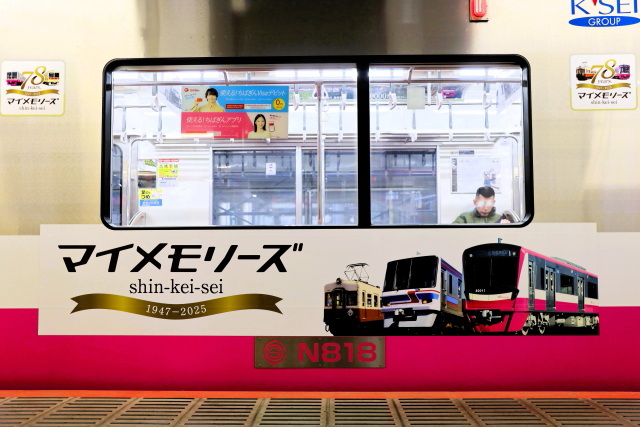
Set N818 of the EMU Shinkeisei N800 series, "My Memories Train"

You may remember when I introduced the news that Keisei Electric Railway Company will absorb Shin-Keisei Electric Railway Company in April 2025. How is the merger project progressing? Just like last November, I recently visited the Shin-Keisei Line and saw the situation with my own eyes once again.

I found that Shin-Keisei was operating a special poster train named My Memories Train, using set N818 of the EMU N800 series. A special sticker showing Shin-Keisei’s 78 years of history is displayed on the front of the train (see the top photo). Large side-body stickers feature Shin-Keisei’s famous trains — the EMU 220, 8900, and 80000 series (see the photo below). In addition, passengers can enjoy special posters inside the train that explain the history of Shin-Keisei.

According to the company, the purpose of My Memories Train is to look back on Shin-Keisei’s 78 years of history together with its passengers. The final chapter of Shin-Keisei Electric Railway is steadily unfolding as the merger within the Keisei Group approaches.

Incidentally, the EMU N800 series is one of the main fleets on the Shin-Keisei Line. It was commissioned in 2005 to replace the old 800 and 8000 series trains. A total of five sets (30 units) were built by Nippon Sharyo. The N800 series is a sister train of the Keisei 3000 series, sharing the same car bodies and technical specifications.

Side body of My Memories Train