Sunday, 29 January 2012

Prepaid Passes in the Tokyo Metropolitan Area

Prepaid passes, Pasmo with seasonal commuter ticket (left) and Suica (right)

If you get around Tokyo, Pasmo or Suica is a must-have card. They are prepaid passes for railway and bus passengers. The function of Pasmo and Suica are the same. The only difference is the issuer. Pasmo is issued by private railway and bus companies, whilst JR East issues Suica. Pasmo and Suica are interoperable; therefore, you just need to make a binary choice.

Once you get a card and deposit some money, you can take almost all railway and bus routes in the Tokyo metropolitan area. It's convenient for shopping as well, because these cards can also be used as electronic money.

Look at the top photo. These are my Pasmo and Suica cards. Since I live along the Odakyu Line, I am a Pasmo holder. This Pasmo is special, because the function of a commuter seasonal ticket is also attached. In this example, I can use this card as a discounted seasonal ticket on the route between Chitose-funabashi Station close to my home and Ootemachi Station near my office. In addition, I can use other railway and bus routes, if I deposit some money in advance. Of course, I can go shopping as well with this card.

I have a Suica also. Why do I have to carry two cards? It's because my Suica is an ID card for admission to my office building. At the entrance, there is a gate, and I need the Suica to pass through there.

Use of Pasmo and Suica is expanding for a number of things.
 
Putting up Pasmo to pass through the entrance gate of Ootemachi Station, Tokyo Metro

More information about Pasmo: http://www.pasmo.co.jp/en/index.html
More information about Suica: http://www.jreast.co.jp/e/pass/suica.html

Thursday, 26 January 2012

The Senseki Line, Scars of 3.11 Earthquake


EMU JR East 205-3100 series leaves Nigatake Station on the Senseki Line, elevated track

Following my blog on January 21st, I would like to introduce you to another railway line in the Sendai metropolis.

The JR East Senseki Line is one of the main commuting arteries along with the Tohoku Line and the Subway Nanboku Line in the Sendai area. Connecting Aoba-dori, the city center of Sendai, and Ishinomaki, the second largest city in Miyagi Prefecture; the total length of the route is 52 km. It carries an average of 21,000 passengers per day (the top photo).

On March 11, 2011, the Senseki line was severely damaged by the giant earthquake. Especially, the section between Takagi-machi and Yamoto was fully-destroyed by the giant tsunami. This section is still interrupted. So, passengers have to take bus services, which are provided by JR East.

On this line, we can see special wrapping trains designed with comic heroes. They are the "Masked Rider" (see the bottom photo) and "Cyborg 009", which are popular characters from Shotaro Ishinomori's science fiction comics. Mr. Shotaro Ishinomori was born in Ishinomori Town near Sendai in 1938. Hence, his pen name, "Ishinomori" is from his hometown.

I read Mr. Ishionomori's comics voraciously in my childhood. Especially, I liked Cyborg 009. The story is that nine cyborgs fight the evil Black Ghost organization. I had a deep sense of empathy for the heroes' sad stories, because they are not humans, but artificial cyborgs.

Unfortunately, Mr. Ishinomori passed away in 1998; however, the comic heroes, he created, are still alive on the trains near his hometown and give the earthquake victims encouragement.


EMU 205-3100 series decorated with "Masked Rider" at Aoba-dori Station, underground track

Tuesday, 24 January 2012

"Kodama-type" EMU in My Old Memory


"Kodama-type" EMU, JNR 181 series, Limited Express "Toki" preserved in the Railway Museum

When I visited the Railway Museum in Saitama City (see my blog on January 2nd), I found a colorful train with a bonnet on the front (see the top photo). That is a so-called "Kodama-type" EMU.

The Kodama-type was first manufactured in 1957 as a limited express train "Kodama (Echo)" for intercity transportation between Tokyo and Osaka: two major cities in Japan. Needless to say, it was the pre-shinkansen era. The official name of the train was the "EMU JNR (Japanese National Railways) 151 series", DC limited express. The design is quite unique, as a large bonnet is attached on the front. The body is also fresh, as it is colored vermilion red and beige. Although, several similar types of limited express EMU have been manufactured since launching the 151 series, we apply the name of Kodama-type to all these designed trains.

The Kodama was the fastest train of that time in Japan. The maximum speed was 110km/hour, and it was able to travel between Tokyo and Osaka (550km) in about 6 hours and 30 minutes. I have a precious experience to ride this limited express train in my childhood (see the bottom photo). Probably, it is the oldest memory of my life. I got onto the Kodama at Tokyo Station to go to Shizuoka with my parents. It was the mid-summer vacation season. I still remember that I enjoyed looking out the window at the passing scenery while eating a "frozen orange", a popular product among travelers of that time.

How time flies!


EMU JNR 151 series, Limited Express "Kodama" in my photo album (Tokyo Station in 1963)

Saturday, 21 January 2012

Spirit of Tohoku, Post-quake Recovery


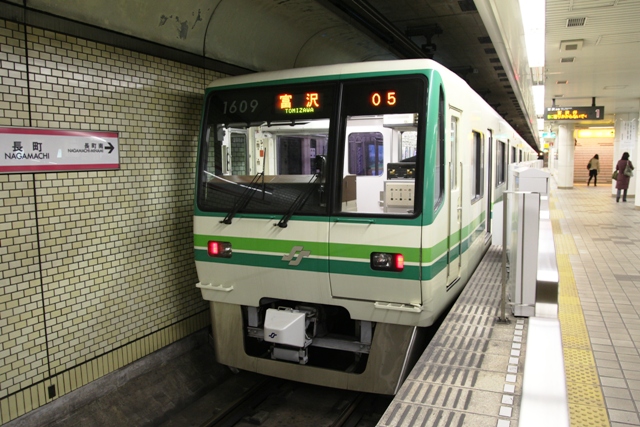
EMU Sendai Subway 1000 series arrives at Yaotome Station, elevated track

Recently, I had an opportunity to visit Sendai City in the Tohoku District. Sendai is situated about 300km north of Tokyo and is the main city of Miyagi Prefecture.

On March 11th, last year, a giant earthquake hit eastern part of Japan. The epicenter of which was located offshore, 170km east of Sendai City. Sendai was severely damaged by the destructive shaking. To make matters worse, the coastal part of the city was devastated by a giant tsunami. It wasn't just someone else's affair, as I lived in Sendai when I was a student.

The railways in the Sendai area, such as the Tohoku Shinkansen, JR East lines and the Sendai Subway Line, were also severely damaged. For example, bridge girders of elevated track section on the Sendai Subway Line were cracked near Yaotome Station. The Sendai City Transportation Bureau, which is the operator of the subway line, speeded up reconstruction efforts of the damaged sections.

Eventually, on April 29th, the entire route of the subway reopened, which was achieved one month ahead of schedule. The operation of the subway Nanboku (South-North) Line, a total of 14.8km in length, returned to normal. Construction of a new route, 13.9km in length, the Tozai (East-West) Line, was also resumed in the downtown area.

I think that people in the Tohoku District have tenacity and endurance. They also are closely united. It's probably because of cold and severe climate in winter. The city life now looks normal.

I saw the "Sprit of Tohoku" in Sendai City.


EMU Sendai Subway 1000 series leaves Nagamachi Station, underground section

More information about Sendai Subway:

Wednesday, 18 January 2012

"Ezuki Narcissus Road" on the Uchibo Line


EMU JR East 209 series runs backed by Mt. Nokogiri-yama on the Uchibo Line

Following my blog on January 10th, I would like to introduce another mid-winter flower field in the Tokyo metropolitan area. That is "Ezuki Narcissus Road" in Chiba Prefecture.

Ezuki Narcissus Road is located 60km directly south of the downtown Tokyo. But, it's more than 110km by railways because trains have to go around the coast of Tokyo Bay. To visit there, you should take the JR East Keiyo Line from Tokyo Station and get off at Hota Station on the Uchibo Line. It takes around 90 minutes by limited express. But, I took a local train that time to relax (see the top photo). The entrance of Ezuki Narcissus Road is only a ten minute walk from the station.

More than 10 milion narcissus are seen on a 3km road. They are planted in fields, slopes, riversides and house gardens. Historically, the planting of narcissus started in the 19th century by local farmers. The cut flowers were shipped to the downtown Tokyo.

Yellow and white colored flowers are fully in bloom now. Many people were visiting there. The sweet smell of narcissus flowers attracts tourists from around the Tokyo metropolitan area. Visitors were spending their time as they pleased; enjoying walking, chatting with local people or taking lunch in the fields. I enjoyed taking flower photogtaphs (see the bottom photo).

The wind was still cold, but sun was stronger than before. The spring is around the corner in Tokyo. I can't wait for a genial season.


Narcissus flowers near Hota Station on the JR East Uchibo Line