Monday, 28 May 2018

De 9003: Black "CENTRAM" in Toyama City

Unit De 9003 of the electric car Toyama Chiho Railway 9000 series, CENTRAM

Tram routes in Japan were abolished one after another due to heavy traffic jams. They just stay in people's minds in many cities such as Yokohama, Nagoya and Sendai. We can't go against the current of time.

Please wait a moment! Toyama City still creates a tram network as the main urban public transportation system. Toyama is the main city of Toyama Prefecture, about 390 km northwest of Tokyo. This city is facing the Sea of Japan and suffers not from traffic jams, but depopulation and aging of society. Currently, the merit of tram systems is being recognized once again in Toyama City from the point of view of barrier-free and environmental protection.

Toyama has a total of 7.6 kms tram network in the urban area. The track is double, partly single. The gauge size is 1,067 mm. The electric system is 600 V DC overhead. CENTRAM is a must-ride streetcar in Toyama City. Its formal name is the electric car, Toyama Chiho Railway De 9000 series. This modern vehicle was launched in 2009 when the Circle Line was opened. It is included in the category of low floor type LRV (light rail vehicle). A total of three units were built by Niigata Transys. The body colors are white (Unit De 9001), silver (Unit De 9002) and black (Unit De 9003). I like the black-colored one best, as it is cool and sophisticated. 

The black CENTRAM is a symbol of the tram city.

Electric car 9000 series (left) and 7000 series (right)

Saturday, 26 May 2018

Railway High Schools in Tokyo

Entrance of Showa Tetsudo (Railway) High School

There are two railway high schools in Tokyo. One is Iwakura High School, and the other is Showa Tetsudo High School. Today, I am going to show you the latter school.

Showa Tetsudo High School (Showa Railway High School) was established in 1928 to foster human resources for the railway industry. It is the only high school with "railway" in its name in Japan. So far, more than 17,000 people graduated from this school, and many of them got jobs in railway companies.

The campus is located near Kita-Ikebukuro station on the Tobu-Tojo line. Its entrance is quite unique, as it looks like a stainless-steel electric car. According to the school website, they have many railway-related facilities in the campus such as a driving simulator of the EMU JR East 205 series, relay interlocking devices, an automatic door of the EMU ex-JNR 101 series and so on.

They also have real rolling stock in their campus. For instance, I found an electric car, Unit 685, of the EMU Eidan (present Tokyo Metro) 500 series across the school fence. This precious electric car was built in 1961 by Kinki Sharyo. After travelling about 3 million kilometers on the subway Marunouchi line, Unit 685 was retired from the track in 1992. Currently, Unit 685 spends its second life in this school as a precious study material. 

I think that the pupils of Showa Tetsudo High School are happy, as they are surrounded by good railway facilities. Good luck!

Unit 685 of the EMU Eidan (present Tokyo Metro) 500 series

Wednesday, 23 May 2018

EMU 7500 Series: Main Force on the Hokuso Line

EMU Hokuso 7500 series arrives at Higashi-Matsudo station

I assumed that I had already introduced all of the railways in the Tokyo metropolitan area in this blog; but, there are still some left. Today, I am going to show you one of those railways.

Hokuso is a local railway company in Chiba Prefecture. It was established in 1972 for the carriage of the Chiba Newtown residents. The route of Hokuso Railway extends to the western part of Chiba Prefecture including Chiba Newtown. Connecting Keisei-Takasago and Imba-Nihonidai stations, its route length is 32.1 km. The track is double and electrified. The gauge size is 1,435 mm. The electric system is 1,500 V overhead. Hokuso trains are directly operated onto the Keisei, Toei-Asakusa and Keikyu lines.

The EMU 7500 series is a main force of the Hokuso Railway. It was launched in 2006 to replace the old model, named the 7000 series. A total of 3 sets, 24 units, were built by Nippon Sharyo and Tokyu Sharyo. As you can see, the 7500 series is a sister train of the Keisei 3000 series. The major difference between the 7500 and the 3000 series is the color of the stripes. The Hokuso 7500 series has blue and light-blue colored stripes; while the Keisei 3000 series has dark-pink and blue-colored stripes on their stainless-steel bodies.

I prefer the Hokuso 7500 series to the Keisei 3000 series, since the color design of the 7500 series is more sophisticated than that of the 3000 series.

Unit 7501 of the EMU Hokuso 7500 series

Official information about the trains on the Hokuso line

Sunday, 20 May 2018

Peony Garden on the Tobu Line

EMU Tobu 20000 series travels on the Tobu line

After admiring beautiful wisteria trellis at Nishiarai-daishi temple, we moved to the peony garden in the same temple. Peony flowers of Nishiarai-daishi temple are more reputable than those of the wisteria trellis. We again enjoyed beautiful flowers there. Specifically, my favorite ones were large pure-white colored peony flowers. The language of peony flowers is bashfulness or compassion; however, I think that it should be noble.

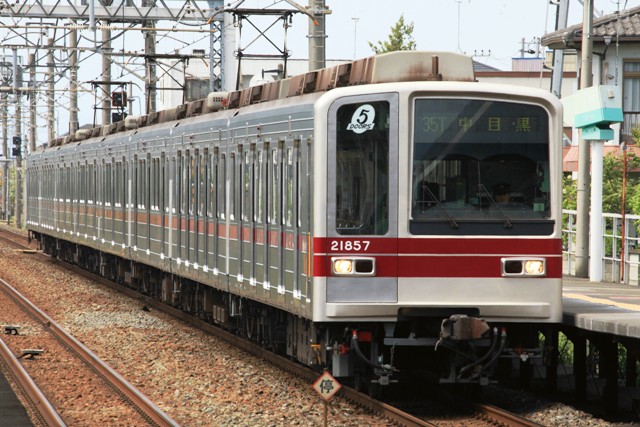
On the way to Nishiarai-daishi temple, I also enjoyed the trains on the Tobu line. The EMU 20000 series is one of my favorite ones. This model was launched in 1988. A total of 24 sets, 192 units, were built by Tokyu Sharyo and Alna Sharyo. The 20000 series is commissioned for direct operation between the Tobu and the Tokyo Metro Hibiya lines.

The Tobu 20000 series will be soon replaced by a new model named the EMU 70000 series. This changing of rolling stock was caused by the construction plan of automatic platform gates on the Tobu and Hibiya lines. For installation of automatic platform gates, all the trains on both routes should have the same size and the same number of doors. The 20000 series has 18 m-long bodies with 6 or 10 doors per car; while the new 70000 series has 20 m-long bodies with 8 doors per car, which is the same size and number of doors as that of the other trains on the Tobu lines.

Please ride on the 20000 series and take pictures before it is too late.

Peony garden near Daishimae station on the Tobu line

Wednesday, 16 May 2018

EMU 817 Series: Black Faced Kyushu Commuter Train

EMU JR Kyushu 817 series stands at Togo station

Kyushu is one of the major islands of Japan. It covers an area of 36,750 square kilometers. As of April this year, Kyushu has a population of 12.9 million. Fukuoka is the largest city on the island. It has a population of 1.57 million. There is a labyrinthine railway network in the urban area of the city of Fukuoka consisting of JR KyushuNishitetsu and Fukuoka City Subway lines.

JR Kyushu's EMU 817 series is the representative commuter train in the city of Fukuoka. It was launched in 2001. A total of 67 sets, 145 units (2-car x 56 sets and 3 cars x 11 sets) were built by Hitachi. Different from the commuter trains in Tokyo, the 817 series is an alternate current train for 20,000 V and 60 Hz overhead electric system.

The good thing about the 817 series in the Fukuoka area is its conversion cross seats. It is different from the older 815 series, which has commonplace long seats. I definitely prefer cross seat trains to long seat ones, since I can enjoy the scenery through the windows on the cross seat trains. Enjoying the scenery is the largest pleasure of railway travelling for me.

In the meantime, the 817 series won the good design award from the Ministry of Economy, Trade and Industry in 2001. The black face is cool; however, its flat shape is not my cup of tea, to be honest. It lacks impact. To hook rail fans, It needs to make a stronger impression.

EMU JR Kyushu 817 series stands at Togo station

Official information about the EMU JR Kyushu 817 series: