Monday, 31 July 2023

The 2nd Generation SDGs Trains

Set 5075 of the EMU Tokyu 5050 series, the 2nd generation "SDGs train"

In April, 2023, Tokyu Railways launched the 2nd generation SDGs Trains on their five routes, namely Toyoko, Den-en-toshi, Meguro, Shin-Yokohama and Setagaya lines.

Let me quickly review the SDGs Trains to start. The Sustainable Development Goals (SDGs) were adopted by all United Nations Member States in 2015 as a universal call to action to end poverty, protect the planet and ensure that all people enjoy peace and prosperity by 2030. In accordance with SDGs, Tokyu launched the special poster trains named "(the 1st generation) SDGs Trains" on the ToyokoSetagaya and Den-en-toshi lines from September, 2020. The purpose of the SDGs Trains is to provide a beautiful living environment. These trains were substantially powered by renewable energy.

Tokyu's initiative was not limited to the partial use of renewable energy. The company then started the use of 100% renewable energy for all trains on all lines in April, 2023. In commemoration of this goal achievement, Tokyu launched the 2nd generation SDGs Trains. I'm going to show you two of them today. The new SDGs train on the Toyoko line is set 5075 of the EMU Tokyu 5050 series. This train is directly operated onto the Tokyo Metro, Tobu, Seibu, Sotetsu and Minatomirai lines. On the other hand, set 310 of the EMU 300 series is the new SDGs Train on the Setagaya line. These trains are ornamented with the 17 goal colors of SDGs. The gradation represents co-creation of the goals. The 2nd generation SDGs Trains are also vivid and beautiful.
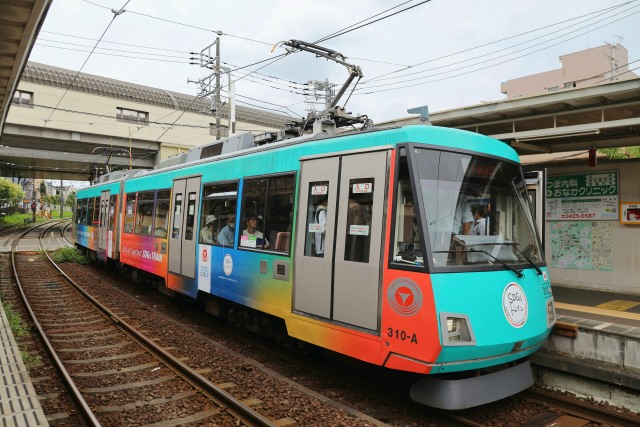
Set 310 of the EMU Tokyu 300 series, the 2nd generation "SDGs train"

Official information about the Tokyu SDGs trains (in Japanese):

Saturday, 29 July 2023

Tama Riverside Walking, Part 9: Keio-Inadazutsumi

EMU Toei 10-300 series crosses Tama River on the Keio-Sagamihara line

The Japan Meteorological Agency made an announcement that this year's rainy season ended on July 22nd in the Tokyo metropolitan area. It means that the 2023 mid-summer has begun. It's very hot every day, but I visited Tama River again, and enjoyed strolling blown by the south wind. My destination this time was Keio-Inadazutsumi. Keio Electric Railway has two railway bridges over Tama River. One is on the Keio main line, and the other one is on the Keio-Sagamihara line. My destination this time was the latter.

As soon as I reached the embankment, what jumped into my eyes was a double-track railway bridge on the Keio-Sagamihara line. The other landmark was the bicycle racing track on the other side of the river. One more, I saw a man who was sitting on the bank under intense sunlight. It's surprising that he was concentrating on the fishing in that heat.

A stainless-steel train with a light-green-colored stripe was soon approaching the bridge. That was the EMU 10-300 series, directly operated from the Toei-Shinjuku line. The 10-300 series was launched in 2005 replacing the old 10-000 series. There are several types of the 10-300 series. The top photo is the fourth batch train. It has two separate frontal lights on the lower part of its "face". Thick green and dark blue colored stripes are seen on the face. After shooting several shots of trains, I found that I was drenched in sweat. I had no room to talk about the angler.

EMU Keio 9000 series crosses Tama River on the Keio-Sagamihara line

Wednesday, 26 July 2023

The 110th Anniversary of Seibu Railway

Set 2069 of the EMU Seibu 2000N series, the 110th anniversary train

Along with Keio Electric Railway, Seibu Railway Company recently celebrated its 110th anniversary. Seibu was established in 1912 under the name of Musashino Railway, and partially opened the present Ikebukuro line in 1915. Since then, Seibu has been growing to be one of the major railway companies in the Tokyo metropolitan area. It has currently a total of 176.6-kilometer-long labyrinthine railway network in the northwestern part of Tokyo Metropolis and Saitama Prefecture.

The history of Seibu has not been an uneventful one. This company had been known for being managed by members of a single family, but, after a scandal involving them breaking a Security and Exchange Law in the early 2000s, the company has been trying to dedicate themselves to modernization of the management style. Rebounded from their scandal, the newly-established Seibu Holdings, Inc. was successfully relisted in 2014. I think the former Seibu was NOT diligent in their railway business, just keen on the florid new business. As a rail-fan, I wish Seibu to value their core business.

To commemorate its 110th anniversary, Seibu launched a special-colored train set 2069 of the EMU 2000N series. Its brown-colored body design was taken from Seibu's historical masterpiece train, EMU DeHa 5560 series. The 5560 series debuted in 1928 as both a commuter and a sightseeing train, and was retired from the track in 1958. Celebrating the 110th anniversary of the company was a good opportunity for Seibu to return to the basics of their vision and mission.

The 110th anniversary train stands at Higashi-Nagasaki station

Official information about the 110th anniversary of Seibu Railway (in Japanese):

Sunday, 23 July 2023

The 110th Anniversary of Keio Electric Railway

The 110th anniversary plate, Keio Electric Railway

On April 13th this year, Keio Electric Railway Company celebrated the 110th anniversary of their rail and bus businesses. The Keio line was initially opened between Sasazuka and Chofu stations (12.2 kilometers) on April 13th, 1913. At the same time, the bus routes between Shinjuku and Sasazuka and the others were also inaugurated. To commemorate the 110th anniversary, Keio is displaying a special plate on the front of train set 9702 of the EMU 9000 series. This low-key design is so Keio!

Keio is one of the major private railways in the metropolitan area. The railway route consists of the Keio and the Inokashira lines, extending to the western part of Tokyo and the northern Kanagawa Prefecture. Its total operating length is 84.7 kilometers. Keio carries an average of 1.5 million passengers per day. The transportation density is about 36,000 passengers per day per kilometer. It' so high because the routes are concentrated in high-density residential areas.

My grandfather, who passed away twenty years ago, was an engineer of Keio Electric Railway. He introduced many trains during his assignment. The classic electric car, type 500, which debuted in 1931, is still seen in his photo album as his first job. My father, who passed away several years ago, also worked for Keio as an architect. I've chosen the other industry, but became an enthusiastic railfan instead. It may come from my family. I hope that my grandfather and father are also celebrating the 110th anniversary from heaven.

Train set 9702 of the EMU Keio 9000 series arrives at Bubaigawara station

Official website, the 110th anniversary of Keio Electric Railway (in Japanese):

Thursday, 20 July 2023

Le Ciel: The 2022 Blue Ribbon Winner

EMU Keikyu 1000-1890 series, "Le Ciel", passes through Byobugaura station

It's a bit old news, but on May 26th, 2022, Japan Railfan Club announced that the EMU Keikyu 1000-1890 series, nickname "Le Ciel", was elected as the Blue Ribbon Prize. What's the Blue Ribbon Prize? It's an annual award presented by Japan Railfan Club since 1958, awarded to the best train that debuted in the previous year. Actually, almost all awarded trains to date are representative carriages in each railway company. Because of the COVID-19 calamity, there were fewer new models, which debuted in 2021, than usual, but I applaud Keikyu Corporation that won the tough election.

Le Ciel is a multi-purpose train. It's used not only for commuters but also for holiday makers. For that purpose, Le Ciel has multi-purpose seats, which the conductor can change from long seats to cross seats using a remote control system. The cross seat mode is applied when it's operated as a reserved seat train or a chartered train. One of my surprises is that Le Ciel is equipped with toilets. Keikyu has only short routes, so the company has been hesitating to equip toilets on their trains for many years. Of course, it will cost a lot for wastewater treatment from now, but the company made the great decision to invest for trains with toilets. Well done!

Incidentally, the nickname, "Le Ciel", was sought from the general public. I don't know why French, but I also like it. I'm very much fond of "the blue sky" on the Keikyu lines.

Interior of the EMU Keikyu 1000-1890 series (the long seat mode) with a toilet

Official information about the 2022 Blue Ribbon Prize by Japan Railfan Club:
Official information about "Le Ciel" by Keikyu Corporation (in Japanese):
Official information about the Keikyu trains by Keikyu Corporation (in Japanese):