Tuesday, 12 May 2015

EMU 1800 Series: Red Evergreen Train

Set number 1819F of the EMU Tobu 1800 series arrives at Tochigi Station

Tobu is one of the major railway companies in Tokyo. They operate the largest private railway network in the Tokyo metropolitan area. It covers the northern part of Kanto District including Tokyo Metropolis, Saitama, Chiba, Tochigi and Gumma prefectures.

As you may know, Tobu gears up for the promotion of tourism to Nikko, a World Heritage Site, by their luxury flagship train, limited express "Spacia". Along with Spacia, Tobu also have a standard express train, the EMU 1800 series to the Nikko area. It also has a strong appeal to rail fans.

The 1800 series was launched in 1969. A total of 9 sets, 54 units, have been manufactured for 19 years. Most of them have already been scrapped or modified to other models; however, set number 1819F is still operated with its original style. Currently, the 1819F is commissioned as a special train during the holiday season. The operation frequency is only several times per year; therefore, plenty of rail fans flock to stations or tracks to see this rare train, when the 1819F is operated.

The 1800 series is definitely my favorite. It has a bright red colored body with a white colored stripe. The classic frontal design is also attractive. Furthermore, silver colored side window frames are good accents. Although its specification is rather old, the sound of the DC motors is very nostalgic and comfortable.

The EMU 1800 series... it is a "red evergreen train".
 
EMU Tobu 1800 series stands at Tochigi Station on the Tobu-Nikko Line
 
More information about rolling stock on the Tobu Railway (in Japanese):

Saturday, 9 May 2015

The 700 Series for the 700th Post

Side view of unit number 723-3013 of the EMU JR West 700 series
 
Thank you for visiting Tokyo Railway Labyrinth. This is the 700th post in my blog. I hope that people all over the world will continue to enjoy this Japanese railway blog. In commemoration of the "700th" post, I am going to show you a train with the number "700" in the name... the EMU "700" series.

The Shinkansen EMU 700 series belongs to JR Central and West on the Tokaido and the Sanyo Shinkensen. It was launched in 1999 to replace the old rolling stock, such as the 0 and the 300 series. A total of 91 sets, 1,328 units have been manufactured by Nippon Sharyo, Hitachi, Kawasaki Heavy Industries and Kinki Sharyo. Currently, a total of 1,008 units are still being operated.

The 700 series has a complicated "platypus" shape on the front. Thanks to this streamlined design, the maximum speed for the 700 series is 285 km/hour. Brothers of the 700 series are also operated in Japan and Taiwan. For instance, the JR Central, West and Kyushu's latest Shinkansen trains, the EMU N700 series with a maximum speed of 300 km/hour, is an improved rolling stock from the 700 series. Similarly, Taiwan High Speed Rail's 700T series, whose maximum speed is also 300 km/hour, is the other brother of the 700 series.

One more... the other "700" series is here.

EMU JR West 700 seies leaves Tokyo Station on the Tokaido Shinkansen
 
More information about the EMU Shinkansen 700 series (in Japanese):

Thursday, 7 May 2015

Lawn Cherry Field on the Chichibu Railway

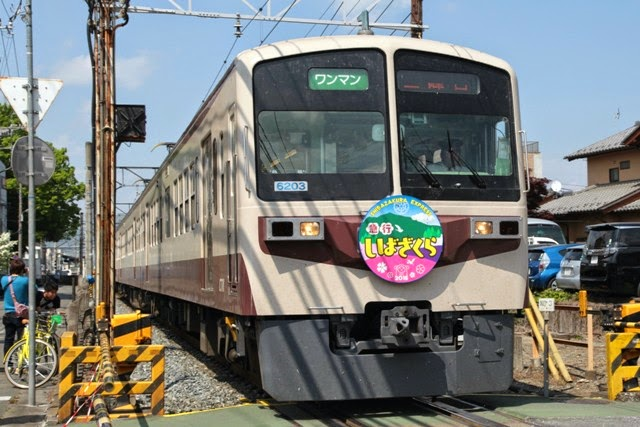
Set number 6203F of the EMU Chichibu 6000 series approaches Ohanabatake Station
 
Shibazakura (lawn cherry) season has come in the Tokyo metropolitan area again. Following the year 2012 and 2013, I visited the other reputable lawn cherry field in a suburban area this year. My destination was Hitsujiyama Park in Saitama Prefecture.

Lawn cherry is a cherry-like flowered short grass, which is originally from North America. It blooms in April to May in Japan as a mid-spring flower. Hitsujiyama (sheep mountain) Park is one of the famous lawn cherry fields in the Tokyo Metropolitan area. More than 400,000 lawn cherries are growing on a hill that covers 1.8 hectares. They are pink, white and lilac colored blossoms.

To get to this gorgeous spot, please take the Chichibu Railway, and get off at Ohanabatake Station. On the way to the lawn cherry field, I came across the EMU 6000 series, which had a special plate of the lwan cherry field on the front. The 6000 series is an express train known as an ex-Seibu 101 series. A total of 3 sets, 9 units were moved to the Chichibu Railway in 2006.

In October last year, the body of the set number 6203F of the 6000 series was changed to a russet color. It is the so-called "the revival color", whose coloring design has been restored to the trains from the 1980s. The revial colored train has a strong appeal to rail fans.

I enjoyed both the beautiful lawn cherry field and the nostalgic colored train on the Chichibu Railway.

 
Lawn chery field in Hitsujiyama Park near Ohanabatake Station on the Chichibu Railway 

Tuesday, 5 May 2015

Wave of Generation Change: The Ginza Line

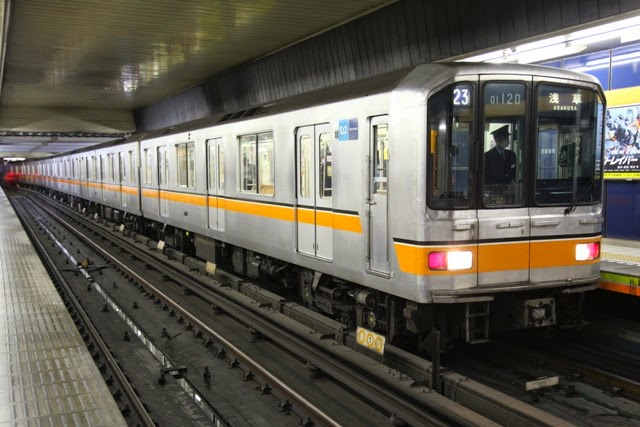
EMU Tokyo Metro 01 series stands at Shibuya Station on the Ginza Line

Following the Chuo Main Line, I am going to show you the other "wave of generation change" in the Tokyo metropolitan area.

The Ginza Line is the oldest subway route in Japan. It was partially opened between Ueno and Asakusa (2.2km) in 1927. Then, the entire route, between Shibuya and Asakusa (14.3km), was fully opened in 1934 by Tokyo Subway Company (present Tokyo Metro). The track gauge is 1,435mm and the electric system is 600V DC. The electric collecting system is the third rail without pantographs.

Today, the Ginza Line has grown up to become one of Japan's busiest commuter lines. Trains are operated every 2 minutes in the morning rush hour, every 2 minutes 15 seconds in the evening rush hour and every 3 minutes in the daytime. For that purpose, a total of 40 sets, 240 units of trains are required.

Currently, generation change of the trains is rapidly going on. The new model, the EMU 1000 series, has increased in number; while the old model, the 01 series, has been retired from the Ginza Line. The 01 series was launched in 1984. It is a short (16 m long) 6-car train with yellowish-orange colored stripe. Yellowish-orange is the "line color" of the Ginza Line.

The 01 series is not going to be operated for very long, and will disappear from the Ginza Line by the end of March next year. Please ride the 01 series now or never!

 
New model, the 1000 series (left) and the old model, the 01 series on the Ginza Line

Saturday, 2 May 2015

Going into the Homestretch: The E351 Series

EMU JR East E351 series, "Super-Azusa" arrives at Chino Station on the Chuo Main Line
 
A wave of generation change is going on in the Tokyo metropolitan area. Following the old local trains, the present express trains will also soon be replaced by a new model on the Chuo Main Line.

The Chuo Main Line connects Tokyo and Nagoya (424.6 km) penetrating Japan's backbone mountains. The whole route is electrified with a 1,500 V DC system. The track is 1,067 mm gauge double-double or double in urban areas; while single track still exists in the countryside.

The EMU E351 series, limited express "Super-Azusa", is the representative train on the eastern half of the Chuo Main Line. It was specially-developed in 1993 for passing through tight curves in mountain ranges at a high speed. Just before entering the tight curves, the train automatically tilts its body to mitigate the centrifugal force. So, it's called a "pendulum train" with a computer-controlled tilting mechanism. Thanks to this device, the 351 series has greatly reduced the travel time on the line.

On February 24th in 2014, JR East made a press release announcing that a new express train, the EMU E353 series, would be launched on the Chuo Main Line as early as the summer of this year. New technology, namely an air suspension type tilting system, is applied for this new model instead of a pendulum type tilting system on the E351 series.

The E351 series is going into the homestretch. It is not going to be operated for very long, and will soon disappear from the Chuo Main Line.
 
EMU JR East E351 series, "Super-Azusa" stands at Shinjuku Station on the Chuo Main Line