Monday, 10 January 2022

Kokubunji: Historical City on the Seibu Line

9104F (Seibu Legend Blue Color) of the EMU 9000 series travels on the Tamako line.

The 735-737 smallpox epidemic was a tragedy that afflicted much of Japan. Approximately 30% of Japanese people lost their lives at the time. The epidemic had significant social, economic, and religious effects throughout the country. When things returned to normal in 741, Emperor Shomu ordered to construct special Buddhist temples named "kokubunji" in all the provinces of Japan. That was the origin of Kokubunji City in Tokyo. Today, only rounded stones are placed indicating the pillar holes positions of the kokubunji in Kokubunji City, but I can feel that the ancient people were praying for social stability. History seems to repeat itself. Needless to say, it means the current COVID-19 calamity.

If you visit Kokubunji City, it's recommended that you use the "Legend Blue Train" on the Tamako line. Along with the "Tomato-colored" train, the Legend Blue Train is popular among rail fans. Its formal name is set 9104 (9104F) of the EMU Seibu 9000 series. Normally, the 9000 series has yellow-colored bodies, but 9104F has dark blue-colored ones.

Incidentally, the 9000 series debuted in 1993 reusing the old equipment of the retired 101 series. 8 sets, 80 cars in total, were built by Seibu Tokorozawa Factory. Due to reusing of equipment from the old train, the specification of the 9000 series was rather old. Seibu Railway converted the old rheostatic electric control system into the latest VVVF inverter (variable frequency drive) system in the mid-2000s.

We can enjoy both the historical site and the rare train in Kokubunji City.

Kokubunji temple ruins in Kokubunji City

Saturday, 8 January 2022

EMU 21000 Series: New Model on the Sotetsu Line

Set 21102 of the EMU Sotetsu 21000 series arrives at Tennohcho station

Sagami Railway (hereafter "Sotetsu") launched a new train model, the EMU 21000 series, for the direct operation between the Sotetsu and Tokyu-Meguro lines.

Let's quickly review the direct operation project. Sotetsu is a major private railway company, but the weakness is its inconvenient line network. Sotetsu trains couldn't run into downtown Tokyo two years ago. Sotetsu's weakness was mitigated in 2019, when the Sotetsu-JR East connecting line was completed. Sotetsu trains are now directly operated onto the JR East line to Shinjuku terminal in Tokyo, but the story didn't end there. Sotetsu then started constructing the second route to downtown Tokyo... the Sotetsu-Tokyu connecting line. Once the new line is completed, Sotetsu trains will be directly operated onto the Tokyu-Toyoko and Tokyu-Meguro lines, and bound for several subcenters in Tokyo starting from the fiscal year 2022.

For the second project, Sotetsu prepared two types of new trains... the EMU 20000 and 21000 series. The 20000 series was commissioned in 2018. The 21000 series then debuted in 2021. The former is composed of 10 cars, and will be operated onto the Tokyu-Toyoko line; while the latter consists of 8 cars, and will be operated onto the Tokyu-Meguro line. Technical specifications of the 20000 and 21000 series are mostly the same. They have ultramarine-colored aluminum-alloy bodies, mono-link type bolsterless bogies and a hybrid-SIC VVVF (variable-frequency drive) inverter electric control system with 190 kW traction motors.

Sotetsu is preparing for the direct operation onto the Tokyu-Toyoko and Tokyu-Meguro lines sufficiently enough in advance.

Set 21102 of the EMU Sotetsu 21000 series stands at Tennohcho station

Thursday, 6 January 2022

SDGs Train on the Toyoko Line

Set 5121, "SDGs train", of the EMU Tokyu 5000 series leaves Jiyugaoka station

Following the Tokyu-Setagaya line, I'm going to show you the other "SDGs Train" on the Tokyu-Toyoko line.

Let me quickly review the concept of SDGs Trains. The Sustainable Development Goals (SDGs) were adopted by all United Nations Member States in 2015 as a universal call to action to end poverty, protect the planet and ensure that all people enjoy peace and prosperity by 2030. Following SDGs, many companies, such as Tokyu Electric Railway, announced new initiatives taking into consideration, for example, environmental problems. Tokyu launched the special poster trains named "SDGs Trains" on the Setagaya, Den-en-toshi and Toyoko lines from September, 2020. The purpose of SDGs Trains is to provide a beautiful living environment. These trains are substantially powered by 100% renewable energy.

The SDGs train on the Toyoko line is set 5121 of the EMU Tokyu 5000 series. Set 5121 was built by Tokyu Sharyo in 2009. It was once launched on the Den-en-toshi line as a 10-car train, but moved to the Toyoko line as an 8-car train only one year after its debut. The reason for moving from the Den-en-toshi to Toyoko line was not clear, but probably because Tokyu held down the introduction of new rollingstock due to the harsh business conditions... namely Lehman's collapse. Tokyu's aggressive property investments had backfired at that time. Shortage of the trains on the Toyoko line must have been a serious problem.

Set 5121 had saved the Toyoko line, and become Tokyu's star... SDGs poster train.

SDGs train stands at Tamagawa station on the Tokyu-Toyoko line

Official information about SDGs Train (in Japanese):

Tuesday, 4 January 2022

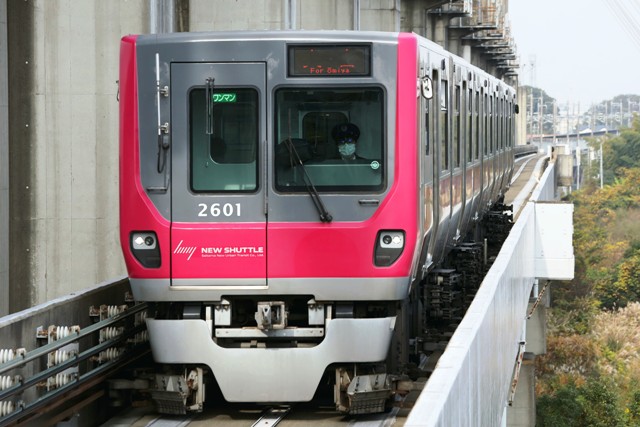
The New Shuttle 2000 Series: Update

Set 24 of the EMU New Shuttle 2000 series travels on the Ina line

Let me continue where I left off my last year’s post.

The EMU 2000 series is the largest fleet on the Ina line of Saitama New Urban Transit Company (hereafter "the New Shuttle"). It was commissioned in 2007 to replace the decrepit 1010 series. 7 sets in total were built by Kawasaki Heavy Industries. Each set has a different body color. They are dark-pink (set 01), orange (set 02), green (set 03), yellow (set 04), blue (set 05), red (set 06) and pale-pink (set 07). Among these, the body color of set 01 was slightly changed from metallic-pink to dark-pink in 2018. It's a typical geek topic that trainspotters like to talk about.

Incidentally, the New Shuttle is a rubber-tired automated guideway transit (AGT). The 2000 series has a stainless-steel body. It was widened a lateral width compared to the previous models in order to alleviate congestion during the rush hour. The one set is composed of six motorcars. The power supply is 600V three-phase alternate current. Instead of an overhead catenary, three rigid wires are installed along the track. The electric control system on the 2000 series is IGBT-VVVF (Insulated Gate Bipolar Transistor - variable frequency drive) inverter. It means that the three-phase alternate current is once converted to direct current by converters, and converted again to three-phase alternate current by inverters on the train to control traction motors. Each set has six 125 kW traction motors. The maximum operating speed is 60 kilometers per hour.

Set 21 (new color) of the EMU New Shuttle 2000 series

Saturday, 1 January 2022

Indonesian Railway Update: New Manggarai Station

8618F of the EMU KAI Commuter 8500 series arrives at new Manggarai station
(Photo: Faris Fadhli)

Happy New Year! The year 2022 has begun. I have received news from an Indonesian rail fan. My thanks go to Faris Fadhli, who kindly sent me the recent photos.

Manggarai station in Jakarta was elevated. Manggarai is located in a subcenter of Jakarta City, and known as the transfer station between the Bogor line and the Loop line. As a result, trains on the Bogor line now arrive at and depart platforms 10, 11, 12 and 13 on the second floor. It's being carried out as part of the double-double track construction project between Manggarai and Cikarang stations.

The top photo shows a train, set 8618 (8618F) of the EMU KAI Commuter 8500 series arriving at elevated Manggarai station. Taking this opportunity, I'm going to review this train. 8618F was operated on the Tokyu line in Japan from 1976 to 2008. After retirement from Tokyu, 8618F was moved to Jakarta to spend its second life. It was a 10-car train in Japan, but has grown longer... 12 cars in Jakarta (temporarily 8 cars at this moment due to a mechanical problem). The body stripes were also changed twice. It has now red and white-colored stripes, which are the standard colors of the local train operator, KAI Commuter. The second life is busier than that of the Tokyu era.

More than ten years have passed since I moved back from Jakarta to Tokyo. Time really flies. Life in Jakarta is now ancient history for me. I miss my days in Jakarta.

Elevated new Manggarai station, Jakarta, Indonesia
(Photo: Faris Fadhli)

Official website, KAI Commuter (in Indonesian):