Tuesday, 29 September 2015

Clematis Hill on the Tokaido Main Line

EMU JR Central 211 series travels on the Tokaido Main Line

It was a beautiful autumn weekend. I visited a garden, named Clematis Hill, near Mt. Fuji in Shizuoka Prefecture, some 120 km west of Tokyo. It was off-season, as the Clematis blooming season was over, but I could enjoy the profound silence backed by the songs of the birds in the garden.

One of the features of this garden is its open-air sculptures. They were works of an Italian artist, Giuliano Vangi. "Donna rigate a acqua (Woman who wears water)" was my favorite work. As its name suggests, the clothes of the woman are at one with water in its surrounding pond. The lotus flowers and the reflection of the blue sky on the water were also very beautiful.

To visit this unique garden, please take the Tokaido Main Line (JR Central's operating section) and get off at Mishima Station. You can see the EMU 211 series there. As you may know, this model has already disappeared from JR East's operating section (Tokyo - Atami) on the Tokaido Main Line, as it was replaced by the new model, EMU E233-3000 series in 2012.

The EMU 211 series was developed by Japanese National Railways in 1985. It has an outdated field excitation electric control system, but we must not forget that the 211 series has realized a large amount of operating cost reduction using its regenerative braking system. Please ride it and enjoy the whirring sound of the DC motor.

Art and railways... It was a gorgeous weekend for me.

 
Clematis Hill near Mishima Station on the Tokaido Main Line

Saturday, 26 September 2015

Sanyo Main Line: Backbone of Japanese Railways

DMU Chizu Express Railway HOT7000 series travels on the JR West Sanyo Main Line
 
Along with the Tokaido Main Line, the Sanyo Main Line is a backbone of the Japanese Railways. Connecting Kobe and Moji, its line length is 534 km. Most of the route is operated by JR West. The track is electrified double-double or double and its gauge size is 1,067 mm. The electric system is 1,500V DC overhead.

The Sanyo Main Line was partially opened by Sanyo Railway in 1888. The whole route was fully opened in 1942, when the Kanmon Submarine Tunnel was completed between Honshu and Kyushu Island. Although the number of long distance passengers has decreased due to the opening of Sanyo Shinkansen in 1975, the Sanyo Main Line still keeps its position of the main arterial railway in the western part of Japan.

If you go to the eastern part of the Sanyo Main Line such as the section between Kobe and Nishi-Akashi stations, various trains are continuously seen on the track. They are express, rapid, local and freight trains, EMUs, DMUs and ELs. For instance, the HOT 7000 series, Super-Hakuto, is an express DMU directly operated from Chizu Express Railway. The blue colored streamlined body is very vivid. The EMU 223-2000 series is a typical rapid commuter train in this section. It is faster than the rivals such as the express trains of Hankyu, Hanshin and Sanyo Railway. You can also see the local train, EMU 207 series, on the other double track.

The Sanyo Main Line is a moving railway museum for rail-fans.

 
EMU JR West 207 (left) and 223-2000 series (right)

Thursday, 24 September 2015

Large Straw Sandals on the Yokohama Municipal Subway

EMU Yokohama Municipal Subway 3000S series stands at Totsuka Station
 
Tokaido is the main trunk railway route in Japan. Connecting Tokyo, the capital city of Japan, and Kobe, the old port city in Hyogo Prefecture, its total length of the route is 590 km.

What was it like to travel on the Tokaido before inauguration of the railway? People were obliged to travel on horseback, in a palanquin or on foot. "Waraji (straw sandals)" were essential for travelers as footwear. They traveled on the Tokaido Road and stayed in the inns at the post stations. Local people made the large straw sandals and displayed them on the street in Totsuka post station. It was a symbol of safe travel. Travelers stopped by there to pray for their safety on the long journey.

Today, travelers don't stop by ex-Totsuka Post Station on the old Tokaido Road anymore, as they use railways, automobiles or airplanes. The large "waraji" has become not necessary for travelers; however, local people continue to make it regularly to pray for traffic safety in the Totsuka area.

To get to this historical spot, please take the Tokaido Main Line or the Blue Line of Yokohama Municipal Subway and get off at Yokosuka Station. The EMU 3000S series is the newest model on the Blue Line. It was launched in 2005 as the fourth batch of the 3000 series group. A total of 8 sets, 48 units have been built by Nippon Sharyo. The blue colored stripe on the front takes passengers' eyes.
 
The large straw sandals are seen on the old Tokaido Road near Totsuka Station

Tuesday, 22 September 2015

Alien Trains on the Tozai Line

EMU JR East 231-800 seres stands at Urayasu Station on the Tokyo Metro Tozai Line

I would like to show you the commuter trains in Tokyo for the first time in a very long while.

The Tokyo Metro Tozai Line is one of the busiest subway routes in Tokyo. Connecting Nakano and Nishi-Funabashi (30.8km), it penetrates downtown Tokyo from west to east. The trains are directly operated onto the JR East Chuo Local Line to Mitaka and the Toyo Rapid Railway to Toyo-Katsutadai, therefore, its maximum operation length reaches 56.4 km. Thanks to the direct train operation between multiple railways, many kinds of trains are seen on the Tozai Line. I am going to show you two examples today.

The top photo is the EMU 231-800 series directly operated from the JR East Chuo Local Line. The 231-800 series was launched in 2003 to replace the old models such as the 103-1000, the 103-1200 and the 301 series. A total of 7 sets, 70 units, have been built by Nippon Sharyo and Kawasaki Heavy Industries. The light and dark blue colored stripes are a good feature of this train. For your information, light blue is "the line color" of the Tozai Line.

The following photo is the EMU 2000 series directly operated from the Toyo Rapid Line. The 2000 series was launched in 2004. A total of 11 sets, 110 units, have been built by Hitachi. This model has been jointly developed with Tokyo Metro. So, the specification of this train is the same as that of 13th batch of the EMU Tokyo Metro 05 series.

 
EMU Toyo Rapid 2000 seres stands at Urayasu Station on the Tokyo Metro Tozai Line

Saturday, 19 September 2015

Looking down into Hell at Nokogiriyama

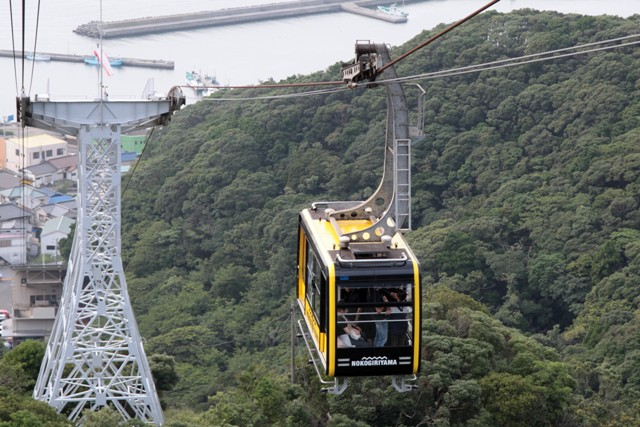
Gondola number 1, Kamome (seagull), Nokogiriyama Ropeway (aerial tramway)

Nokogiriyama (Mt. Saw) is a small mountain in Boso Peninsula, Chiba Prefecture, about 110 km southeast of Tokyo. As its name suggests, Nokogiriyama has saw-like jaggy rocks on its ridge line. They are tuffaceous rocks deposited around two million years ago that are famous as building material, called Boshu-seki (Boso Domain stone). The quarrying was started in the Edo Period (1603-1868) and continued until 1982, when the environmental protection regulation was enhanced.

Today, the ex-quarry is open to the public as a unique sightseeing spot. Specifically, an over-hanging rock, called "Jigoku-nozoki (looking down into hell)", is popular among tourists. If you stand on Jigoku-nozoki and look down into the deep valley, you will see the hell, which is really thrilling.

To get to this unique spot, Nokogiriyama Ropeway is convenient. Nokogiriyama Ropeway is an aerial tramway opened that in 1962. Connecting Nokogiriyama-sanroku (mountain foot of Nokogiriyama) and Nokogiriyama-sancho (summit of Nokogiriyama) stations, its route length is 680 m. The height difference between the two stations is 223 m. It takes about 4 minutes to go one way. The operation interval is about 15 minutes.

The present gondolas are third generation ones built in 2012 by CWA, Switzerland. They are yellow colored gondola number 1, Kamome (seagull), and red colored gondola number 2, Chidori (plover). Each gondola can hold up to 28 passengers. The yellow and red colored bodies are very vivid against the green forest.

Visit the saw mountain and look down into hell!

"Jigoku-nozoki (looking down into hell)" near Nokogiriyama-sancho Station

Official information about Nokogiriyama Ropeway:
Official area map of Mt. Nokogiri: