Monday, 28 April 2025

Preserved Electric Locomotive in Hitachi City

Electric locomotive Hitachi Mining Railway No. 13 preserved in Hitachi City

Hitachi is known as the city where Hitachi Ltd. was founded. It’s located in the northern part of Ibaraki Prefecture, about 150 kilometers north of Tokyo. The origin of this city traces back to the Hitachi Copper Mine, which was discovered in the late 16th century. The area developed rapidly in the early 20th century after the introduction of machinery such as rock drills, but this historic mine was unfortunately closed in 1981 after its resources were exhausted.

The Hitachi Mining Railway played an important role in the modernization of the Hitachi Copper Mine. This railway opened in 1908 to transport passengers, materials, and ore. Connecting Sukegawa (present-day Hitachi) and Daiou-in, its total operating length was 5.4 kilometers, and its track gauge was 762 millimeters. In 1957, the line carried 6,500 passengers per day, but it was unfortunately abolished in 1981 as part of streamlining efforts.

Please look at the top photo. This is Electric Locomotive No. 13, which is preserved at the Nippon Mining Museum in the city. It was built by Hitachi in 1926 and was mainly used for freight trains. The locomotive weighs 8,000 kilograms and is equipped with two 33 kW direct current motors. Its wheel arrangement is Ao-Ao. After 34 years of operation, it was retired from service in 1960.

What impressed me most was its pantograph—it looks like a tower! I wondered how the engineers insulated it to prevent current leakage and short circuits. It remains a mystery to me. Anyway, I enjoyed observing this precious electric locomotive from the early days of Japanese industrial history.

Pantograph of Electric Locomotive No. 13

Official website, "Nippon Mining Museum": https://www.jx-nmm.com/english/museum/

Friday, 25 April 2025

2025 Sakura Season on the Gotemba Line

Limited express "Fuji-san (Mt. Fuji)" running on the Odakyu line

The sakura (cherry blossom) season has already passed in Tokyo, but the front line of blossoms is still moving northward across Japan. A person traveling with this “sakura front” could enjoy the flowers for more than two months. The front also climbs into the mountains. I recently visited the foothills of Mt. Fuji in Shizuoka Prefecture.

I got off at Suruga-Oyama Station on JR Central’s Gotemba Line. My destination was Fuji Reien (Fuji Cemetery), where my grandmother’s grave is located. As I approached the cemetery, I was greeted by fully bloomed sakura trees on the mountain slopes. Their light pink blossoms created a vivid contrast with the blue sky and snow-capped Mt. Fuji.

Taking this opportunity, I’d like to give an update on the limited express train Fuji-san (Mt. Fuji) that runs on the Gotemba Line. The Fuji-san departs from Shinjuku Terminal on the Odakyu Line and continues directly onto JR Central’s Gotemba Line. The train used for this service is the EMU Odakyu 60000 series, MSE (Multi Super Express). The MSE normally consists of ten cars, but the formation can be divided into six- and four-car sets for greater operational flexibility. For the Fuji-san service, a six-car trainset is used.

I found a special “Mocoron” sticker on the front of the MSE. Mocoron is Odakyu’s mascot character. The sticker is part of Odakyu’s initiative to support child-rearing. For this purpose, the MSE includes a special lavatory equipped with a baby bed.

Fully bloomed sakura trees and snow-capped Mt. Fuji

Tuesday, 22 April 2025

Preserved Tramcar in the Open-air Architectural Museum

Unit 7514 of the Toei 7500 series tram preserved in Koganei City

The Edo-Tokyo Open-Air Architectural Museum is a lovely place where you can see many historic Japanese buildings. It’s located in Koganei City, about 30 kilometers west of central Tokyo. Since the 17th century, Tokyo has lost a number of precious old buildings because of fires, floods, earthquakes, and even wars. To protect and share what’s left, the Tokyo Metropolitan Government opened this museum in 1993 as an annex of the Edo-Tokyo Museum. The museum’s goal is to relocate, rebuild, and preserve buildings of great cultural value, and to hand down these treasures to future generations. One of my favorite spots is the public bathhouse Kodakara-yu (see the photo below).

The museum doesn’t just display old buildings. Please take a look at the top photo — this is unit 7514 of the Toei 7500 series tram. The 7500 series was introduced in 1962 as a mid-sized (12.52-meter-long) double-bogie tramcar for the Tokyo streetcar lines. Each car had two 60 kW DC motors and could run up to 40 kilometers per hour. After running for 16 years, unit 7514 was retired in 1978.

By the way, unit 7504, which I showed in a previous post, is a “sister car” of this one. You may notice that the color of the body stripe is different. The red stripe on unit 7514 was the original design used when the series debuted in 1962. On the other hand, the blue stripe on unit 7504 appeared around 1975, when one-man (driver-only) operation started.

Kodakara-yu (center) in the Edo-Tokyo Open-Air Architectural Museum
 
Official information about unit 7514 (Edo-Tokyo Open-Air Architectural Museum)
(Please scroll to the bottom of the page)

Saturday, 19 April 2025

The 12th Generation Sounyan Train

The 12th generation Sounyan Train (westbound) arriving at Izumi-chuo station

On March 31st, Sagami Railway (Sotetsu) launched the 12th-generation Sounyan Train. Today, I’d like to show you this new “poster train.”

Let’s start with a quick review of Sounyan. He’s Sotetsu’s mascot character—a “new species of cat,” according to the company’s website. He was born on March 10th somewhere along the Sotetsu Line, joined Sotetsu in 2014, and has been working in public relations ever since. He’s good at finding new things, and his hobbies are photography and eating out.

He seems like a fine young cat, but he also has a small mental burden—people often mistake him for a raccoon dog! That has apparently troubled him for a long time. What a detailed backstory he has! Well, as they say, no one can live on sweet words alone.

Jokes aside, the purposes of the Sounyan Train are to promote the charm of the Sotetsu Line and to give passengers a relaxing experience.

Trainset 11002 of the EMU 11000 series is used for this 12th-generation version. The 11000 series is Sotetsu’s commuter train that debuted in 2009. To reduce manufacturing costs, it shares most of its technical specifications with JR East's EMU E233 series.

Please look at the top photo. A stuffed Sounyan is sitting in the driver’s cab! It’s so cute—but I feel like I’ve seen something similar before... Let me think—oh, yes, Odakyu’s “Mocoron”!

Incidentally, you can check out my past posts about the 1st, 3rd, 4th, 10th, and 11th-generation Sounyan Trains as well.

The 12th generation Sounyan Train (eastbound) arriving at Yumegaoka station

Official information about the 12th Sounyan Train by Sotetsu (in Japanese):

Wednesday, 16 April 2025

Serving a Double Purpose on the Odakyu Line

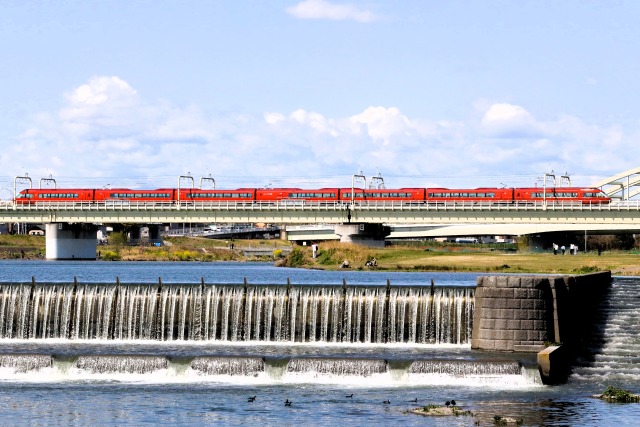
Romancecar "GSE" crossing Odakyu Tama River Bridge

It’s mid-spring in Tokyo, and daytime temperatures are now over 20 degrees Celsius every day. The best season of the year has arrived! I recently visited the bank of the Tama River bank on the Odakyu line.

As soon as I reached the embankment, what caught my eye was a double-double track railway bridge—the Odakyu Tama River Bridge. About five minutes later, my photo target appeared: the EMU Odakyu 70000 series, “Romancecar GSE (Graceful Super Express)”.

GSE is the newest model in the Romancecar fleet. It features upper-deck cockpits, allowing passengers to enjoy the forward view from the very front car. It also has large side windows that provide a clear, wide view of the scenery. The body color of the GSE is called “rose vermilion.”

Please take a look at the top photo—the GSE is crossing the Tama River in the morning sun, under a bright blue sky. Beautiful!

After finishing my train photography, I switched gears to another hobby of mine—fossil collecting. As I’ve mentioned before, it’s been my lifelong passion. This time, my hunting field was the riverbed near the Odakyu Tama River Bridge. In this area, we can observe many fossiliferous beds from the Iimuro Formation, which consists of shallow marine sediments deposited about 1.3 to 1.1 million years ago.

Please look at the photo below—this was my find of the day, a fossilized Fusumagai (Clementia vatheleti). It’s a large, thick, rounded bivalve. Welcome back to the world above ground, after more than a million years!

I truly served a double purpose that day on the Odakyu Line.

Fossil "Fusumagai (Clementia vatheleti)" found near the Odakyu Tama River Bridge