Wednesday, 13 June 2012

Access to the Sanctuary for Mountain Worship


Funicular "Aozora" passes through the middle point of the route on the Mitake Tozan Railway

It is early summer in Tokyo. The temperature is 20 to 25 degrees Celsius, but once the sun glows, it hits nearly 30 degrees Celsius easily. The best thing in this season would be to go somewhere to keep myself cool at the weekend.

Mt. Mitake is listed right along with Mt. Takao (see my blog on September 24th, 2011) as a spot to get to readily from downtown Tokyo. It is located 50km west of the city center. To visit there, you should get off at Mitake Station on the JR East Ome Line (see my blog on November 4, 2011). Then, transfer to a funicular train on the Mitake Tozan Railway.

This railway was opened in 1934 between Takimoto and Mitakesan stations. The total line length is 1100m, and the height difference between the highest and lowest points of the route is 423m. Lovely vehicles, Aozora (blue sky) and Hinode (sunrise) are operated every 20 minutes (see the top photo).

In the meantime, Mt. Mitake is famous as a sanctuary for mountain worship. Japanese people have believed mountains to be the home of gods since the pre-Buddhism era (before 552 A.D.). Mt. Mitake is no exception. Today, mountain worship becomes part of Buddhism. Many Buddhist groups climb up this mountain as their religious training.

Mt. Mitake, it is one of the best areas to gain fresh energy for Tokyoites, meanwhile the best places for Buddhists who worship mountains.


Funicular "Hinode" arrives at Takimoto Terminal on the Mitake Tozan Railway

More information about  Mitake Tozan Railway (in Japanese):
http://www.mitaketozan.co.jp/cablecar 
Front view from the funicular train, Mitake Tozan Railway (movie):

Sunday, 10 June 2012

Corn Poppy Field on the Chichibu Railway


Classic EMU Chichibu 6000 (ex-Seibu 101) series passes through Oyahana Station

Early June is an off-flowers season in the Tokyo metropolitan area. Late spring blossoms such as azalea and rose have already fallen, meanwhile early summer flowers such as hydrangea and iris haven't been seen yet.

But, don't give up so fast. We still have an opportunity to view a field of beautiful flowers. That is a corn poppy field in the Chichibu region, which is located 70km northwest of downtown Tokyo. It is a quiet suburban area within the Chichibu Mountains.

The corn poppy field is situated as a part of Chichibu Highland Ranch. We can see a vast carpet of flowers on the top of a hill. Red, vermilion and pink colored blossoms stretch along the ridge to the vanishing point (see the following picture).

To visit this colorful corn poppy field, take the Chichibu Railway and get off at Oyahana Station in Minano Town. As I mentioned in my blog on August 1st, 2011, this local railway firm cherishes second-hand trains that were renovated after acquiring them from major railway companies, such as JR East, Tokyu and Seibu. Chichibu Railway is often compared to the railway museum.

The top photo is an example of second hand trains, the EMU 6000 series, which is an ex-Seibu 101 series. It has been operating on the Chichibu Railway since 2006. I like this nostalgic face with two large windows very much.

Enjoying a local railway and visiting a beautiful flower field in the weekend, that's what's keeping me going.

 
Corn poppy field in the Chichibu highland ranch near Oyahana Station, Chichibu Railway

Thursday, 7 June 2012

Lupinus Hill on the Tobu-Tojo Line


EMU Tobu 50000 series, express train arrives at Ikebukuro Station on the Tojo Line

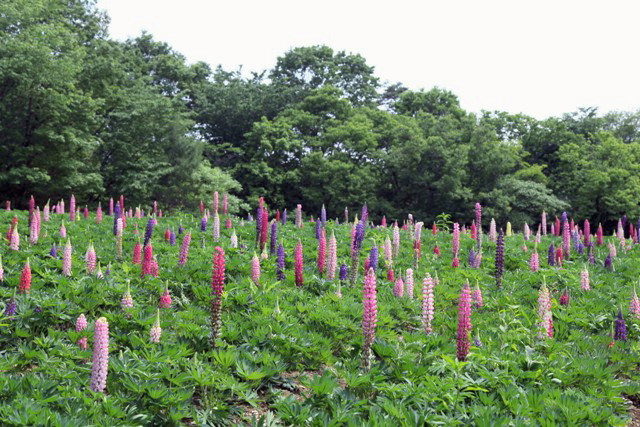
Lupinus, also known as Lupins or Lupines, is a leguminous plant originally from the Mediterranean region, Africa and the Americas. The shape of the flower is similar to that of wisteria, but the flowers open up from the bottom to the top. So it is called Nobori-fuji (climbing wisteria) in Japan. Numerous colors are seen in the flowers such as yellow, pink, purple and white.

Where can we see Lupinus? One of the reputable Lupinus fields in the Tokyo metropolitan area is Musashi Kyuryo National Government Park in Saitama Prefecture, which is located about 60km northwest of downtown Tokyo. A total of 35,000 flowers are seen near the western entrance of the park in late May and early June (see the following picture).

To visit Musashi Kyuryo National Government Park, the Tobu-Tojo Line is convenient. Connecting Ikebukuro, a subcenter of Tokyo and Kawagoe City in Saitama Prefecture, Tobu-Tojo Line was opened in 1914. Then, it was fully opened in 1925 between Ikebukuro and Yorii. The total line length is 75km. It takes about one hour from downtown Ikebukuro to Shinrin Koen Station by express train.

The orange colored EMU, Tobu 50000 series is a major fleet on the line. It was launched in 2005. Currently, 9 sets, a total of 90 units are operated on the Tojo Line, meanwhile their brothers, namely 50050, 50070 and 50090 series are also operated on the Tojo and the other Tobu lines.

My weekend travel seeking trains and flowers goes on and on.

 
Lupinus field in the Musashigaoka Shinrin-koen (Musashi Hills Forest Park) near Shinrin-koen Sta.

More information about trains on the Tobu Railway (in Japanese): http://www.tobu.co.jp/corporation/rail/vehicles/

Monday, 4 June 2012

EMU 2100 Series, Flagship Model on the Keikyu Line


EMU Keikyu 2100 series limited express train passes through Kogane-cho Station
 
As I mentioned in my previous article (see my blog on October 31st, 2011), one of the features of railways in the Tokyo metropolitan area is that many companies are in competition to attract passengers.

Keikyu Corporation is no exception. For example, this company is facing fierce competition from JR East in the section between downtown Tokyo and Yokohama, a major city in Kanagawa Prefecture. Meanwhile, they are challenging Tokyo Monorail Company on the route between downtown Tokyo and Tokyo International Airport (Haneda).

As a regional private railway company, Keikyu has clear corporate strategies to survive in this challenging business environment. They are train speed and passenger service. The maximum speed of the trains is faster than that of JR East. As the top ranking passenger service, Keikyu operates the luxury limited express train without additional fares.

EMU 2100 series assume the major role of the above strategies (see the pictures). Its maximum speed is 120km/hour, and runs between Shinagawa and Yokohama in 17 minutes. The 2100 series train provides amenities, such as comfortable switchable cross seats and traditional Nishijin fabric curtains on the windows.

In the meantime, some of the 2100 series trains adopt the VVVF inverter (variable-frequency drive) system manufactured by Siemens. This system produces sol-fa sound when it boots up. It is quite unique and famous as the Singing Train among rail-fans.

Keikyu 2100 series is fun to look at and rides great.

 
EMU Keikyu 2100 series passes through Minami-Oota Station

More information about EMU Keikyu 2100 series (in Japanese): http://www.keikyu.co.jp/about/train/train_2100.html

Friday, 1 June 2012

Gomen-Nahari Line, Visit to the Heartland of Tosa Domain


Railcar Tosa-Kuroshio Type 9640 arrives at Tano Station on the Gomen-Nahari Line

Following my blog on May 11th, I would like to introduce the other railway in Kochi Prefecture. That is Tosa-Kuroshio Railway, which took over the ex-JNR (Japanese National Railways) Nakamura Line.

This company opened a new route, Gomen-Nahari Line in 2002, sixteen years after it was founded. Connecting Gomen on the JR Shikoku Dosan Line and Nahari in the eastern part of the prefecture, the total length is 42.7km. A lovely rail car Type 9640 is operated every half an hour during the daytime (see the top photo).

The train of the Gomen-Nahari Line makes you visit to the heartland of Tosa Domain (now Kochi Prefecture), because there are many hometowns of Ishin-shishi on this line. Who are "Ishin-shishi"? They were anti-shogunate political activists in the 19th century. The group of Ishin-shishi overthrew the Tokugawa Shogunate, and established a new government in 1867. This restoration was the important turning point in Japan's transition from a feudal society to a modern nation. Yataro Iwasaki, later the founder of Mitsubishi Group, was born near Aki Station. Meanwhile, Shintaro Nakaoka, who has brought together the anti-shogunate people, was from Kitagawa Village near Nahari Station.

Why did many Ishin-shishi come from Kochi Prefecture? Although there are a lot of views, I guess it is because the people in this prefecture were independent, adventurous and ambitious, distant from the nation's major cities. You can see one of such a merchant's houses near Tano Station even today (see the following photo).

Oka-goten (Palace of Oka Family) built in the Edo Period near Tano Station 

More information about Tosa-Kuroshio Railway:
http://www.tosakuro.co.jp/tosakuro/top_E.html
More information about the railcars of Tosa-Kuroshio Railway (in Japanese):