Tuesday, 4 November 2014

EMU 2000 Series: Sole Model on the Saitama Railway

EMU SR 2000 series arrives at Tamagawa Station on the Tokyu Meguro Line
 
Let me start where I left off last time.

Saitama Railway (SR) is a short local commuter line connecting Akabane-Iwabuchi in Tokyo Metropolis and Urawa-Misono in Saitama Prefecture. The track is double and the electric system is 1,500 V DC overhead. The gauge size is 1,067 mm. Most of the route is constructed underground. All the trains are directly operated onto the Tokyo Metro Namboku Line and some of them are extended onto the Tokyu Meguro Line.

The EMU 2000 series is the sole model owned by SR. It was launched in 2001 when the SR Line was opened. A total of 10 sets, 60 units, have been manufactured so far by Kawasaki Heavy Industries in collaboration with Kinki Sharyo. The 2000 series is a 6-car train with three motor cars (3M3T). The body is made of aluminum alloy, but the doors are made of stainless steel to save on costs. The technical specifications are the same as those of the Tokyo Metro 9000, the Tokyu 3000 and the 5080 series for direct operations.

The Automatic Train Operation (ATO) system is adopted on the SR Line. A driver just pushes a button after the doors close. The train is, then, operated automatically to the next station. The driver doesn't need to drive the train, but he (or she) is on board for safety. The same system is also adopted on the Tokyo Metro Namboku Line.

The human-machine system must be the most powerful safety mechanism.

 
EMU SR 2000 series stands at Tamagawa Station on the Tokyu Meguro Line 

Saturday, 1 November 2014

Rail Yard Tours on the Saitama Railway

EMU SR 2000 (left) and Tokyo Metro 9000 series (right) in the Urawa-Misono Rail Yard
 
October is the month of railways in Japan, which was originated from the opening of Japan's first railway that was completed on October 14th in 1872 between Shimbashi and Yokohama stations. In commemoration of this special day, the Japanese Government designated October 14 as Railway Day in 1994. Since then, many railway companies have started to hold special public events in October such as rail yard tours and/or special memorial train operations.

This year, Saitama Railway (SR) held a public rail yard tour on October 25 in their Urawa-Misono Rail Yard. It was a bright and clear day. I saw many families with small children, young couples and rail fans in the yard, which is normally closed to the public.

SR exhibited their EMU, the 2000 series, in the rail yard. Next to the 2000 series, the Tokyo Metro 9000 series and the Tokyu 3000 series were also lined up for rail photo lovers. For your information, the Tokyo Metro and the Tokyu trains are directly operated onto the SR Line.

Along with the train exhibitions, many activities were also seen in the yard. For example, maintenance vehicle tours were very popular attractions for the kids. A farm products fair held by the local farmers in the yard was also popular among young mothers. I should say the event was most successful for all visitors.

I am going to introduce the trains on the SR line next time. To be continued...

 
Maintenance vehicle tours in the Urawa-Misono Rail Yard 

Thursday, 30 October 2014

Aerial Tramway to Mt. Yahiko

Gondola number 1 (Umihiko) of Yahiko-yama Ropeway in Niigata Prefecture
 
Let me start where I left off last time.

After visiting Yahiko Shrine, many worshippers and sightseers head to Mt. Yahiko, which stands against the shrine. The easiest way to get to the summit is to use a gondola called Yahiko-yama Ropeway.

Yahiko-yama Ropeway is an aerial tramway, which was opened in 1958. Connecting Sanroku (foot of the mountain) and Sancho (summit) stations, the total route length is 981 m. The height difference between the highest and lowest points of the route is 450 m. The gondola is operated every 15 minutes with an operating speed of 3.71 m per second. It takes about 5 minutes from Sanroku to Sancho Station.

The two gondolas, namely Yamahiko (number 1) and Umihiko (number 2), hold up to 35 passengers each. The two current gondolas were manufactured by Kinki Sharyo in 1990. The cream-colored body with green and orange colored stripes is vivid and my favorite.

The summit of Mt. Yahiko, which rises 634 m out of the sea, is a gorgeous scenic spot. Visitors can see boundless expanse of the Sea of Japan, Niigata Plain and Sado Island, but it is said that the most beautiful scene at this spot is the sunset over the Sea of Japan. I couldn't see the sunset, as it was cloudy when I visited there recently. We, Japanese, think that it is because of our everyday behavior.

I am going to live right and visit Mt. Yahiko again.

 
Scenic view from Mt. Yahiko

Tuesday, 28 October 2014

Old Shrine on the Yahiko Line

EMU JR East 115 series (Yahiko color) arrives at Yoshida Station on the Yahiko Line
 
The JR East Yahiko Line is a short local route in Niigata Prefecture, some 300 km north of Tokyo. Connecting Higashi-Sanjo on the Shinetsu Main Line and Yahiko, its total length is only 17.4 km. The route is a single track, and the electric system is 1,500 V DC overhead. The gauge size is 1,067 mm. A 2-car train, the EMU 115 series, is operated every hour on average. The train runs without a conductor on board because it has fewer passengers than the main line. The Yahiko Line is a typical local route in the countryside.

The body color of the 115 series on the Yahiko Line is called Yahiko-color. It is a white-colored body with yellow and green stripes. Only 3 sets, 6 units, of the Yahiko-color 115 series are operated on the track. As you may know, a rarity packs in rail fans to the track.

In the meantime, the terminal of the Yahiko Line, namely Yahiko Station, is located in a small quiet Yahiko Village. This
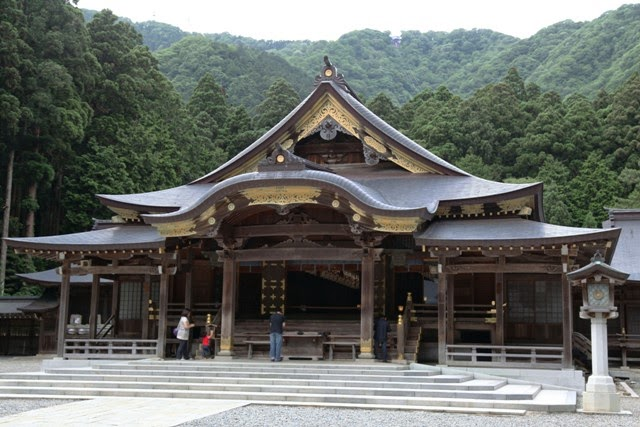
 village is famous for Yahiko Shrine. The foundation of Yahiko Shrine is unknown, but it was opened about 1,300 years ago or more, as the name of shrine was seen in an old anthology, called Manyo-shu, which was published in 759. The shrine was built backed by Mt. Yahiko. Being surrounded by the mountains and the deep forest, we can feel a holy atmosphere in the precinct.

To be continued...
 
Yahiko Shrine is located near Yahiko Station on the JR East Yahiko Line

Saturday, 25 October 2014

Special Poster Train on the Yamanote Line

Special poster train, set Tou-514 of the EMU JR East E231-500 series    

JR East has launched a special poster train on the Yamanote Line. It has a reddish brown-colored body, while the standard train on the Yamanote Line has a light green-colored body. But what is it for?

As I introduced before, Tokyo Station is going to celebrate its 100th anniversary on 20th of December this year. In commemoration of the anniversary, the special poster train has debuted. Tokyo Station was opened in 1914 as the central railway terminal of Japan's capital city. The Marunouchi Entrance Building was also opened at that time as the main building of Tokyo Station.

Since then, this station has been expanding its scale and functions, while at the same time, renovation work of the Marunouchi building was started in 2007, because it had aged. It cost 50 billion yen (500 million US dollars) and was completed in 2012.

You can see the history of the Tokyo Station on the body of the special train, set number Tou-514 of the EMU E231-500 series. The reddish brown-colored body shows a color of bricks, which were materials for the Marunouchi Building.

JR East also plans many events related to the 100th anniversary such as special nostalgic train operation and an exhibition in the station yard. The official ceremony is scheduled on December 19th, inviting the stationmaster of Amsterdam Central Station (the Netherlands) and the President of Metro North Railroad (the United States). For your information, Amsterdam Central and New York Grand Central are sister stations of Tokyo Terminal.


Close-up photo of the special poster train