Saturday, 10 October 2015

Patoden in Kagoshima City

Electric car 9507 of the 9500 series (Patoden color) in Kagoshima City

A patoden is a special poster train for a road safety campaign. What does a patoden look like? It looks like a police patrol car painted with black and white colors. It also has red colored squares, which resemble warning lamps, on top of the train's face. In many cases, the patoden is a streetcar operated on a shared track of a public road. It means that many car drivers, riders and pedestrians can easily see it. The patoden is eye-catching and is expected to reduce the number of traffic accidents.

For instance, the Transportation Bureau of Kagoshima City Office has a patoden, car number 9507, for their two tram routes. It is sponsored by the Kagoshima Prefectural Police and major auto manufacturers. You can see the slogan, "Let's get rid of traffic accidents!" on the side body of the streetcar. The letters of the KAGOSHIMA PREFECTURAL POLICE are a bit coercive, aren't they?

Car number 9507 was built in 1997 by Aluna Koki. It belongs to the electric car 9500 series. A total of 15 units of the 9500 series were built from 1995 to 2000. Their electric and mechanical equipment, such as DC motors and rheostatic control system, are rather old, since they have been diverted from the retired 800 series, but are still in good condition.

For your information, The Transportation Bureau of Kagoshima City has a total of 13.1 km tram routes in the urban area. The gauge size is 1,435mm and the electric system is 600V DC overhead.

 
Electric car 9510 of the 9500 series (standard color) in Kagoshima City

Thursday, 8 October 2015

Projection Mapping Event in the Traditional Garden

EMU Keihan 2400 series arrives at Shichijo Station on the Keihan Main Line

Projection mapping is an advanced technology using a computer and a variety of objects in place of a screen. These objects may be walls of buildings or complex landscapes. Projection mapping is currently very popular in Japan. I recently saw one such event in a unique venue... a Buddhist temple in Kyoto City.

Kodaiji was established in 1606 by Kita-no-mandokoro, who was a widow of a pre-eminent Daimyo, Toyotomi Hideyoshi. This historical temple is famous for its traditional Japanese style garden, and popular among tourists. The projection mapping was held in the temple garden using karesansui (a traditional dry landscape garden), a garden gate and hedges. I could enjoy the fantastic projected scenery one after another with live violin music. A half-moon was also beautifully shining in the clear night sky.

To visit this event, I took the Keihan Main Line and got off at Gion-Shijo Station. My vehicle was the EMU 2400 series, a standard commuter train launched in 1969. A total of 6 sets, 42 units have been built by Kawasaki Heavy Industries. The 2400 series is known as the first commuter train with air-conditioners in the Kansai (Kyoto-Osaka-Kobe) area.

For your information, Keihan is one of the major private railway companies in the Kansai area. The route extends to the eastern part of the Kansai area including Kyoto, Shiga and Osaka Prefectures. The track is electrified (1,500 V DC, overhead) and the gauge size is 1,435 mm.

Projection mapping event is held in Kodai-ji temple near Gion-Shijo Station

Official information about rolling stock of Keihan Electric Railway (in Japanese):

Tuesday, 6 October 2015

Visit to the Northern Kanto City

EMU JR East E233-3000 series stands at Utsunomiya station yard

Utsunomiya is the main city in Tochigi Prefecture, some 110 km north of Tokyo. It is located in the northern part of Kanto Plain, and known as the machine and food industries city.

I often stop by Utsunomiya, when I go sightseeing in Nikko, the World Heritage site. Whenever I visit Utsunomiya, I enjoy walking in the downtown area, as there are many beautiful spots. They are quiet and peaceful. Jiko-ji temple near the prefectural government office is one such place. The large red colored gate is vivid. It is also famous for the cherry blossoms in spring.

To visit Utsunomiya, there are three railway routes from downtown Tokyo. The Tohoku Shinkansen is the fastest and most convenient route for flying passengers, but it is a bit expensive. Tobu Railway is also convenient, if you live in the eastern part of Tokyo. I often take the JR East Shonan-Shinjuku Line, as it is suitable for people who live in the western part of Tokyo. It takes 1 hour and 40 minutes from Shinjuku, a western terminal of Tokyo, to Utsunomiya without having to transfer.

The main fleet on the Shonan-Shinjuku Line is the EMU E233-3000 series, which is composed of 10 or 15 cars. My favorite is a double-decker Green Car (the first class car) in the central part of the train. Once you pay a small extra fee (780 yen), a comfortable reclining seat is provided for you. I recommend it for long distance journeys over 100 km.


Main gate of Jiko-ji temple near Utsunomiya Station

Saturday, 3 October 2015

EMU 6000 Series: New Climber in Kobe City

EMU Shintetsu 6000 series arrives at Maruyama Station

Kobe Electric Railway (Shintetsu) has a 70 km-long network in the Rokko mountain area. Its route has many steep sections. Their rolling stock must have special equipment to climb up the steep tracks. Following "the expert climber", EMU 1100 series, I am going to introduce you to the new climber, EMU 6000 series, today.

The 6000 series debuted in 2008. A total of 2 sets, 8 units have been built by Kawasaki Heavy Industries. It is a 4-car train composed of all motor cars to climb up the steep track. A regenerative brake system is equipped. The 6000 series is known as Shintetsu's first stainless-steel train. I like this modern body design, but the nostalgic design of the expert climber, 1100 series, is also my favorite.

On June 9th, Shintetsu gave a press release announcing that the new model, 6500 series will be launched in spring of the year 2016. The purpose of the introduction of the new model is to replace the old model, 1000 series. The outer design of the 6500 series is the same as that of the 6000 series, however, the 6500 series will be a 3-car train with two motor cars. It will be equipped with the new VVVF electric control (variable frequency drive) system using new semiconductor devices.

Shintetsu's main train fleet was built during the so-called rapid growth years of Japan's economic boom in the 1960's and 1970's. Currently, Shintetsu has a hard time with the transition of their rolling stock to the next generation.

 
EMU Shintetsu 6000 series stands at Maruyama Station

Thursday, 1 October 2015

The 8900 Series: New Model on the Toei Arakawa Line

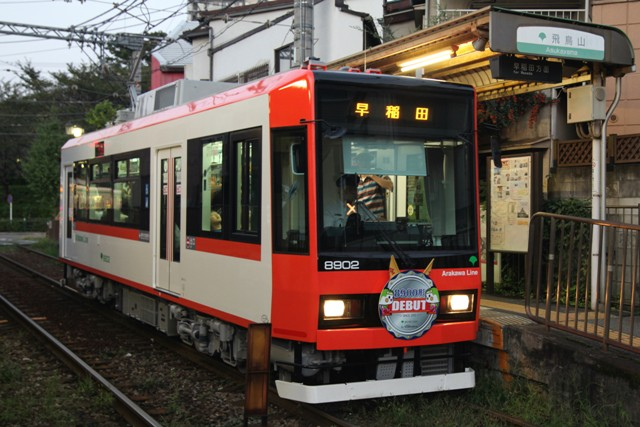
Electric car, Toei 8900 series stands at Asukayama Stop on the Arakawa Line

On September 18, the Transportation Bureau of the Tokyo Metropolitan Government (Toei) launched a new model of their electric car, the 8900 series, on the Arakawa Line. This is the first introduction of a new model in seven years.

The rectilinear-designed body painted with orange and white colors is very vivid for people living along the line. Energy saving LED lights light up the interior. The electric control system, the VVVF inverter (variable frequency drive), is also energy saving. Two units, namely car numbers 8901 and 8902, have been built by Aluna Sharyo. The operator plans to launch the other six sets by 2017. Their body colors will be blue, rose-red and yellow.

I easily shot this new model at Asukayama Stop last weekend, since the operator published the timetable of the 8900 series on their website. It was sunset and getting dark, but the new electric car stood out backed by the evening gloom. The LED interior lights were brighter than I thought.

For your information, the Arakawa Line is a precious survivor of the tram route in Tokyo. It had been operated as two routes, Routes 27 and 32, which were merged into one route, the Arakawa Line, in 1974. Connecting Waseda and Miniowabashi, its route length is 12.2 km. The track is 1,372 mm-size gauge and double. The electric system is 600 V DC overhead.

The 8900 series will soon be the symbol of the Toei-Arakawa Line.

The oldest model, 7000 series (left) and the newest model, 8900 series (right)