Friday, 14 September 2018

Satoyama Torocco Train in Chiba Prefecture

Kominato Railway's Satoyama Torocco train

"Satoyama" is a unique landscape in Japan. It is a mountain close to a living area. Local people gather firewood and edible wild plants in satoyama. It also functions as a windbreak for the living area. Satoyama has a secondary natural environment that cannot exist without the moderate intervention of human beings. Satoyama should be taken care of by people.

We can see a typical satoyama landscape in Boso peninsula of Chiba Prefecture. It consists of villages, rice fields and green mountains. Satoyama Torocco train, which is operated by a small local private railway company, is a convenient way to see satoyama landscape. Satoyama Torocco train was launched in 2015 by Kominato Railway using a light railway-style locomotive and 4-car coaches. It is similar with those of Kurobe Kyokoku Railway in Toyama Prefecture, Akasawa Forest Railway in Nagano Prefecture and Sherpa-kun in Gumma Prefecture.

The locomotive is named the Class DB4. It is a diesel locomotive made to resemble the Koppel steam locomotive in the 1920's. Its body length is 8.45 meters. The DB4 has a diesel engine, which was made by Volvo, with 256 kW output. The coaches have special roofs made of ultra-violet ray protection glass.

The operating section of Satoyama Torocco train is between Kazusa-Ushiku and Yoro-keikoku (18.5 kilometers). Satoyama Torocco train travels slowly on the track, so that the passengers can be relaxed and enjoy the one hour travel in the countryside.

Satoyama Torocco tour would be a journey to landscape in the original state in Japan.

Side view of the Class DB4 diesel locomotive, not a steam locomotive

Official information about  Satoyama Torocco train:

Tuesday, 11 September 2018

Tobu Crayon Shinchan Train: Part 3

Crayon Shinchan Train, 51055F of the EMU Tobu 50050 series, travels on the Tokyu line

One year has already passed since the Crayon Shinchan Train disappeared from the track. I still have their unreleased photos, so that I am going to show you them today.

As I posted before, Crayon Shinchan is a popular TV animation series created by Usui Yoshito. The main character, Crayon Shinchan, is a 5-year-old boy, who goes to kindergarten. The series depicts the everyday life of Crayon Shinchan with his parents, a baby sister, friends, kindergarten teachers and so on. Kasukabe City in Saitama Prefecture is the stage of this famous animation. Kasukabe is located on the Tobu-Isesaki line.

Starting from November 3rd, 2016, Tobu Railway had been operating special poster trains with a Crayon Shinchan design (Crayon Shinchan Train) to promote tourism to Kasukabe City. They were five sets of the EMU 50050 series. Each 10-car train set was beautifully decorated with Crayon Shinchan characters on a yellow (51055F), blue (51056F), red (51057F), orange (51058F) and green (51059F) colored background. Tobu trains were directly operated onto the Tokyo Metro-Hanzomon line and the Tokyu-Denentoshi line so that people in Tokyo Metropolis and Kanagawa Prefecture also enjoyed these unique trains in their areas. Although Crayon Shinchan Train was very popular among children, the operation of this special poster train was terminated on August 31st, 2017.

Incidentally, the EMU 50050 series is Tobu's standard commuter train launched in 2006. A total of 18 sets, 180 units, are operated on the track. It has the concepts of universal design and low energy consumption.

Crayon Shinchan Train, 51057F of the EMU Tobu 50050 series, travels on the Tokyu line

Saturday, 8 September 2018

Ex-Keio Train in Choshi City: Part 2

2002F of the EMU Choden 2000 series arrives at Inubo station

Choshi is situated in the easternmost part of Chiba Prefecture. It is located at the tip of the cape, so that the whole city is surrounded by the Pacific Ocean. Because of its topography, Choshi is cooler than the other cities in the Tokyo metropolitan area in summer; meanwhile, it is warm in winter. I am jealous of people in Choshi.

There is another fascination in Choshi. It is a unique local private railway, namely Choshi Electric Railway (Choden). Choden has only three active sets of rolling stock. They are 3001F, 2001F and 2002F.

2002F of the EMU 2000 series is a 2-car train consisting of one driving motor car (DeHa 2002) and one driving trailer (KuHa 2502). These cars were originally operated on the Keio line in Tokyo under the names of DeHa 2069 and SaHa 2576 of the EMU 2010 series. After retirement from the Keio line, they moved to Iyo Railway in Shikoku Island in 1984. These cars were then moved again to Choden in 2009. The "face" of the KuHa 2502 was remodeled from a middle car (SaHa 2576) in the days of Iyo Railway.

2002F is currently painted two tones of dark rose and beige. It is a revival color design of Choden before 1990. It looks just like the revival colored trains on the Seibu and the Izu-Hakone lines. Revival color is the key trend on the Japanese Railway to attract passengers like me... a rail-fan.

Side view of 2002F, the EMU Choden 2000 series

Official information about the trains of Choshi Electric Railway (in Japanese):

Wednesday, 5 September 2018

2018 Summer Memories: Romance Car GSE

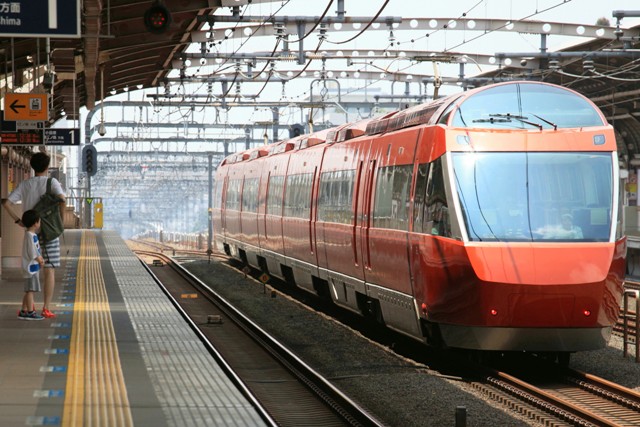
EMU Odakyu 70000 series, Romance Car GSE, travels on the Odawara line

It was very hot this summer in the Tokyo metropolitan area. On July 23rd, the highest temperature in Kumagaya City was 41.1 degrees Celsius, which was an all-time record high in Japan. The only thing I could do was escape the city and go to the highlands, but the trains to resort areas were crowded with passengers, because it was the summer holiday season.

Odakyu Romance Car was no exception. Whenever I happened to see it, the train to Hakone, which is a reputable resort in the Tokyo metropolitan area, was almost full. Specifically, the new Romance Car model, namely GSE (the EMU 70000 series), was very popular among the tourists. GSE is a 7-car train with upper-deck cockpits. Passengers can enjoy the view ahead. It is the same as the previous models such as NSE, LSE, HiSE and VSE, but GSE is more elaborate. For instance, it has large band windows to secure a clear visual field for passengers. On the same score, there are no luggage racks above the windows in car number 1 and 7, where passengers want to enjoy the front and the back views.

Regarding the technical specifications of GSE, an electrohydraulic full active suspension system is notable. It is a special device to minimize the lateral swinging movement of the train. The electric control system is state of the art full SiC-VVVF inverter.

Just in case, have I already taken Romance Car GSE? Good question! No, I haven't to be honest. Sorry for cracking wise.

EMU Odakyu 70000 series, Romance Car GSE, passes through Chitose-Funabashi station

Sunday, 2 September 2018

The 3100 Series: New Model to the Resort Mountain

Electric car Hakone Tozan 3100 series (2-car train) arrives at Miyanoshita station

I recently visited Hakone Tozan Railway for the first time in a year and a half. What was new with this dependable transporter that climbs up the resort mountain?

On May 15th, 2017, the company launched new electric cars, the 3100 series, on their Hakone Tozan line. It is a 2-car train composed of two motor cars. The 3100 series is a sister train of the previously debuted 3000 series, named "Allegra" ("Hello" in Rumantsch). What is the difference between the 3000 and the 3100 series? The 3000 series has two cabins per car; meanwhile, the 3100 series has single cabin per car. In other words, the 3000 series can be operated as a single-car train; meanwhile, the 3100 series must be operated as at least a 2-car train. 

Except for the number of the cabins, the other specifications of the 3000 and the 3100 series are almost same. For instance, they have 14 meter-long bodies. They have a state of art regenerative brake system. The common greatest selling-point is their large windows, which provide the passengers with the beautiful scenery of Hakone Mountain.

So far, 4 cars of the 3000 and the 3100 series have been built by Kawasaki Heavy Industries. A breakdown is two cars of the 3000 series and one set of the 3100 series. I saw plenty of inbound tourists boarding on the 3000 and the 3100 series. It seems popular among them.

Introducing the new models, Hakone Tozan Railway is at the new developing stage.

Electric car Hakone Tozan 3000 series (single-car train) + 3100 series (2-car train)

Official information about the electric car 3100 series (in Japanese):
Official movie of Hakone Tozan Railway:
https://www.youtube.com/watch?v=ZShmBT2rSAM&t=7s