Wednesday, 29 June 2011

Ekiben --- a Unique Railway Culture in Japan


Ekiben “Hayabusa-mamegui Bento” sold in Tokyo Station

An "Ekiben" is a meal for railway passengers in Japan. It is packed in a box to be easily carried around and sold at stations and on trains. Many vendors launch thousands kinds of unique ekibens throughout the country and compete with each other in their sales. Generally speaking, ekibens are typically filled with local foods, which are cooked with local recipes. Their wrapping papers usually depict the sceneries or specialties of the particular areas.

The top photo shows an example of an ekiben, which is sold in Tokyo Station. It’s one of my favorite. Unfortunately, Tokyo is a big city without any famous local foods. Instead, this ekiben is sumptuous and healthy. Its layout is colorful and sophisticated as well. A salmon slice and eggs, an eel slice, a chicken egg, a scallop, mushrooms, vegetables and vinegered rice are cooked Japanese-style.

When I was small, railway passengers bought ekibens from vendors on station platforms. As soon as a train stopped at a way station, passengers opened the train windows and called the vendors, who were shouting “bento, bento… (meaning a meal box)”. I was always surprised that vendors were selling dozens of ekibens with brisk efficiency during the train stop of several minutes. But times have changed since then. Nowadays, we cannot open the train windows. So, there is no shouting vendor on a platform and we have to buy ekibens at special shops in station yards or on trains. However, ekibens have survived as a "must-have" for railway travellers in Japan.

Ekiben --- it’s a unique railway culture in Japan.
 
Hayabusa-mamegui Bento, before opening up

Tuesday, 28 June 2011

Culmination of Shinkansen Technologies


Shinkansen N700 series at Tokyo Station

As I introduced before (see the blog of April 23rd, 2011), “Shinkansen” is the train that represents Japan. Its total railway network length is nearly 2400km and there are 1 million passengers per day now.

The history of the Shinkansen started in 1964 when the Tokaido Shinkansen was opened between Tokyo and Shin-Osaka stations. The round-nosed first Shinkansen train; EMU 0 series was launched just before the Tokyo Olympics. So far in the 47 years, Japan National Railway and its successors; JR companies have launched 15 series of trains one after another.

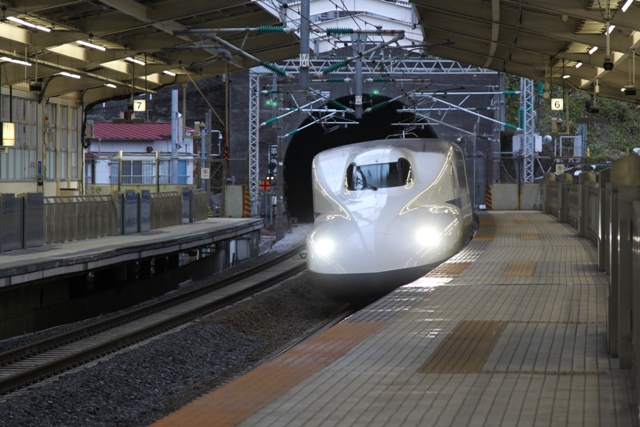
Look at the top photo. It’s the EMU JR Central and West N700 series at Tokyo Station. This train, which was launched in 2005, is the latest model on the Tokaido and the Sanyo Shinkansen. It consists of 16 cars (2 units of 3M1T and 2units of 4M) and its maximum speed is 300km/h on the Sanyo Shinkansen, meanwhile 270km/h on the Tokaido Shinkansen.

The most distinctive feature of N700 series is its improvement in speed on a curve passage. There are a lot of tight curves on the Tokaido Shinkansen because it's the oldest one. Its minimum curve radius is 2500m; therefore, the maximum speed on a curve passage was limited to only 255km/h in the past. However, by tilting the train's body with a high technology, the N700 series achieved operating at a speed of 270km/h on a 2500m radius curve passage.

JR N700 series … it’s a culmination of Shinkansen technologies.


Shinkansen N700 series passes through Atami Station, the Tokaido Shinkansen

Sunday, 26 June 2011

During the Rainy Season … Hydrangea and Train

Hydrangea and EMU Keio 1726F at Higashi-matsubara Station on the Inokashira Line

It’s rainy season just before midsummer in Tokyo. We have been having hot and humid days. At times like that, the only thing that saves my gloomy feelings is viewing hydrangeas which come into flower this season. There are many famous places with hydrangea blossoms in the Tokyo metropolitan area, but one of the undiscovered viewing spots is on the Inokashira Line of the Keio Electric Railway.

This railway company has been working on planting plants on the embankments of the railways to prevent slope failure and protect the environment since 1991. Nowadays, we can enjoy seeing colorful hydrangea blossoms at the side of the railways specifically around Shimo-kitazawa, Shin-daita, Higashi-matsubara and Meidaimae stations in June. The top photo shows beautiful purple and blue blossoms with EMU 1026F at Higashi-matsubara Station. Meanwhile, the bottom one is of pink and white blossoms with EMU 1015F near Shimo-kitazawa Station.

Among them, my favorite one is Hagashi-matsubara station, because the side of the railway at this station is illuminated from mid to late June to allow evening viewing of the blossoms. Although, we can see the beautiful blossoms as we have in the past, the night lights were cancelled this year, because of the electric power shortage, which was caused by the nuclear power plant disasters that followed the giant earthquake and tsunami. I’m really disappointed, but it’s inevitable when I think about the disaster victims.

The hydrangeas at Higashi-matsubara Station this year will withstand the test of time for me as a memorable scene of the giant earthquake year.
Hydrangea and EMU Keio 1715F near Shimo-kitazawa Station on the Inokashira Line

Saturday, 25 June 2011

Odakyu Romance Car, Yearning since My Childhood


The existing oldest romance car, EMU 7000 series near Chitose-funabashi Station

In the Tokyo metropolitan area, several private railway companies compete with gorgeous express trains as their flagships. One of the famous and venerable trains is “the romance car”, which is operated by Odakyu Electric Railway Company. Its route extends from Shinjuku; a subcenter of Tokyo to Hakone; a reputable mountain resort in a western suburb.

Odakyu first launched a resort train in 1935 as the “hot spring express”; however, it was forced to stop operating due to World War II in the 1940’s. After the war, Odakyu resumed the operation of the express in 1950 under the name of the romance car.

An epoch-making event occurred in 1957, when they launched the romance car, EMU 3000 series. This train established 145km/hour; the world’s fastest record of a narrow gauged railway at that time. Then, Odakyu launched new romance cars one after another.

Look at the top photo. It’s the oldest existing romance car; EMU 7000 series, which has been operating since 1980. I like this train very much, because the passengers can enjoy the view ahead. The cockpit is up stairs.

Meanwhile, the recent trend of the romance car is not only a resort train but also a commuter express. Look at the bottom photo. It’s the newest model; EMU 60000 series. This train operates between downtown Tokyo, such as Otemachi on the Tokyo Metro Chiyoda Line and Karakida; a commuter town in a western suburb of Tokyo.

Odakyu romance car … it’s a yearning since my childhood.

 
The newest model of the romance car, EMU 60000 series at Odawara Station

More information about Odakyu Romance Car: http://www.odakyu.jp/english/rc/index.html

Thursday, 23 June 2011

The Yamanote Line, Japan's Most Crowded Trains

EMU JR East E231-500 Series at Tokyo Station, the Yamanote Line
As I introduced in my last article (see the blog of June 22nd, 2011), the Yamanote Line is well known as Japan’s most crowded railway. The train runs every 2.5 minutes in the morning, every 4 minutes in the daytime and every 3 minutes in the evening of weekdays. Meanwhile, it operates every 3 minutes on Saturday, Sunday and national holydays. The train, whose name is EMU JR East 231-500 series, is composed of 11 cars (6M5T). The track gauge is 1067mm and the electric system is 1500V DC overhead.

This busy line is looped through several down town areas of Tokyo, such as Shinjuku, Shibuya, Ikebukuro and Shinagawa. Its total length is 34 km and all the trains run in the same direction throughout the day; clockwise or counterclockwise. The train covers the entire route in about 60 minutes. There are 29 stations and most of them are interchange stations to the subway, private railways and/or other JR lines.

It’s quite intersting that the inside of the Yamanote loop is regarded as the center of Tokyo in general. For example, if you have a house or an apartment there, you would get prestige as being rich or a winner (My apartment is located on the outside of the Yamanote loop unfortunately). Most of the prices inside of the loop are more expensive than those on the outside.

The Yamanote Line … it might be a modern castellated wall, which separates the center and the suburbs of Tokyo City.

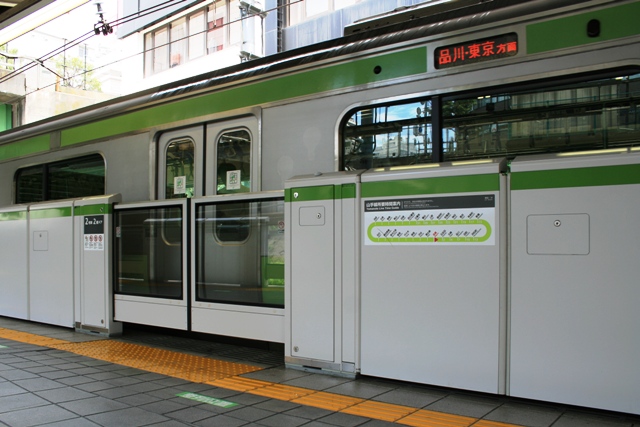
An automatic platform gate to prevent passengers from falling off the platform edge at Meguro Station, the Yamanote Line