Thursday, 30 August 2018

Buffy Fish Owl on the Fujikyu Line

6501F, "Matterhorn", of the EMU Fujikyu 6000 series (ex-JR East 205 series)

I felt like somebody was watching me. I was in a park lying at the foot of Mt. Fuji then. Who was that?

I noticed before long. "He" was a Buffy Fish Owl raised in the park. The formal name of the park is Fuji Kachoen (Fuji Flowers and Birds Park). This species was originally from Malaysia. The species name, Buffy Fish Owl, is from their buffy body color and their most favorite food, namely fish. He was flint-eyed and looked sharply at me in his cage. Am I a fish?

To get to Fuji Kachoen Park, the nearest station is Kawaguchi-ko on the Fujikyu line. Fujikyu is a local railway company in Yamanashi Prefecture. Connecting Otsuki and Kawaguchi-ko (Lake Kawaguchi), its operating length is 23.6 km. The track is single (1,067 mm gauge) and the electric system is 1,500 V DC overhead catenary. Several trains are directly operated onto the JR East Chuo main line through Otsuki Terminal.

The EMU 6000 series is the main fleet on the Fujikyu line. It was originally the EMU JR East 205 series being operated in the Tokyo area. Fujikyu purchased 6 units of the 205 series from JR East in 2012 and modified them to operate on the Fujikyu Line. The standard 6000 series has blue colored bodies with a yellow stripe on the front; however, only one set, namely 6501F, has a red colored body, named Matterhorn. It is because Fujikyu ties up with Matterhorn-Gotthard Railway in Switzerland.

Buffy Fish Owl is raised in Fuji Kachoen near Kawaguchi-ko station on the Fujikyu line

Monday, 27 August 2018

Seibu Akaden on the Tamagawa Line

247F of the EMU Seibu New 101 series (Akaden) arrives at Shin-Koganei station

Revival color is the key trend on the Japanese Railways. Many companies are operating revival colored trains with previously used body colors to attract passengers. The main targets are sightseers and veteran rail-fans. For instance, the Keio 8013F, the Keikyu 823F, the Tobu 8111F, 8568F, 8575F, 8577F, the Tokyu 1017F and the Izu-Hakone 5501F belong to this category. We can enjoy extraordinary experiences, as the familiar trains change to nostalgic ones.

Seibu Railway is no exception. On December 17th 2017, they launched a revival colored train, 247F of the EMU New 101 series, in commemoration of the 100th anniversary of their Tamagawa line. The 247F is a 4-car train built by Tokyu Sharyo in 1980. Its technical specification is rather old, but the 247F is still active in the front lines. The previous color was all white, but it has been changed to a dark rose color with a beige stripe called Akaden (red electric car). This color design was used from 1960 to 1990 on the Seibu lines. It is quite unique, since the current color design of the Tamagawa line trains is all white.

Incidentally, the Seibu Tamagawa line was opened in 1917 to transport gravel from the Tama riverbed to large cities for construction. The route was, then, changed to a commuter line in 1967. Connecting Musashi-Sakai on the JR East Chuo Line and Koremasa near Tama River, its operating length is 8 kilometers. The track is 1,067mm-wide single and electrified. The electric system is 1,500 V DC overhead catenary. The trains are operated every 12 minutes.

247F of the EMU Seibu New 101 series (Akaden) kept in Shiraitodai railyard

Friday, 24 August 2018

The 110th Anniversary of Tamaden

Set number 308, "Happy Maneki-neko", of the electric car Tokyu 300 series

There are two traditional tram routes in the Tokyo metropolitan area. One is the Toei (Tokyo Metropolitan Government) Arakawa Line and the other is the Tokyu-Setagaya line. Today's topic is the latter.

The Setagaya line, connecting Sangenjaya and Shimotakaido (5.0 kilometers), is a branch route of "Tamaden (the Tamagawa line)". The main route of Tamaden was opened in 1907 connecting Shibuya and Futako-tamagawa via Sangenjaya. The main route was constructed as a shared track on highway Route 246; meanwhile, the branch route (the Setagaya line) was then constructed as an exclusive track. Unfortunately, the main route was abolished in 1969, due to heavy traffic jams. As a result, only the branch route was left as the Setagaya line.

On March 6th in 2017, Tokyu Corporation celebrated the 110th anniversary of Tamaden. In commemoration of the anniversary, Tokyu launched a special poster train, "Happy Maneki-neko" on the Setagaya line. The design of the poster train came from Maneki-neko, whose birth place is Gotoku-ji Buddhist temple on the Setagaya line. "Maneki-neko" is an ornament in the shape of a cat beckoning with a forepaw. It is said that Maneki-neko brings good luck.

The formal name of the Happy Maneki-neko train is set number 308 of the electric car Tokyu 300 series. It was built in 2001 by Tokyu Sharyo. The original body color of set number 308 was "sunshine red", which was also a beautiful color.

The Setagaya line and the Tokyu 300 series are true descendants of Tamaden.

Set number 308, the original color, of the electric car Tokyu 300 series (September 2014)

Official information about the Happy Maneki-neko train (in Japanese):

Tuesday, 21 August 2018

2018 Summer Memories: Oga - Sea of Japan Fireworks

EMU JR East E6 series, super-express Komachi, stands at Akita station

It was very hot this summer in Japan. I was very busy at work but could manage to take a 4-day holiday in the middle of August. I visited Akita Prefecture in Tohoku District with my family.

Oga Peninsula is a major resort area in Akita Prefecture. Being located in the Oga Quasi-National Park, Oga is famous for the joys of its marine view and mountains with hot springs. On August 14th, a fireworks event was held in Oga City, which is located in the southern part of the peninsula. About 10,000 gorgeous and well programmed fireworks were set off on the beach. Japanese people have a love of fireworks so that more than 180,000 people flocked to the beach and added a sort of poetic charm to the summer season. I was also one of them.

To get to this resort area, the Akita Shinkansen is convenient. The EMU JR East E6 series is a high speed "mini-shinkansen" train for the Akita Shinkansen. The E6 series is coupled with the E5 and H5 series. It is operated from Tokyo to Morioka Station on the Tohoku Shinkansen. The E6 series is, then, detached after arriving at Morioka Station, and travels by itself to Akita Station, because the route between Morioka and Akita is constructed as a so-called mini-shinkansen. It means that the standard sized shinkansen trains, such as the E2, E4, E5, H5 and the E7 series, are unable to enter the mini-shinkansen sections. The maximum speed of the E6 series is 320 kilometers per hour.

2018 Oga - Sea of Japan Fireworks

Official information about the Akita Shinkansen:
Official information about the EMU E6 series (in Japanese):

Saturday, 18 August 2018

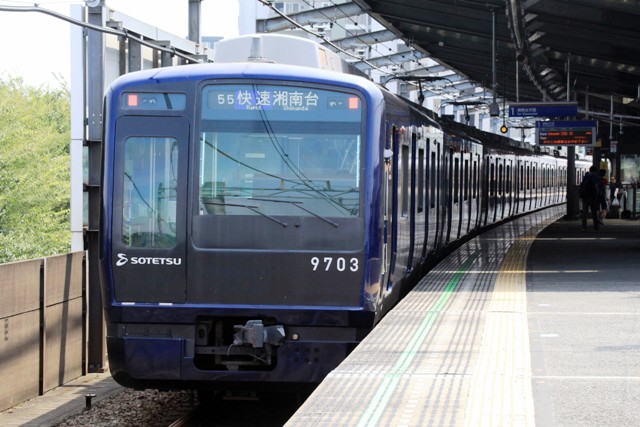
Sotetsu New Color: Update

EMU Sotetsu 9000 series arrives at Izumi-chuo Station on the Izumino line

Sagami Railway (hereafter Sotetsu) is one of the major private railway companies in the Tokyo metropolitan area. Starting from Yokohama, the main city in Kanagawa Prefecture, Sotetsu connects Ebina on the Main Line and Shonandai on the Izumino Line. There are 25 stations over a total operating length of 35.9km.

I seldom use Sotetsu as it doesn't run into downtown Tokyo, but I recently had an opportunity to take it for the first time in a year and a half. After finishing my meeting on the Sotetsu line, I stopped at Izumi-chuo station to take some train photos. Wherever we go, we, rail-fans, have something we like to do. Life is always enjoyable for rail-fans.

What was new with Sotetsu? The company had its centenary anniversary in December 2017. In commemoration of the anniversary, Sotetsu has been changing the train coloring with a new corporate color named Yokohama Navy Blue. On April 10th 2016, Sotetsu launched the first new colored train, set 9703F of the EMU 9000 series. Currently, 4 sets of the EMU 9000 series have been renovated and have new color bodies (the original color design is here). They are 9702F, 9703F 9704F and 9705F. The interior of these 4 sets has also been changed. The special feature is the leather-covered cross seats in car numbers 5 and 8. The leather was made in Scotland.

Furthermore, on February 11th 2018, Sotetsu launched a new model, EMU 20000 series, with Yokohama Navy Blue color bodies. I am going to report on the new model in a few days.

EMU Sotetsu 9000 series stands at Izumi-chuo Station on the Izumino line

Official information about the trains on the Sotetsu lines (in Japanese):