Thursday, 15 February 2024

When the Season Changes on the Odakyu Line...

Odakyu's mascot train, "Mokoron", approaches Kurihira station on the Tama line

It's still cold in Tokyo. In this season, the mountains block the cold, wet wind blowing from the northwest, which causes heavy snow to fall on the Japan Sea side. Then, only dry air comes to the Pacific side such as Tokyo. It basically stays clear in Tokyo every day, but not so always. Once a low-pressure system approaches the Pacific side, Tokyo also experiences snowfall.

Last week, a strong low-pressure system hit Tokyo. We saw 9 centimeters of snow. It was a hard time for railway employees, as they got sucked into the snow shoveling in the railway facilities. Thanks to their hard work, I could visit my favorite train shooting spot, Kurihira station, on the Odakyu-Tama line. I could shoot Odakyu's mascot train, "Mokoron", backed by the snow-covered world. Please look at the top photo. You can see the large stuffed Mokoron boarding on the train. I had chills, but it was worth the wait.

Two days later, the weather improved. It was a warm and sunny day. I enjoyed taking a walk near Chitose-funabashi station on the Odakyu line. When I passed by a small park, I found an early-blooming cherry tree there. It blossomed earlier than usual this year. Beautiful! Just like last year, a white-eye was coming to the tree. Judging from the belly stripe pattern, it's female. She was keen on sucking the nectar. Its green-colored head was brilliant.

When the season changes on the Odakyu line, we can enjoy both winter and spring scenes.

A white-eye sucks nectar of early-blooming cherry blossoms

Monday, 12 February 2024

52 Seats of Happiness

Set 4009 of the EMU Seibu 4000 series, "52 Seats of Happiness"

After posting "Final Chapter of the Seibu 4000 series", I remembered that another type of the 4000 series is operated on the Seibu lines. That's the Seibu restaurant train, named "52 Seats of Happiness". I'm going to introduce to you this special train today.

52 Seats of Happiness was developed by Seibu Railway in 2016 celebrating their 100th anniversary. That's basically a sightseeing train like JR East's "Irodori" and "Resort Yamadori", but it also functions as a restaurant train. All seats are reserved and passengers can enjoy luxurious meals on the train. As its name suggests, the maximum capacity of the vehicle is only 52 passengers. 52 Seats of Happiness is operated between downtown Tokyo and Seibu-Chichibu on an irregular basis. It takes about two hours and a half each way. It's very slow because passengers need sufficient time for dining. It costs 100 USD per person on average with a meal. The vehicle for 52 Seats of Happiness is set 4009 of the EMU Seibu 4000 series. It's the 4-car train consisting of two passenger coaches, one kitchen car and one multi-purpose car. Technically, it's composed of two control trailers and two motorcars. Its specifications are rather old, because it's a renovated train originally built in 1989. For example, its electric control system is traditional rheostatic.

You may ask, "Have you ever been on 52 Seats of Happiness?" Unfortunately, not yet. It quickly fills up with reservations before I know... I'm always busy and... (so many excuses!).

Top car of "52 Seats of Happiness"

Official information about the Seibu restaurant train, "52 Seats of Happiness" (in Japanese):

Friday, 9 February 2024

Winter Scenery on the Gotemba Line

Set V9 of the EMU JR Central 313-3000 series travels on the Gotemba line

It's still cold in Tokyo, but the sunlight is getting stronger. I can't keep fidgeting at home. My next destination was the JR Central Gotemba line.

Let me review the Gotemba line. It's a local route straddling Kanagawa and Shizuoka prefectures. Connecting Kozu and Numazu, its route length is 60.2 kilometers. Both Kozu and Numazu are transfer stations for the Tokaido Main line. In other words, Gotemba line is a bypass route of the Tokaido Main line. The thing is, the Gotemba line was opened in 1889 as a part of the Tokaido Main line, but in 1934, the short cut route was opened. The former Tokaido Main line was remained for the local people after that under the new name of Gotemba line.

I got off at Matsuda station, and enjoyed walking along the foot of Shibusawa Hill. After reaching the bank of Kawaoto River, I enjoyed looking the pellucid stream, wooded hills, blue sky and railway bridge. They were diffidently beautiful, but it's lacking something. Ten minutes later, a train was approaching me. This is the one! It was JR Central's local train, EMU 313-3000 series. Five more minutes later, the other train crossed the river. It was the EMU 313-2600 series. If I remember correctly, the former has cross-seats. On the other hands, the latter has only long- seats. You may ask "So what?" Please don't say things like that.

I enjoyed the winter scenery and trains on the Gotemba line to my heart's content.

Set N2 of the EMU JR Central 313-2600 series travels on the Gotemba line

Tuesday, 6 February 2024

Deja Vu on the Odakyu Line

EMU Odakyu 70000 series passes through the Second Shobu Tunnel

The Second Shobu Tunnel is the shortest tunnel on the Odakyu line. It's only 60.3 meters long. Almost all the Odakyu trains are longer than 60.3 meters, so, even when the top car passes through the tunnel, the very last car hasn't entered it yet. What makes the story of the Second Shobu Tunnel even more interesting is that this tunnel is located on a gently curved track. As a result, we can take a unique photo in this spot. The proof of the pudding is in the eating. Please look at the top photo. You can see the EMU Odakyu 70000 series, which is bisected by the tunnel. Isn't it unique? Isn't it interesting?

I know that nobody likes my bragging, so, I would like to move on to the next topic. When I shot the Odakyu train and the Second Shobu Tunnel, I had a strange feeling. I felt that I've seen this scenery before. Is this deja vu? I wonder what caused it. Three days later, I abruptly remembered it. Evidence is better than debate. Please look at the photo below. It was shot near Meidaimae station on the Keio-Inokashira line. You can see the EMU Keio 1000 series, which is bisected by the bridge of National Route 20. The structure is not a tunnel but a road bridge; however, you can see similar scenery in both photos. Two obtained images are very similar, aren't they?

EMU Keio 1000 series passes through the bridge of National Route 20

Saturday, 3 February 2024

Winter Roses on the Arakawa Line

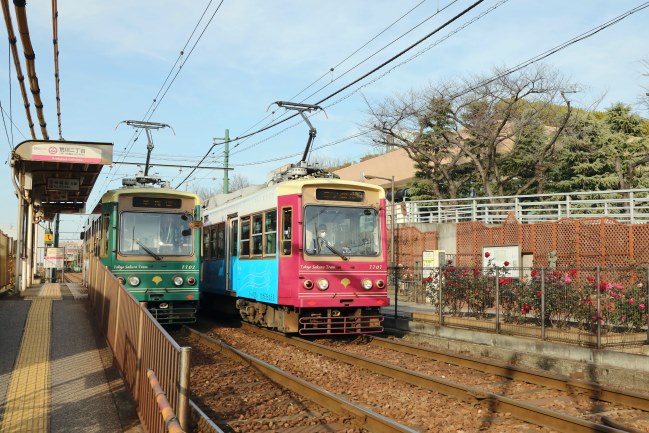
Electric car unit 8804 of the Toei 8800 series and the rose blossoms

It is mid-winter in Japan. In this season, the backbone mountains block the cold and wet wind blowing from the northwest, which causes heavy snow to fall on the Japan Sea side. In contrast, it's clear every day in Tokyo on the Pacific Ocean, because the only dry air jumped over the backbone mountains. The maximum daytime temperature is lower than 10 degrees Celsius in Tokyo; however, I found that the roses were blooming beautifully here and there outside the downtown area. One of the examples is on the Arakawa line, which is operated by the Tokyo Metropolitan Government (Toei).

Let me review the Arakawa line. It's a precious survivor of the tram route in Tokyo. It was once operated as two routes, namely Routes 27 and 32; however, they were merged into one route, the Arakawa Line, in 1974. Connecting Waseda and Minowabashi, its route length is 12.2 kilometers. The track is 1,372 millimeter-size gauge and double. Its electric system is 600 V DC with catenaries.

After looking at the magenta-colored rose blossoms, I decided to shoot both the roses and the magenta-colored tram in the same image. If my memory serves me correctly, there are 7 units of magenta-colored trams on the line, namely unit 8801 to 8805, 8905 and 8906. Five minutes later, the tram, which I was looking for, was approaching me. That's unit 8804 of the electric car 8800 series. Its body color was completely same as those of the roses beside the track (top photo). Hooray!

Electric car Toei 7700 series and the rose blossoms