Friday, 2 March 2012

Gondola Lift in Queenstown, NZ

Gondola lift in Queenstown, New Zealand
 
Recently, I had an opportunity to visit South Island in New Zealand. Since I didn't have chance to take the trains there, I will introduce a gondola lift which I took in Queenstown.
 
Queenstown is located in Otago District, the southwestern part of the South Island. The history of the town started in the 1860s, when gold was discovered in the Arrow River, a short distance from the town. Once the population of the town reached several thousands, however, the luck didn't hold long. The gold depleted and the population quickly decreased to several hundreds.
 
Currently, Queenstown has revived as a resort town. 1.3 million tourists visit there every year. The population is about 10,000. The urban area is very small, but it is bustling with throngs of tourists.
 
A highlight in Queenstown is the scenic view from Bob's Peak. To climb up this summit, the gondola lift is convenient (see the top photo). A gondola rises 450 vertical meters above the town at an average incline of 37.1 degrees to the peak. The total operation length is 730m. It's only a 5 minute ride. So, I could get a gorgeous view of the lovely town, Lake Wakatipu, a long Z-shaped lake formed by glacial processes and the Southern Alpine mountains (see the bottom photo).
 
For your information, one of the features of this aerial tramway is that it is able to carry bikes. A 4 seat gondola is equipped with a special basket for bikes. There are many mountain bike tracks on the hill for all levels of riders.
 
View of Queenstown and Lake Wakatipu from Bob's Peak

Thursday, 1 March 2012

Recovery from the Tsunami


Airport access train, EMU Sendai Airport Transit 721 series arrives at snowy Sendai Station

When the giant tsunami following the 9.0-magnitude earthquake hit the Tohoku District on March 11, 2011, the tide gauge near Sendai Airport recorded a 5.7m high. The airstrip and the main building, located 1km west of the coast, were severely damaged. The airport access railway, which connects Sendai City and the airport, also suffered catastrophic damage. Specifically, the underground track between Sendai Airport and Mitazono stations was fully-submerged. The airport was closed for about one month, meanwhile it took 7 months to recover the railway.

The Sendai Airport Access Railway (total 17.5km) is a composite route of two lines. One of them is the Sendai Airport Line of Sendai Airport Transit (SAT). The other is a part of the Tohoku Main Line of JR East. The former line is quite new as it was opened in 2007. Both SAT and JR East operate their own trains alternately. They are EMU SAT 721 series (see the top photo) and JR East 721-500 series (the bottom photo). The design and the specification are the same, but the coloring is different. SAT's trains are blue and orange colored, whilst JR East's trains are green and blue.

This airport access railway is very convenient. It takes only 17 minutes from the center of Sendai City to the airport. It gains an upper hand over the bus services in speed. So, passengers had been eagerly waiting for the recovery of the railway.

The star of the airport access transportation finally staged a comeback on October 1st, 2011.


Note: Sendai is the main city of Miyagi Prefecture, 300km north of Tokyo.

Airport access train, EMU JR East E721-500 series at snowy Sendai Station

Monday, 27 February 2012

Tokyo Station Building under Renovation


Southernmost part of Tokyo Station Building under renovation

Tokyo Station is the largest railway terminal in Japan, and was opened in 1914 as a central station of the capital city. The 20 surface and elevated tracks are used by the conventional JR and shinkansen (bullet train) lines. Meanwhile, 10 underground tracks are allocated for the conventional JR and the Tokyo Metro subway lines.

The Main Building (Marunouchi Entrance Building) is located in the western part of the station. It is red brick masonry, and appointed as an important national and cultural property.

This building, which was completed in 1914, is now under renovation which started in 2007, and will be completed mid to late this year. In addition to the railway operation facilities, a gallery, hotel and underground car parking are being constructed inside. It is said that the total construction cost is 50 billion yen (625 million US dollars).

Recently, a part of the protection cover of the building was unveiled; and a beautiful facade emerged (see the top photo). It is still a small part of the building; but it has a strong presence in the station and its surrounding area.

Furthermore, the construction and development of Tokyo Station area will continue until 2014. Currently, construction of the Yaesu Entrance side (eastern side) is also proceeding at a good rate.

My office is located on the 20th floor of a building on the Yaesu Entrance side so I can see the progress of the construction clearly from the window (see the bottom photo).

Tokyo Station is evolving toward the centenary.


Veiw of Tokyo Station including Main Building (center, red brickwork) under renovation

Friday, 24 February 2012

Classic EL and Fukujuso along the Railway Track


Electric locomotive (EL) Chichibu DeKi 501 with limestone freight train leaves Nagatoro Station

After visiting Mt. Hodo in Chichibu District (see my blog on February 18th), I went back to Nagatoro Station to catch the train home. On my way to the station on foot, I found a classic electric locomotive (EL) on the track of Chichibu Railway.

It was number 501 of Type DeKi 500. It was manufactured in 1973 by Hitachi Ltd. The main task of this EL is pulling freight trains. Its features are rather classic; however, the bluish body with a white stripe still has a youthful beauty. Specifically, I love its nostalgic design. Look at the top photo. You can see a deck and steps on the front of the locomotive. In the past, almost all Japanese ELs had decks like this. But, this design was faded out from an engineering viewpoint. Currently, we cannot see this type of EL on major railways, such as on the JR lines. So, Type DeKi 500s are highly valued for their historical significance.

In the meantime, I found lovely yellow flowers beside the railway track (see the bottom photo). They were "Fukujuso (Far East Amur adonis)", which are well known among Japanese people as a typical spring ephemeral. We can see these flowers in winter and/or early spring. It is said that Fukujuso brings us happiness and luck in Japan. It's probably because Fukujuso comes into bloom in the New Year holiday season.

I enjoyed the classic EL and beautiful flowers together. This is what is attractive in the Chichibu District.


FYI, I have linked to Panagos89's website, which introduces Greek railways. Please enjoy unique movies, shot by an enthusiastic railfan in Greece.

Fukujuso flowers along the railway track near Nagatoro Station, Chichibu Railway

Wednesday, 22 February 2012

N700 Series, the Biggest Force of Shinkansen Fleet


EMU JR Central N700 series arrives at Atami Station, the Tokaido Shinkansen

Replacing the 300 series (see my blog on February 19th), the EMU Shinkansen N700 series has recently become the biggest force on the Tokaido and Sanyo Shinkansen.

The N700 series launched in 2005, is the latest model on the Tokaido and the Sanyo Shinkansen. It is composed of 16 cars; and its maximum speed is 300km per hour on the Sanyo section, and 270km per hour on the Tokaido section. In addition to its speed, the other outstanding feature is its curve passage performance. By tilting the train's body using advanced technology, the N700 series achieved an operation speed of 270km per hour on a 2500m curve.

In the early stages of introducing the N700 series, they were used for Nozomi (Desire), the fastest trains stopping only at major stations, such as Nagoya and Kyoto. But, currently, the N700 series is used for all types of Shinkansen.

Look at the top photo. It is at Atami Station, located 100km west of Tokyo on the Tokaido Shinkansen. Previously, all of the N700 series trains, Nozomi and Hikari (Light), passed through this local station; however, recently, some of the N700 series, such as Kodama (Echo), have started to stop there.


The 300 series will retire soon, meanwhile the N700 series will emerge onto center stage. We cannot resist the tide of railway history.

N700 series, Super Express Kodama at Atami Station, the Tokaido Shinkansen

Monday, 20 February 2012

New Landmark on the Tokyo Metro Yurakucho Line


EMU Tokyo Metro 10000 series at Shin-Kiba Station on the Yurakucho Line

Following the completion of Tokyo Sky Tree (see my blog on July 29th, 2011); a new landmark was opened in Tokyo, the Tokyo Gate Bridge (see the bottom photo).

Tokyo Gate Bridge is a 2.9km long road bridge across Tokyo Bay. Unlike Trans-Tokyo Bay Highway (a 14km long tunnel-bridge combination) and Rainbow Bridge (a 798m suspension bridge), it is not an express road, but a toll free local street. Due to two kinds of restrictions, the designing of the bridge was very difficult. One of them is the Aviation Law. The bridge location is close to Tokyo International Airport; therefore, it is prohibited to construct a tall suspension bridge. Another restriction is to secure vertical clearance for large vessels to enter Port of Tokyo. 
Consequently, a truss-type design was adopted. The shape of the bridge became to be similar in appearance with a dinosaur. So, Tokyoites call this bridge "Dinosaur Bridge".

To visit this new landmark, it is convenient to get off at Shin-Kiba Station on the Tokyo Metro Yurakucho Line (see the top photo). Pedestrians can climb up the bridge easily, as there is a free elevator next to the bridge girder. I visited there last Saturday. It was very cold and windy at the 61m high bridge; however, a superb view there was, enough to quickly wash away all of my everyday stresses. I could see Tokyo's other new landmark, Tokyo Sky Tree, clearly from there.

I would like to visit Tokyo Gate Bridge again in summer to enjoy night view of the downtown and cool night breeze.


Tokyo Gate Bridge near Shin-Kiba Station on the Tokyo Metro Yurakucho Line

Sunday, 19 February 2012

Countdown to the Last Run, Shinkansen 300 Series


EMU Shinkansen 300 series and railfans at Tokyo Station, the Tokaido Shinkansen

It was Friday evening, 8.40pm at Tokyo Station. Despite the cold and occasional flurries, a number of rail fans were waiting for a train, which would arrive at platform number 16. That was the EMU Shinkansen JR West 300 series originally from Okayama Station. Why is it so popular among rail fans? It's because the EMU 300 series will retire soon. Recently, JR Central and West made a press release that the last run is planned on March 16th on the Tokaido and Sanyo Shinkansen.

The EMU 300 series launched in 1990 to decrease the travel time between Tokyo and Osaka, Japan's two major cities, competing with airliners. For that purpose, the maximum speed was raised up from 220 to 270km per hour. The new super express train, "Nozomi (Desire)" commenced and was operated using the 300 series. Since then, the EMU 300 series have been running east and west on the Tokaido and Sanyo Shinkansen. But, in recent years, they didn't have many lines, as the new EMU 700 and N700 series have replaced them. Consequently, March 16th will be their last run.

The retirement date is still one month away; however, many rail fans are visiting stations to take pictures and/or ride the 300 series to remember it. They are adults, children, boys, girls, mothers and families. Sayonara (good bye) and arigato (thank you) to the 300 series. We will never forget you through the years.

A young female railfan shoots 300 series at Tokyo Station, the Tokaido Shinkansen

More information about the last run, EMU Shinkansen 300 series (in Japanese):

Saturday, 18 February 2012

Nostalgic Aerial Tramway and Wintersweet Field


Aerial tramway on Mt. Hodo, Chichibu District in Saitama Prefecture

After enjoying the beautiful riverside scenery at Iwadatami (see my blog on February 14), I visited Mt. Hodo, which is also located near Nagatoro Station.

To climb up this mountain, it is convenient to take an aerial tramway, "Hodo-san Ropeway" (see the top photo). "Ropeway" is probably a "Japanglish (Japanese re-creation of English)" word. Do you use the word "ropeway" in your country? You don't use it, do you?

Putting that aside, Hodo-san Ropeway is a classic aerial tramway, which was completed in 1961. It is run by a subsidiary of Chichibu Railway. The riveting steel gondola, which can hold 50 people, looks aged and out of date. But, its classic design is very nostalgic for me. It delivers passengers between the foot and the summit of Mt. Hodo in only 5 minutes, no time at all, because it is only 832 meters long.

Last weekend, it was very crowded with many couples and families. In spite of full-operation, every 7 minutes, the layover was more than 40 minutes.

The 497m peak is a different world. We can see the superb scenery of Chichibu Basin surrounded by Kanto Mountains, such as Mt. Ryogami and Mt. Bukoh. Another attraction is a wintersweet field. Currently, about half of the wintersweet blossoms are in bloom (see the bottom photo). I could smell the sweet flavors of yellow flowers on a brilliantly sunny day.

Even though it was a little journey on the weekend; the harvest was rich and various.


Wintersweet flowers on Mt. Hodo

More information about "Hodo-san Ropeway (Aerial Tramway)" (in Japanese):
http://www.chichibu-railway.co.jp/kanko/nagatoro/hodorope/rope.html

Thursday, 16 February 2012

"Iwadatami" on the Chichibu Railway


EMU Chichibu 7500 series (Ex-Tokyu 8090 series) arrives at Nagatoro Station, Chichibu Railway

Nagatoro is a well known sightseeing spot in Saitama Prefecture. It is located 80km north of Tokyo, and situated in the northeast corner of Chichibu Basin. Nagatoro is a beautiful valley, which was incised by Ara River over a long period of time. Especially, "Iwadatami" is a famous view point (see the bottom photo). You can see piles of rocks on the both sides of the river. These rocks are metamorphic, which were generated by extremely high pressure in the deeper part of the subsurface around 100 million years ago. They look like straw mats in Japanese houses.

To enjoy 100 million years of the earth history, you should take Chichibu Railway, and get off at Nagatoro Station. It takes only 5 minutes from the station to Iwadatami on foot. Then, you can paddle your way down the river on a traditional boat. It is a perfect way for those who would like to enjoy beautiful riverside sceneries. Chichibu Railway is a local company, which connects several cities in the northern part of Saitama Prefecture. You can transfer to this railway from many routes such as the Joetsu Shinkansen at Kumagaya, the Seibu Line at Chichibu and the Tobu Tojo Line at Yorii station. As I introduced in my blog on August 1st, 2011, Chichibu Railway has been taking over trains, which were retired from other companies, such as Seibu, Toei and Tokyu (see the top photo). Riding these evergreen trains is also an exciting experience for rail fans.

Chichibu is a lot of fun.

 
"Iwadatami (piles of rocks)" along Ara River near Nagatoro Station, Chichibu  Railway

Tuesday, 14 February 2012

Rival Railway Story, JR East vs. Tokyu


EMU Tokyu 5050 series leaves Jiyugaoka Station on the Toyoko Line

Tokyu is a major private railway company in the Tokyo metropolitan area. They have a labyrinthine railway network in the southwestern part of Tokyo and Kanagawa Prefecture. It had been looking to be in an impregnable position as the leading railway company in Tokyo; however, Tokyu couldn't rest on their laurels forever. The situation quickly changed in 2001.

On December 1st, 2001, another giant, JR East commenced operation of the Shonan-Shinjuku Line train between the western part of Tokyo and Kanagawa Prefecture. The Shonan-Shinjuku Line is not a newly constructed line. It is just a composite route of several existing commuting and freight lines. But, the idea was very creative. Consequently, passengers became able to go to Yokohama, a major city of Kanagawa Prefecture, from Shibuya, a subcenter of Tokyo, in 24 minutes.

Tokyu was greatly shocked by this newly operating train of JR East. They took countermeasures immediately by speeding up trains on the Toyoko Line. The fastest train, "Limited Express" now connects Shibuya and Yokohama in 25 minutes. It costs 260 yen, which is 120 yen cheaper than that of JR East.

Furthermore, Tokyu plans a direct operation with the Tokyo Metro Fukutoshin Line through Shibuya Station. Once it is completed, people, who live in the northwestern part of Tokyo and Saitama Prefecture, will be able to go to Yokohama directly from their nearest station.

The competition is going to continue from this point. As a customer, I welcome this kind of competition, as long as safety is assured.

 
EMU JR East E231 series arrives at Ikebukuro Station on the Shonan-Shinjuku Line

Friday, 10 February 2012

"SL Usui" and "Glasses Bridge" in Gunma Prefecture


JR East "SL Usui" (steam locomotive D51 plus passenger cars 12 series) at Yokokawa Station

Are steam locomotives (SLs) still operated in your country?

In Japan, yes, they are, but not regularly. Several railway companies have SLs for operating special trains, such as the promotion of sightseeing spots or festivals on the lines.

In Gunma Prefecture, which is located north of Tokyo, JR East operates special SL trains. One of the famous routes is the Shinetsu Main Line in the western part of the prefecture. This area has some famous sightseeing spots and superb hot springs. Last weekend, I took a special SL train, "SL Usui" from Takasaki Station, and visited Usui Pass area (see the top photo).

"SL Usui" is composed of steam locomotive, D51 498, and five passenger cars. D51 498 was manufactured in 1940 at Takatori Works of the Department of Railways. It was retired in 1972; however, it came back into operation in 1988 for pulling special trains on the JR East lines. The body is beautiful shiny black, and the piercing whistle doesn't seem old at all.

After one hour of traveling, "SL Usui" arrived at Yokokawa Terminal. Then, I visited a heritage railway bridge, "Megane-bashi (Glasses Bridge)" by foot (see the bottom photo). Megane-bashi was constructed in 1893 as a railway bridge. It is made of brick, and appointed as a national important cultural property in 1993. A British engineer, Charles Assheton Whately Pownall designed it with Seiichi Furukawa. I got lost in the graceful view of the bridge.

I enjoyed the weekend being surrounded by the out of the ordinary.

"Glasses Bridge" on the dead track near Yokokawa Station

Tuesday, 7 February 2012

Countdown to the Last Run, Odakyu HiSE and RSE


EMU Odakyu "Romance Car" RSE, 20000 series passes through  Kyodo Station

Do you know the Japanese word "Mottainai"?

Mottainai has a similar meaning to the English word "wasteful". But, it is a bit different. In Japan, "Mottainai" is often used in relation to the throwing away of things or foodstuffs, which are still usable. Specifically, old people, who know the lean days of Japan, often use this word.

Odakyu Railway recently decided the displacement plan of their trains. Consequently, two types of "Romance Car" will be retired soon. They are the EMU 10000 series, HiSE, and 20000 series, RSE.

The EMU 10000 series, HiSE (see the bottom photo) was launched in 1987 in commemoration of the 60 year anniversary of the Odakyu Line. To ensure a good view of the scenery, the passenger rooms of this train are high up. It is unique, but barrier-free readiness for the aged and the disabled judged by current standards is difficult.

The EMU 20000 series, RSE (see the top photo) was launched in 1991 to commence direct operation to Numazu on the JR Central Gotenba Line. The most peculiar point is that it has a double decker Green Car (first class) at the center of the 7-car train. It is a quite gorgeous; but, it has been suffering from a decrease in passengers.

I understand the company situation, such as the barrier-free policy and the decreasing of passengers; however, these Romance Cars are still usable.

I must say "Mottainai". I hope that other railway companies take over these premier trains and operate them in the future.


EMU Odakyu "Romance Car" HiSE, 10000 series passes through  Kyodo Station

More information about Odakyu Romance Car: http://www.odakyu.jp/english/rc/index.html
More information about the last run of Romance Car HiSE & RSE (in Japanese): http://www.odakyu.jp/lastrunning/

Saturday, 4 February 2012

Urban "Hatsumode" on the Tokyo Metro Ginza Line


EMU Tokyo Metro 01 series leaves Tameike-Sanno Station on the Ginza Line

I just celebrated New Year, but I can't believe it is February already. Before introducing the topics of this month, I would like to keep to the subject of January a bit more.

During the New Year's season in Japan, many people visit shrines and temples. This is called "Hatsumode", the first visit to a shrine and a temple. The purpose of Hatsumode is to ask a god for a favor, or simply to turn over a new leaf and refresh yourself.

I visited Hie Shrine near Tameike-Sanno Station on the subway Ginza Line. The shrine is located on the top of a hill, which is surrounded by office buildings (see the bottom photo). After taking three flights of open air escalators, you can get to the altar. It is a typical urban shrine in downtown Tokyo, isn't it?

In the meantime, the Ginza Line is the oldest subway in Japan. It was partially opened between Ueno and Asakusa (2.2km) in 1927 (see my blog on September 10, 2011). Then, the entire route, between Shibuya and Asakusa (14.3km), was fully opened in 1934 by Tokyo Subway Company (present Tokyo Metro). Today, the Ginza Line has grown up to become one of Japan's representative commuter lines (see the top photo).

Recently, Tokyo Metro announced the launching of new EMU 1000 series this spring. The first train has already been completed and is being tested at a depot now.

The Ginza Line is providing us with something worth telling, even after 85 years of history.

 
Hie Shrine and office buildings near Tameike-Sanno Station on the Tokyo Metro Ginza Line

More information about new EMU Tokyo Metro 1000 series (in Japanese): http://www.tokyometro.jp/series1000/index.html
Detailed description about new EMU Tokyo Metro 1000 series (in Japanese): http://www.tokyometro.jp/series1000/ebook/#page=2

Wednesday, 1 February 2012

City of "Hot Sea" and Izukyu Railway


EMU Izukyu (ex-Tokyu) 8000 series at Atami Station, JR East Ito Line

Atami is well known as a resort city in the Tokyo metropolitan area. It is located in the eastern part of Shizuoka Prefecture; and 100km west of downtown Tokyo. From Shinagawa, one of the city centers in Tokyo, Atami is close, just 33 minutes away by the quickest Shinkansen train.

The name of the city, Atami, means "hot sea". Obviously, it represents that hot springs are seen on the coast in this city. In fact, we can see many bursts of steam from hot water wells here and there in the city. Another appeal of Atami is its beautiful view of the Pacific Ocean. You can see Hatsushima and Ooshima islands floating in an endless sea from every side of the city (see the bottom photo).

Atami also acts as a gate city to Izu Peninsula. To visit this resort peninsula, take the JR East Ito Line from Atami Station. The trains on the Ito Line are directly operated into Izukyu, a local private railway along to the east coast of the peninsula.

You can see nostalgic commuter trains of Izukyu Railway at Atami Station (see the top photo). They are EMU Izukyu 8000 series, ex-Tokyu 8000 series from Tokyo. They moved to Izukyu to spend second life after retirement from Tokyu Railway. Their brothers were also moved to other companies such as KRL Jabodetabek in Jakarta, Indonesia (see my blog on September 17, 2011).

A trip to Atami is interesting all the way through.

 
Hatsushima Is. (left) and Ooshima Is. (right), winter morning view of the Pacific Ocean from Atami

More information about Izukyu Railway: http://www.izukyu.jp/foreign_language/en/index.html

Sunday, 29 January 2012

Prepaid Passes in the Tokyo Metropolitan Area

Prepaid passes, Pasmo with seasonal commuter ticket (left) and Suica (right)

If you get around Tokyo, Pasmo or Suica is a must-have card. They are prepaid passes for railway and bus passengers. The function of Pasmo and Suica are the same. The only difference is the issuer. Pasmo is issued by private railway and bus companies, whilst JR East issues Suica. Pasmo and Suica are interoperable; therefore, you just need to make a binary choice.

Once you get a card and deposit some money, you can take almost all railway and bus routes in the Tokyo metropolitan area. It's convenient for shopping as well, because these cards can also be used as electronic money.

Look at the top photo. These are my Pasmo and Suica cards. Since I live along the Odakyu Line, I am a Pasmo holder. This Pasmo is special, because the function of a commuter seasonal ticket is also attached. In this example, I can use this card as a discounted seasonal ticket on the route between Chitose-funabashi Station close to my home and Ootemachi Station near my office. In addition, I can use other railway and bus routes, if I deposit some money in advance. Of course, I can go shopping as well with this card.

I have a Suica also. Why do I have to carry two cards? It's because my Suica is an ID card for admission to my office building. At the entrance, there is a gate, and I need the Suica to pass through there.

Use of Pasmo and Suica is expanding for a number of things.
 
Putting up Pasmo to pass through the entrance gate of Ootemachi Station, Tokyo Metro

More information about Pasmo: http://www.pasmo.co.jp/en/index.html
More information about Suica: http://www.jreast.co.jp/e/pass/suica.html

Thursday, 26 January 2012

The Senseki Line, Scars of 3.11 Earthquake


EMU JR East 205-3100 series leaves Nigatake Station on the Senseki Line, elevated track

Following my blog on January 21st, I would like to introduce you to another railway line in the Sendai metropolis.

The JR East Senseki Line is one of the main commuting arteries along with the Tohoku Line and the Subway Nanboku Line in the Sendai area. Connecting Aoba-dori, the city center of Sendai, and Ishinomaki, the second largest city in Miyagi Prefecture; the total length of the route is 52 km. It carries an average of 21,000 passengers per day (the top photo).

On March 11, 2011, the Senseki line was severely damaged by the giant earthquake. Especially, the section between Takagi-machi and Yamoto was fully-destroyed by the giant tsunami. This section is still interrupted. So, passengers have to take bus services, which are provided by JR East.

On this line, we can see special wrapping trains designed with comic heroes. They are the "Masked Rider" (see the bottom photo) and "Cyborg 009", which are popular characters from Shotaro Ishinomori's science fiction comics. Mr. Shotaro Ishinomori was born in Ishinomori Town near Sendai in 1938. Hence, his pen name, "Ishinomori" is from his hometown.

I read Mr. Ishionomori's comics voraciously in my childhood. Especially, I liked Cyborg 009. The story is that nine cyborgs fight the evil Black Ghost organization. I had a deep sense of empathy for the heroes' sad stories, because they are not humans, but artificial cyborgs.

Unfortunately, Mr. Ishinomori passed away in 1998; however, the comic heroes, he created, are still alive on the trains near his hometown and give the earthquake victims encouragement.


EMU 205-3100 series decorated with "Masked Rider" at Aoba-dori Station, underground track

Tuesday, 24 January 2012

"Kodama-type" EMU in My Old Memory


"Kodama-type" EMU, JNR 181 series, Limited Express "Toki" preserved in the Railway Museum

When I visited the Railway Museum in Saitama City (see my blog on January 2nd), I found a colorful train with a bonnet on the front (see the top photo). That is a so-called "Kodama-type" EMU.

The Kodama-type was first manufactured in 1957 as a limited express train "Kodama (Echo)" for intercity transportation between Tokyo and Osaka: two major cities in Japan. Needless to say, it was the pre-shinkansen era. The official name of the train was the "EMU JNR (Japanese National Railways) 151 series", DC limited express. The design is quite unique, as a large bonnet is attached on the front. The body is also fresh, as it is colored vermilion red and beige. Although, several similar types of limited express EMU have been manufactured since launching the 151 series, we apply the name of Kodama-type to all these designed trains.

The Kodama was the fastest train of that time in Japan. The maximum speed was 110km/hour, and it was able to travel between Tokyo and Osaka (550km) in about 6 hours and 30 minutes. I have a precious experience to ride this limited express train in my childhood (see the bottom photo). Probably, it is the oldest memory of my life. I got onto the Kodama at Tokyo Station to go to Shizuoka with my parents. It was the mid-summer vacation season. I still remember that I enjoyed looking out the window at the passing scenery while eating a "frozen orange", a popular product among travelers of that time.

How time flies!


EMU JNR 151 series, Limited Express "Kodama" in my photo album (Tokyo Station in 1963)

Saturday, 21 January 2012

Spirit of Tohoku, Post-quake Recovery


EMU Sendai Subway 1000 series arrives at Yaotome Station, elevated track

Recently, I had an opportunity to visit Sendai City in the Tohoku District. Sendai is situated about 300km north of Tokyo and is the main city of Miyagi Prefecture.

On March 11th, last year, a giant earthquake hit eastern part of Japan. The epicenter of which was located offshore, 170km east of Sendai City. Sendai was severely damaged by the destructive shaking. To make matters worse, the coastal part of the city was devastated by a giant tsunami. It wasn't just someone else's affair, as I lived in Sendai when I was a student.

The railways in the Sendai area, such as the Tohoku Shinkansen, JR East lines and the Sendai Subway Line, were also severely damaged. For example, bridge girders of elevated track section on the Sendai Subway Line were cracked near Yaotome Station. The Sendai City Transportation Bureau, which is the operator of the subway line, speeded up reconstruction efforts of the damaged sections.

Eventually, on April 29th, the entire route of the subway reopened, which was achieved one month ahead of schedule. The operation of the subway Nanboku (South-North) Line, a total of 14.8km in length, returned to normal. Construction of a new route, 13.9km in length, the Tozai (East-West) Line, was also resumed in the downtown area.

I think that people in the Tohoku District have tenacity and endurance. They also are closely united. It's probably because of cold and severe climate in winter. The city life now looks normal.

I saw the "Sprit of Tohoku" in Sendai City.


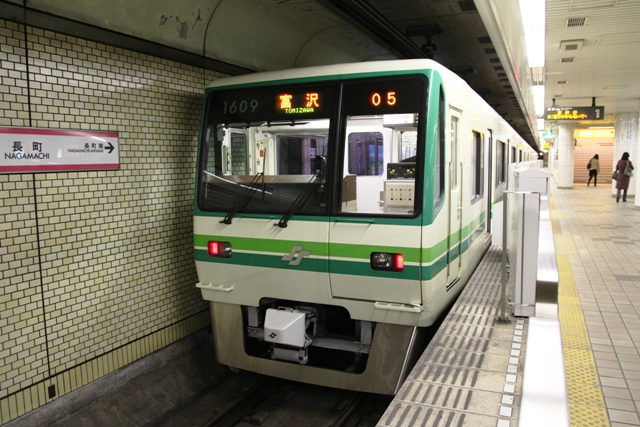
EMU Sendai Subway 1000 series leaves Nagamachi Station, underground section

More information about Sendai Subway:

Wednesday, 18 January 2012

"Ezuki Narcissus Road" on the Uchibo Line


EMU JR East 209 series runs backed by Mt. Nokogiri-yama on the Uchibo Line

Following my blog on January 10th, I would like to introduce another mid-winter flower field in the Tokyo metropolitan area. That is "Ezuki Narcissus Road" in Chiba Prefecture.

Ezuki Narcissus Road is located 60km directly south of the downtown Tokyo. But, it's more than 110km by railways because trains have to go around the coast of Tokyo Bay. To visit there, you should take the JR East Keiyo Line from Tokyo Station and get off at Hota Station on the Uchibo Line. It takes around 90 minutes by limited express. But, I took a local train that time to relax (see the top photo). The entrance of Ezuki Narcissus Road is only a ten minute walk from the station.

More than 10 milion narcissus are seen on a 3km road. They are planted in fields, slopes, riversides and house gardens. Historically, the planting of narcissus started in the 19th century by local farmers. The cut flowers were shipped to the downtown Tokyo.

Yellow and white colored flowers are fully in bloom now. Many people were visiting there. The sweet smell of narcissus flowers attracts tourists from around the Tokyo metropolitan area. Visitors were spending their time as they pleased; enjoying walking, chatting with local people or taking lunch in the fields. I enjoyed taking flower photogtaphs (see the bottom photo).

The wind was still cold, but sun was stronger than before. The spring is around the corner in Tokyo. I can't wait for a genial season.


Narcissus flowers near Hota Station on the JR East Uchibo Line

Tuesday, 17 January 2012

47th Annual "Ekiben Festival" in Tokyo


Packages of two Ekibens, "Northern Festival" (left) and "Maezawa Roast Beef Sushi" (right)

As I introduced in my June 29th, 2011 blog, "Ekiben" is a unique railway culture in Japan. It's a meal for railway passengers, sold at stations. Generally, it's packed in a box to be easily carried around.

Since last Thursday, the "Ekiben Festival" is being held at Keio Department Store in Shinjuku, Tokyo. It's a famous annual event among Tokyoites, because 250 kinds of local Ekibens are gathered from railway stations throughout Japan. This 47th time around, plenty of Ekibens have been collected specifically from the Tohoku District, where a giant earthquake and tsunami hit last year. Needless to say, it's a strong support to this disaster area.

I bought two Ekibens from the Tohoku District. One of them is "Northern Festival", which comes from Miyako Station, the JR East Yamada Line. Miyako is one of the tsunami-devastated cities and is in the process of recovering from the disaster. "Northern Festival" is packed with seafood and rice. Salmon eggs, crab meat, sea urchin, seaweed, chicken egg, vegetables and rice are cooked in the local-style. I enjoyed the harvest from the sea.

The other one is "Maezawa Roast Beef Sushi", which comes from Ichinoseki Station, the JR East Tohoku Line. There are no reports of casualties in Ichinoseki City; however, more than 5000 houses were damaged by the destructive shaking. "Maezawa Roast Beef Sushi" is packed with roast beef and vinegared rice cooked in a sushi-style. The material of roast beef is local Maezawa beef. I enjoyed the taste of the premier beef.

Pray for Tohoku.

Setouts of two Ekibens, "Northern Festival" (left) and "Maezawa Roast Beef Sushi" (right)

Saturday, 14 January 2012

Flagship Model of Romance Car Fleet


EMU Odakyu 50000 series, "Romance Car" VSE passes through Kyodo Station

As I introduced in my June 25th, 2011 blog, the "Romance Car" is the train that represents Odakyu Electric Railway Company. Connecting Shinjuku; a subcenter of Tokyo and Hakone, Enoshima and other reputable resorts, Odakyu has been operating this luxury limited express train since 1950. So far, a total of 8 models have been launched. Currently, 6 of them are still operating on the routes.

If I introduce a flagship model of the Romance Car, I can instantly select the EMU 50000 series without question (see the top photo). The EMU 50000 series, also known as VSE (Vault Super Express), launched in 2005 to replace old models. Before the debut of the 50000 series, Odakyu had been suffering from a decreasing number of Romance Car passengers. It was serious because the decreasing number of passengers was much larger than that of sightseers to resorts on the Odakyu Line. It meant that the visitors to the resorts were not satisfied with the existing Romance Cars.

Because of this, the daring style was adopted by the new Romance Car, EMU 50000 series. For example, the cockpit is up stairs. So, the passengers can enjoy a front view through the wide window (see the bottom photo). The roof design has also been changed to a near-futuristic, vault-shape. The interior has become more luxurious.

In late 2005, the EMU 50000 series received a "Blue Ribbon Prize" from Japan Rail Fan Club. This award is given to the best new train model of the year. Odakyu's effort finally bore fruit.

EMU Odakyu 50000 series, "Romance Car" VSE at Hakone-yumoto Station

Tuesday, 10 January 2012

Canola Flowers, Hint of Spring on the Tokaido Line


EMU JR East E231 series arrives at Ninomiya Station on the Tokaido Line

It's the coldest season of the year in Tokyo. Northerly winds bring cold, dry air over the metropolitan area. The daytime maximum temperature is lower than 10 degrees Celsius every day. However, just outside the downtown area has already been filled with hints of spring here and there. One of the examples is Azuma-yama (Mt. Azuma) near Ninomiya Station on the Tokaido Line.

Azuma-yama, this small mountain, is located 70km southwest of the downtown Tokyo. It's facing the Pacific Ocean to the south and is only ten minutes walk from the station. The 136-meter peak is less of a famous sightseeing spot than a recreation area for local people. It's a small hill that you might see anywhere in Japan.

But if you climb up this small mountain, you will find a different world. Numerous yellow flowers are blooming beautifully in the sunshine in the western portion of the summit (see the bottom photo). They are canola blossoms lovingly cared for by local people. In spite of it being a cold and windy place, canola blossoms are at their best now telling of the arrival of spring. Even more amazingly, insects are visiting the flowers for nectar.

To visit Azuma-yama, take the JR East Tokaido Line and get off at Ninomiya Station (see the top photo). It takes about 70 minutes from Tokyo station by local train. For your information, Limited Express and Rapid Service trains pass through this station, as Ninomiya is a small stop.

Spring is on the way in Tokyo.

Canola flowers at the summit of Azuma-yama near Ninomiya Station on the Tokaido Line

Saturday, 7 January 2012

EF63: Sherpa of Mountain Pass


Electric locomotive JNR EF63 1, top number unit of type EF63, Usui Pass Railway Heritage Park

When I visited Usui Pass Railway Heritage Park (see my December 31st, 2011 blog), my primary purpose was to reunite with "Sherpa of Mountain Pass".

Sherpa of Mountain Pass, officially called EF63 (see the photos) is an electric locomotive, which was specially manufactured to support trains to get over Usui Pass. After the abolishment of a rack-and-pinion railway system in 1963, a non-rac-and-pinion operation was introduced in this heavy traffic. Since then, EF 63 had been operating as a Sherpa of Mountain Pass.

The real job of the EF63 was to push and pull trains in the section between Yokokawa and Karuizawa stations (11.2km). When the train approached from Yokokawa to Karuizawa, it had to climb nearly 600m to the pass within a 9km horizontal distance. It was very hard work indeed. So, the EF63 was a dependable sherpa for railway passengers.

When the train arrived at Yokokawa, it took several minutes to fit the coupling of the train with the EF63. It was a good time to buy an Ekiben (meal box) for passengers. In childhood I used to love "Kamameshi", a local Ekiben, which was served in a rice cooker-shaped bowl. Placing plenty of local foods, Kamameshi's layout was colorful and sophisticated.

Today, Nagano Shinkansen trains breeze through Usui Pass with a maximum speed of 210km per hour. Since the Shinkansen train does not need electric locomotive support, the EF 63 operation was abolished in 1997. Only several units were preserved in the heritage park in token of their glorious triumph.

Time waits for no-one.

Electric locomotive JNR EF63 12 at Usui Pass Railway Heritage Park in Gunma Prefecture

More information about Usui Pass Railway Heritage Park (in Japanese): http://www.usuitouge.com/bunkamura/index.php

Wednesday, 4 January 2012

Second Life in Indonesia, EMU JR East 203 Series


EMU KRL Jabodetabek (ex-JR East) 203 series arrives at Manggarai Station, Indonesia
Photo: Courtesy Faris Fadhli

I have received news from an Indonesian rail fan again. The EMU ex-JR East 203 series has launched on the KRL Jabodetabek (Jakarta Metropolitan Electric Railway) in Indonesia (see the top photo).

The EMU 203 series was first manufactured in 1982 under the name of JNR (Japanese National Railways). A total of 17 sets, 170 units had been operating on the Joban Line. It had also been directly operating into the Tokyo Metro Chiyoda Line.

I often rode the 203 series on the Chiyoda Line to go to my office. I liked it because the 203 series was the first air-conditioned JR train on the Chiyoda Line. Before launching the 203 series, it was very hot and humid on the subway trains in midsummer. It was caused by heat emissions from the electric control instruments on the trains. Engineers thought that an air-conditioner would be useless because it also emitted a large amount of heat. But advances in technology enabled electric control instruments on the 203 series to refrain from emitting heat. As a result, this allowed the 203 series to install air-conditioners.

Last August, the first set of 203 series arrived in Jakarta, Indonesia to spend a new life after retirement from JR East. They were modified to the local style and launched at the year-end. The body was changed from a green colored belt to a flashy red-yellow mask and belt, an Indonesian style.

As I described before (see the blog of September 17th, 2011 etc.), there are many ex-Tokyo trains, a total of nearly 400 cars in this giant city railway (see the photo below).
 
A fleet of EMUs from Japan, ex-Tokyu 8500 series (left), ex-Tokyo Metro 05 series (center) and ex-JR East 203 series (right) at Jakarta Kota Station, KRL Jabodetabek, Photo: Courtesy Faris Fadhli

Monday, 2 January 2012

EMU Shinkansen 0 Series, Revisit to the Railway Museum


Demonstration of turntable operation at Main Hall in the Railway Museum, Saitama City 

Happy New Year! The year 2012 has begun. At the opening of New Year, I would like to introduce you to the first Shinkansen train EMU JNR 0 series preserved in the Railway Museum.

I have recently revisited the Railway Museum in Saitama City, a northern suburb of Tokyo (see my April 11, 2011 blog). Since it was just Christmas, many families, couples and rail fans were visiting there (see the top photo). The first Shinkansen, EMU 0 series was preserved in the special exhibition room next to the main hall (see the bottom photo).

The round-nosed 0 series was launched on the JNR (Japanese National Railways) Tokaido Shinkansen just before the 1964 Tokyo Olympics. Since then, 3216 carriages had been manufactured. The 0 series could reach 210 kilometers per hour, a new world speed record. So, it was considered a symbol of Japan's rapid economic growth and the starting point of its modern railway system.

This train is full of memories for me. I first rode on the 0 series when I visited the Ise-Shima National Park with my parents. I fully enjoyed the 210km/h speed from Tokyo to Nagoya. A school trip to Kyoto in my third year of junior high school was also an unforgettable memory for me.

Following the launch of faster models, the 0 series was gradually withdrawn. Japan's first bullet train model, 0 series, made its last regular run on November 30, 2008. Subsequent trains improved on the above speed record.

I will treasure my memories of the 0 series for a lifetime.


EMU JNR Tokaido Shinkansen 0 series is preserved at the Railway Museum in Saitama City